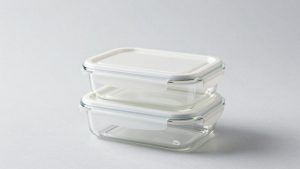
Choose a 5 cup glass food storage container for substantial leftovers or a generous lunch. Five U.S. cups equal 40 fluid ounces. If you pack a full five cups of soup or want space to toss a salad, size up. For a bagged lunch with sauce or broth, look for an explicit leakproof claim for the exact model.
What fits in a 5 cup glass food storage container?
Think of five cups as the size on the label. What you can comfortably pack depends on the underside of the lid, the shape of the dish, and what you plan to do after opening it. A container that closes over five cups of pasta may still be too crowded for mixing in sauce at lunch.
| What you pack | What to prioritize |
|---|---|
| Rice, chicken, and vegetables | A broad base so ingredients can sit side by side |
| Salad with toppings | Extra headroom and a separate cup for dressing |
| Soup or saucy leftovers for the fridge | Enough clearance below the lid to carry the dish level |
| Broth or a saucy lunch in a bag | An explicit leakproof claim for that model and a bag that keeps it upright |
| A recipe yielding a full five cups | A larger container with room to close, carry, and serve |
A 32-fluid-ounce dish holds four U.S. cups by volume. It may suit a smaller lunch, but choosing it for a full five-cup batch leaves you one cup short even before you allow any clearance. A 4.7-cup dish is closer and can make sense if your portions already fit that size. If you know you need five usable cups, start by looking at six-cup options and verify the fill space.
How to measure a 5 cup glass food storage container
Use a liquid measuring cup and room-temperature water to check a dish you already own. With the dish on a level counter, add water up to the level you would actually fill with food. Record the amount, then check how much space the closed lid leaves above that line.
If the lid has a raised or recessed center, look at how far its underside projects into the dish. You can check for contact with a dry lid, then lift it straight up and look for moisture. This checks clearance at rest. For a lunch you expect to stir, try the container with your usual portion and a spoon before buying more of the same size. For freezer use, follow the maker’s filling and care directions.
Choose the shape and lid for where you use it
A wide rectangular dish makes it easy to arrange a main and side in the same layer. A taller dish takes up less shelf area if it has a smaller footprint, but check that it clears the shelf above. Measure the space with the lid on and include any tabs that extend past the glass.
A lid for the refrigerator or a commute
For leftovers that stay on a refrigerator shelf, prioritize a lid you can seat evenly and remove without jerking the dish. If the container will ride in a bag with broth, sauce, or dressing, check that the seller or manufacturer explicitly describes that exact lid-and-base combination as leakproof.
One near-size example is the Rubbermaid Brilliance Glass 4.7-cup container listed by Target. The retailer describes it as leakproof and identifies it as the glass version. Its listed capacity suits buyers who can pack a slightly smaller portion. When shopping for this example, confirm that the listing specifies a glass base. Target also lists a 4.7-cup Brilliance model under a similar name.
A removable gasket can be worth paying for if you often pack oily sauces and the maker gives instructions for removing and reinstalling it. If the gasket is fixed, look at whether you can reach the groove around it during washing. Before committing to a set, check whether the maker sells the exact replacement lid or gasket in the United States.
Check the fit where you store and carry it
Measure the narrowest part of the lunch bag opening, the depth of the refrigerator shelf, and the usable height between shelves. Compare those measurements with the container’s outside dimensions, including the lid. A rectangular dish that fits inside a bag still needs to pass through the zipper opening.
For stacked storage, check the combined height of filled dishes with their lids closed. For empty storage, look at whether the bodies nest and where the lids will go. If the retailer lists shipping dimensions or gives a single measurement for a multipack, look for dimensions of one closed container before relying on the numbers.
Check which parts can go in each appliance
Read the care instructions for the glass base, the lid, and the gasket individually. A listing may emphasize that a dish can go in the oven while giving separate instructions for the lid. Microwave directions may call for removing the lid or opening a vent or latch before reheating.
Decide which transitions your routine actually requires. For example, if you portion lunches on Sunday and reheat them at work, check freezer and microwave instructions, including how the maker says to handle a frozen dish before reheating. Follow model-specific restrictions on temperature changes and discard glass with damage as directed by the maker. For leftovers, USDA recommends dividing food into shallow containers for cooling. If you have several cups to cool, the depth of the food matters when choosing whether to use one dish or divide it between smaller ones.
Compare the cost per usable container
Count the number of glass bases in the size you need, then divide the delivered cost by that number. A mixed set can work for lunches and sides if you use several capacities. If you want matching portions for the week, verify how many bases in the bundle are close to 40 fluid ounces.
Start with one if you are unsure about the shape, lid effort, or packed weight. Try it in your bag and your usual storage spot. For mostly dry leftovers kept at home, a lid that’s easy to clean and available as a spare may do more for you than a more complicated closure. If you carry liquids regularly, an explicitly leakproof design is a feature worth budgeting for. Consider delivery charges and replacement lid cost when choosing where to buy.
Conclusion
Choose a roughly 40-fluid-ounce glass dish if your usual portion leaves clearance under the lid. Go larger for a measured five cups plus room to stir, and choose a model with an explicit leakproof claim for liquids carried in a bag. Check the closed dimensions and care instructions before buying a set.
More from Amazon
Programs that pair well with the guide above. Offers and eligibility are set by Amazon and may change.
Set up recurring deliveries of everyday items on eligible products. Terms and savings are set by Amazon.
Explore Subscribe & SaveCollect the home and kitchen items you want in one registry that guests can shop from.
Create a wedding registryFree shipping on eligible items, Prime Video and more. Eligible new members can start with a free trial.
Start a Prime free trialAudiobooks and podcasts to listen to on the go. Eligible new members can start with a free trial.
Try Audible freeAs an Amazon Associate we earn from qualifying purchases.