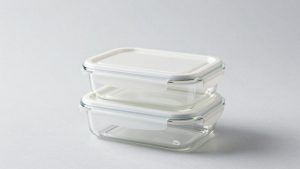
Choose an Amazon Basics glass food storage container set by counting the bases that fit your meals. Two documented 14-piece configurations each have seven bases, but their capacities differ. A mixed set works for snacks and shared leftovers. For five identical lunches, buy five matching meal-size bases.
What comes in an Amazon Basics glass food storage container set?
A 14-piece box can contain seven glass bases and seven matching lids. Two U.S. retailer listings show different capacity mixes under similar names, so use the contents list for the selected item. Compare the sizes and shapes you will use before relying on the number on the box.
| Documented configuration | Glass bases and matching lids | Small bases | Meal-size or larger bases |
|---|---|---|---|
| 14-piece mix with 4.5-cup rectangles | 7 bases and 7 lids | Two 1.6-cup rectangles and two 1.7-cup rounds | One 4-cup round and two 4.5-cup rectangles |
| 14-piece mix with 3.6-cup rectangles | 7 bases and 7 lids | Two 1.29-cup rounds and two 1.6-cup rectangles | One 3-cup round and two 3.6-cup rectangles |
| 20-piece configuration described by Consumer Reports | 10 bases and 10 lids | Two 307 mL rounds, two 380 mL rectangles, and one 402 mL square | One 709 mL round, two 850 mL rectangles, one 945 mL square, and one 1,845 mL rectangle |
These are documented configurations. Compare the box contents on your selected listing before placing an order. The 20-piece column uses the reported metric capacities because converting them to cups can make different containers look alike after rounding. For orientation, 709 mL is about 3 U.S. cups, 850 mL is about 3.6 cups, 945 mL is about 4 cups, and 1,845 mL is about 7.8 cups. Those are labeled capacities and leave a smaller working volume when you need room under the lid.
Identify the exact mix before adding it to your cart
Open the selected variant and check its contents description, shape breakdown, and product identifier. Similar photos can show the same arrangement of round and rectangular dishes while the capacities differ. If the title and contents disagree, use the package label or ask the seller to confirm the mix.
The 14-piece configuration with 4.5-cup rectangles gives you three bases labeled at least 4 cups. The other 14-piece configuration tops out at 3.6 cups. If a 4-cup dish is already snug for your usual lunch, that difference will affect several meals each week. If a little over 3 cups is enough and you have a narrow shelf, compare the actual outside dimensions of the 3.6-cup version and the larger one before deciding.
Look at what changes when you switch a color or size selector. Check whether the capacity diagram and written contents refer to the variant currently selected. A product photo of stacked dishes can tell you how the glass looks, but it rarely tells you how many bases share the size you need. When the model number is available, retain it with the order details so you have a reference if you later need to identify a lid.
How many lunches can an Amazon Basics glass food storage container set cover?
Count containers that hold a complete lunch before counting the small ones for sides or snacks. Either documented 14-piece mix gives you three bases at or above 3 cups, with two identical meal-size rectangles. The 20-piece configuration has five at roughly 3 cups or more across several shapes and sizes.
If you eat the same grain bowl five days in a row, decide whether you need the containers to hold equal portions, occupy the same bag space, and share the same lid. A mixed box can hold five lunches if your portions suit the sizes, but filling a 3-cup round and a nearly 8-cup rectangle to the same depth produces very different servings. Standardized bases simplify assembly when you want to portion by eye or stack five identical dishes on one shelf.
If you prepare meals twice a week, two identical rectangles may cover the first batch and the round dish can hold the third serving. In that schedule, the small bases still have a job for fruit, dressings, or individual sides. If you cook for several people at once, work from the number of servings you need ready on the busiest day. That count tells you more than how many pieces the entire box includes.
Choose the sizes around what you cook and carry
A mixed set pays off when you use its small, medium, and large dishes for different jobs. Start with the serving you prepare most often, then assign the other bases to food you already store. This helps you decide whether a larger bundle will replace dishes you own or take up more cabinet space.
Use the smaller dishes for snacks and meal components
The smallest bases are useful for berries, dips, chopped vegetables, or a topping you want to carry separately. Measure a typical portion with anything you add before closing the lid. For a few tablespoons of dressing, a dedicated small cup may take up less room in a lunch bag.
A 1.6-cup rectangle can be a useful companion to a larger meal dish when you carry food you want to keep cool while you heat the main course. If the smaller base is mostly for thick dip, check that you can comfortably scoop from its corners. A round dish may be easier to scrape clean, while a small rectangle can line up neatly with a sandwich or another container in a square bag.
If you already own small containers you use daily, give those bases a lower value in your purchase decision. Consider whether the new lids will make a practical difference or whether the set simply duplicates what is in your cupboard. If all the small dishes would be extras, a set of three or four identical meal-size bases can be a more useful buy even when its total piece count is lower.
Match the medium and large bases to the meal
For lunch, check how the food sits under the lid and whether you have room for a fork or spoon. A shallow rectangle can hold rice and vegetables side by side, while a deeper round dish can suit a stew. A large rectangle is useful when leftovers need to feed more than one person.
Use a dish you already own to establish a reference. Pack a normal lunch, close it, and see whether the lid touches the food. Try stirring the meal in the open dish if you usually mix it after reheating. A serving that just fits at the rim might travel awkwardly or leave too little room to stir. Check the outside size separately so you know how much space it uses with the closure fitted.
You can also compare what goes into the same shelf space. Trace the outside of a dish that already fits, including the lid, onto a sheet of paper. When a listing gives dimensions for an individual base, sketch the new footprint over that outline. Check height separately and confirm whether the listed dimensions include the lid. A product page may show the dimensions of the entire set or its shipping box, so look for a measurement tied to the individual container.
Think about the shape of the ingredients before deciding what counts as a suitable base. Sliced chicken can lie flat beside rice, while a whole piece over the rice may sit too high in a shallow dish. A roomy rectangle can hold lasagna without breaking the slices up. A round dish might work better when most leftovers are spooned out by the serving. The best mix is the one that fits the way you portion your usual food.
Check closure and care instructions for the selected set
Compare how the lid locks, how the seal can be cleaned, and what the instructions allow for each component. Retail listings for similarly named 14-piece mixes give different microwave directions for the lids. Use the packaging or instructions supplied with the exact set to settle any discrepancy.
Buy for the kind of food you plan to transport
Check for an explicit leakproof claim that applies to the exact container and lid if you carry soup or thin sauce. A locking closure describes how the lid attaches. It also matters whether the gasket sits flat against a clean rim and whether every latch closes as directed.
The U.S. retailer listing for the 14-piece mix with 4.5-cup rectangles describes its locking lid as leakproof. The Consumer Reports description identifies clamp-style closures and removable gaskets on its 20-piece sample. Those details help you compare how the sets are assembled. The public description for the 20-piece set does not provide the lab’s seal performance scores, so use the exact product’s transport instructions when deciding whether to carry liquids.
After buying a set rated for liquid transport, check a new lid with cool water over the sink before relying on it in a bag. Follow the fill directions, engage every latch, and tip the container briefly. A damp rim may point to a trapped crumb, a gasket that needs reseating, or a latch that did not close. A dry rim only shows how that assembly performed in this quick check. Continue to follow the use instructions, including keeping the container upright when directed.
Read the microwave directions for the glass and the lid
Look for separate directions for the base and closure. A lid may need to come off or be vented in a particular way during reheating. If you use the containers at work, check that you can open them easily and that the largest base can turn freely on the microwave tray.
The Woot listing for the 4.5-cup rectangle configuration excludes its lids from microwave use. The Woot listing for the configuration with 3.6-cup rectangles describes vented microwave use for its lids. That is a reason to read the instructions for the product in front of you. If you cannot verify that a lid is approved for microwaving, remove it and use a separate microwave-safe cover as appropriate. USDA guidance calls for using utensils labeled microwave-safe.
Check oven and freezer instructions separately. Follow the specified appliance limits and the directions for moving glass between temperatures. For a full batch of broth, a freezer-rated container with adequate expansion space matters more than the capacity printed in the product title. If you regularly reheat an entire meal in the dish, a size that leaves room to stir may be the most useful upgrade.
Think through cleanup and replacement parts
Look at the lid grooves and whether the gasket is designed to come out for cleaning. Follow the care directions for removing and reinstalling it. If a seal or latch eventually needs replacing, search with the exact base identifier, shape, and size so you can confirm a match.
Mixed sets can require more time to sort after washing because several lids look similar. Keep the lids near their corresponding bases or sort them by shape. For meal prep, a set with several identical bases saves some of that effort. If dishwasher capacity is tight, count how many lids fit where their instructions allow them to go and how much room the glass bases need below.
Check any replacement listing for compatibility before assuming you can order individual lids. A round closure for a 4-cup dish is useful only if it fits the rim profile of your dish. If replacement availability matters, verify the part number or seller support before choosing a large bundle. If you already own part of a set, measure and identify the bases you plan to keep before adding more pieces.
Compare the cost of the containers you will use
Start with the delivered price and the number of bases that fit your regular portions. Include tax and delivery on the same basis across listings. If four containers would sit unused, a bigger box can cost more per usable dish even when the price per advertised piece looks lower.
Calculate the cost for your actual routine
Count the bases you expect to use for a specific job, such as lunches of at least 4 cups, and divide the delivered cost by that count. Include the matching lids in your definition of a usable dish. If other sizes solve a different storage problem, give them credit separately.
Imagine a hypothetical $28 delivered seven-base set in which you would use three dishes for lunch and none of the smaller ones. For lunch, that works out to about $9.33 per suitable dish. A hypothetical $32 delivered pack with four identical meal-size dishes works out to $8 per dish. If you need small dishes for sides and would otherwise buy them separately, include their value in the comparison. The example uses made-up prices so you can apply the math to the options in your cart.
Check whether you’re comparing a new set, an open-box offer, or an incomplete resale listing. If the seller lists a damaged or missing closure, count only the bases you can cover with a confirmed compatible lid. Factor in whether you have to place a second order for parts. A useful lower price depends on receiving the sizes and matching lids you need.
Buy a mixed set when it fills several gaps
Choose the assortment if you can assign a job to most sizes, such as snacks in the small dishes, lunches in the medium bases, and shared leftovers in the large rectangle. If the main job is repeating one portion, compare the assortment with a pack that repeats your preferred size.
A quick inventory helps if you are replacing an old collection. Set aside the dishes you used in the last week and write down what each one held. If nearly everything is in one size, look for more of that footprint. If you need a pair of snack dishes, two lunch rectangles, and a larger serving dish, the mix may cover several jobs at once. Choose between the 14-piece configurations by the capacity of the three larger bases first, then compare the smaller shapes.
Check how the set fits when filled and when put away. Filled dishes need to sit securely on the shelf. Clean bases need a place where they can nest or stack as intended, and lids need space to dry and remain easy to find. Measure a tight shelf or drawer before buying, especially if the larger base is the reason you want the set. If you seldom store a batch that big, a shorter stack of medium dishes may fit your routine better.
Conclusion
Buy the Amazon Basics mix whose glass bases match your portions, and confirm the exact capacity list and lid directions before checkout. Choose the 14-piece mix with larger rectangles if you need three dishes of at least 4 cups. For five equal lunches, look for five matching meal-size bases.
More from Amazon
Programs that pair well with the guide above. Offers and eligibility are set by Amazon and may change.
Set up recurring deliveries of everyday items on eligible products. Terms and savings are set by Amazon.
Explore Subscribe & SaveCollect the home and kitchen items you want in one registry that guests can shop from.
Create a wedding registryFree shipping on eligible items, Prime Video and more. Eligible new members can start with a free trial.
Start a Prime free trialAudiobooks and podcasts to listen to on the go. Eligible new members can start with a free trial.
Try Audible freeAs an Amazon Associate we earn from qualifying purchases.