Key takeaways
- When shopping for glass meal prep containers, the real decision is not simply which material sounds more premium. It is whether you value better resistance to sudden temperature changes, lower upfront cost, lighter everyday handling, or easier replacement. Both borosilicate…
When shopping for glass meal prep containers, the real decision is not simply which material sounds more premium. It is whether you value better resistance to sudden temperature changes, lower upfront cost, lighter everyday handling, or easier replacement. Both borosilicate and soda lime glass can be excellent for storing lunches and leftovers, but they suit different kitchens and routines.
The best choice depends on how you use containers: moving meals from freezer to oven, carrying them to work, stacking them in a crowded refrigerator, or replacing a broken piece without spending much. This guide compares borosilicate glass vs soda lime glass meal prep containers so you can choose confidently in 2026.
Our top picks



As an Amazon Associate we earn from qualifying purchases at no extra cost to you. Ratings are shown as listed on Amazon.
Quick Verdict
Choose borosilicate glass if you regularly expose containers to temperature changes, such as transferring a chilled meal into a preheated oven. It generally offers greater resistance to thermal shock and is often thinner and lighter for its strength. It usually costs more, however, and its lids may still be the weak point.
Choose soda lime glass if you want affordable, sturdy containers for refrigerator storage, packed lunches, reheating, and ordinary dishwasher use. Soda lime is the more common glass type and can perform very well when you avoid abrupt temperature swings. For many households, it delivers the better value.
Neither material is automatically oven-safe. Always follow the container maker’s instructions, remove plastic lids before heating, and avoid placing cold glass directly on a hot burner, grill, or very hot surface.
Side by Side
| Factor | Borosilicate Glass | Soda Lime Glass |
|---|---|---|
| Comfort | Often lighter and easier to carry; smooth surfaces feel refined | Can be heavier, especially in large sizes; familiar and substantial |
| Durability | Better resistance to thermal shock, but still breakable from drops or impacts | Strong for daily storage, but more vulnerable to sudden temperature changes |
| Price range | About $3–$8 per container in sets, depending on size and lid quality | About $2–$6 per container in sets |
| Maintenance | Usually dishwasher-safe; inspect silicone seals and locking lids | Usually dishwasher-safe; heavier pieces may occupy more rack space |
| Space needed | Often nests efficiently; rectangular shapes stack well | Comparable stacking, though thick walls can reduce usable interior space |
| Look | Very clear, sleek, and commonly associated with premium cookware | Clear and practical, with more variation in thickness and finish |
| Resale | Limited resale value; complete, undamaged sets are easiest to pass along | Limited resale value; recognizable brands and complete lids help |
| Best for | Freezer-to-oven routines, frequent reheating, and long-term daily use | Budget-conscious meal prep, refrigerator storage, and packed lunches |
Where Borosilicate Glass Wins
Borosilicate glass is formulated with boron compounds that help it handle temperature changes better than ordinary soda lime glass. That advantage matters when your meal-prep routine includes frozen casseroles, chilled leftovers, or oven reheating. A container rated for oven use may move from a refrigerator to an oven more safely than a comparable soda lime container, although the manufacturer’s temperature limits still apply.
It is also a practical choice for people who carry containers frequently. A medium 22-ounce container may weigh roughly 1.3 to 1.8 pounds with its lid, depending on wall thickness and hardware. Borosilicate models can sometimes keep weight toward the lower end of that range while retaining good strength. The difference is noticeable when you carry two or three lunches in a work bag.
Many borosilicate sets also have clean, straight-sided shapes that stack efficiently. A 22-ounce rectangular container might measure approximately 7.5 by 5.5 by 2.5 inches, while a larger 3- to 4-cup piece may be close to 8 by 6 by 3 inches. Exact dimensions vary, but the general benefit is easy cabinet organization: matching footprints stack more neatly than assorted bowls.
For shoppers comparing options, the Magic Mill Premium Borosilicate Glass Food Storage Containers set is listed at $36.99 for 24 pieces, including 12 bowls and 12 airtight locking lids. A borosilicate label can be useful, but the actual value still depends on the shapes, seal design, oven instructions, and how many pieces you will use regularly.
One caution: borosilicate is not unbreakable. A drop onto tile, a sharp impact against a sink, or a damaged rim can still destroy the container. Thermal-shock resistance reduces one type of risk; it does not protect against impact.
Where Soda Lime Glass Meal Prep Containers Wins
Soda lime glass is the standard material used for many everyday food containers, drinking glasses, jars, and bakeware. It is less resistant to rapid temperature changes than borosilicate glass, but that does not make it unsuitable for meal prep. If you let frozen food thaw in the refrigerator before reheating, or warm refrigerated food gradually, soda lime containers can serve reliably for years.
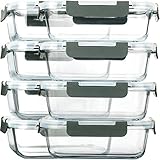
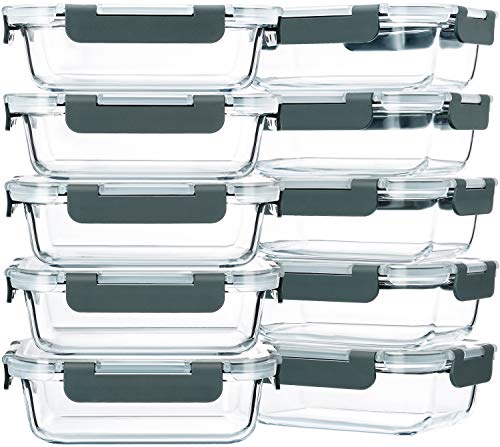
The biggest advantage is cost. A 10-piece set with five containers and five lids commonly sells for about $25–$45, while larger sets may cost $40–$70. The M MCIRCO 10 Pack, 22 oz Glass Food Storage Containers with lids is listed at $35.99 in both gray and green versions. At roughly $3.60 per container-and-lid place setting, that type of set can be appealing for a household that needs several lunches at once.
Soda lime containers are also easy to replace. Because the material is widely used, you are more likely to find comparable sizes at supermarkets, home stores, and major online retailers. That matters if one container breaks or a lid disappears. Replacing a single inexpensive piece is often less frustrating than trying to match a specialized premium set.
Use soda lime thoughtfully. Do not pour boiling soup into a cold container, place a frozen container into a hot oven, or set hot glass on a wet or cold countertop. Let food cool before sealing it for the refrigerator, and check whether the product is rated for microwave and oven use. The lid, gasket, and clips may have lower heat limits than the glass itself.
Cost Over 5 Years
For a realistic comparison, consider a household that needs 10 usable meal-prep containers and replaces two containers or lids during five years. A budget soda lime setup might cost $36 initially, plus $8–$20 for replacements, for a five-year total of approximately $44–$56. A midrange borosilicate setup might cost $50–$80 initially, plus $10–$25 in replacement pieces, for a total of approximately $60–$105.
That estimate does not assume every container breaks, and it excludes dishwasher electricity, shipping, and optional accessories. It also does not guarantee that borosilicate will last longer. A careful owner may keep either material for more than five years, while a container dropped on a hard floor can fail on the first day.
There are additional value differences. A good airtight lid can prevent spills and food waste, while stackable shapes can save refrigerator space. If a better seal helps you carry lunch instead of buying a $12 restaurant meal once a week, either type can pay for itself quickly. Material is only one part of the ownership cost.
Which One for Your Home
Small apartment
Choose a compact set with nesting shapes and lids that store flat. Soda lime is usually the economical choice if your meals go from refrigerator to microwave and your cabinet space is limited. Borosilicate is worth considering if you frequently use one container for freezer storage and oven reheating. Prioritize footprints under about 8 by 6 inches so containers do not consume an entire shelf.
Family with kids or pets
Soda lime can make sense when you need many containers at once and want affordable replacements. Select rectangular pieces with secure, four-sided locking lids and avoid overfilling them. Borosilicate may be preferable for adult meal prep involving repeated temperature changes, but neither glass type is ideal for careless handling near tile floors. Keep glass containers out of children’s lunch bags unless your household is comfortable with the breakage risk.
Rental
Renters often benefit from a moderate soda lime set rather than an expensive collection. If a container breaks during a move, replacement cost is lower and matching pieces are easier to find. Use a silicone mat or trivet under hot containers to protect counters, and never use a glass container directly on a stovetop unless it is specifically designed for that purpose.
Long-term home
In a long-term kitchen, buy the material that matches your cooking habits rather than the lowest sticker price. Borosilicate is a strong fit for batch cooking, freezing individual portions, and reheating meals in an oven-rated dish. Soda lime remains the better value for cold storage, lunches, and routine microwave use. Keep a few spare lids and avoid mixing sets with incompatible seal sizes.
FAQ
Is borosilicate glass safer than soda lime glass for food?
Both can be suitable for food when the finished product is made and labeled for food storage. Borosilicate’s main material advantage is thermal-shock resistance, not automatic food safety. Check the product’s food-contact, microwave, dishwasher, and oven instructions, and discard any container with cracks, chips, or a damaged rim.
Can borosilicate glass go from the freezer to the oven?
Only if the specific container is rated for that use. “Borosilicate” does not override the manufacturer’s instructions. Leave room for food to expand, remove the lid, avoid preheating restrictions, and follow any maximum temperature listed in the manual or on the packaging.
Why is soda lime glass used in so many meal prep containers?
Soda lime glass is widely available, relatively inexpensive, and suitable for ordinary storage and reheating when handled correctly. It offers a practical balance of clarity, cleanability, and cost. Its limitation is greater sensitivity to sudden temperature changes compared with borosilicate glass.
Are glass beakers suitable for meal prep containers?
No. Laboratory glassware should not be treated as food-storage equipment simply because it is glass. For example, the Karter Scientific 3.3 Boro Griffin Low Form Glass Beaker Set is listed at $16.99, but beakers are designed for laboratory use, not airtight food storage, stacking in a refrigerator, or carrying lunch. Choose containers specifically labeled for food contact and meal prep.