Key takeaways
- Choosing by calories alone: A 500-calorie salad may need 32 ounces, while 500 calories of dense pasta may fit in 20-24 ounces.
- Ignoring compartments: Dividers take up room. A divided 32-ounce container may hold less usable food than an open 32-ounce container.
- Filling to the lid: Overfilled containers leak, crush food, and make reheating uneven. Leave headspace, particularly with sauces and liquid meals.
- Confusing listed and usable capacity: The advertised volume may be measured to the rim. Practical fill capacity is lower when you need room for the lid.
- Buying a set without checking dimensions: A large multipack is not useful if the containers do not fit your shelves or lunch bag.
- Using a container that is too large: Excess empty space allows food to shift during transport. A snug 24-ounce container often protects a regular meal better than an oversized tub.
What's inside
The Short Answer
For most 500-calorie meals, choose a 24- to 32-ounce meal prep container. A 24-ounce container is usually the best fit for compact meals such as chicken with rice and vegetables, pasta salad, chili, or a grain bowl. Choose 32 ounces when the meal contains bulky vegetables, leafy greens, fruit, or a large portion of lean protein.
A good starting size is approximately 7.5 by 5.5 by 2 inches (19 by 14 by 5 centimeters) for a 24-ounce rectangular container. A 32-ounce container is commonly about 9 by 6.5 by 2 inches (23 by 16.5 by 5 centimeters), although exact dimensions vary by brand and shape.
As an Amazon Associate we earn from qualifying purchases at no extra cost to you. Product prices and availability are accurate as of the date shown and are subject to change.


![Freshware Meal Prep Containers with Lids [15 Pack] 3 Compartment, Food Storage Containers, Bento Box, BPA Free, Stackable, Microwave/Dishwasher/Freezer Safe (32 oz)](https://m.media-amazon.com/images/I/51PDcijg6TL._SL160_.jpg)
Capacity does not equal calorie count. A container measures volume, while calories depend on ingredients and portions. Foods with high water content, such as vegetables and fruit, need more space than calorie-dense foods such as rice, cheese, nuts, or avocado. For dependable portion control, measure ingredients by weight or use measuring cups first, then select the container that holds the finished meal without compressing it.
Standard Sizes
Meal prep containers are commonly sold in ounces, but those ounces refer to fluid volume rather than the weight of the food. One fluid ounce is approximately 29.6 milliliters. The table below gives practical capacity ranges and typical exterior measurements. Check the manufacturer’s listed dimensions before buying, especially if the containers must fit a lunch bag, refrigerator shelf, or microwave.
| Container size | Capacity | Typical exterior dimensions | Best use |
|---|---|---|---|
| Small snack | 8-12 oz (237-355 mL) | 5 x 3.5 x 1.75 in (12.7 x 8.9 x 4.4 cm) |
Fruit, nuts, sauces, yogurt, or a small side |
| Compact meal | 16-20 oz (473-591 mL) | 6.5 x 5 x 2 in (16.5 x 12.7 x 5.1 cm) |
Light meals, sandwiches, or calorie-dense dishes |
| Standard meal | 24 oz (710 mL) | 7.5 x 5.5 x 2 in (19 x 14 x 5.1 cm) |
Most 500-calorie meals with moderate portions |
| Large meal | 28-32 oz (828-946 mL) | 9 x 6.5 x 2 in (22.9 x 16.5 x 5.1 cm) |
Bulky salads, high-volume meals, or meals with fruit |
| Extra-large | 40-oz-plus (1.18 L-plus) | 9.5 x 7 x 2.75 in (24.1 x 17.8 x 7 cm) |
Large salads, meal-and-snack combinations, or leftovers |
For a typical 500-calorie plate, a 24-ounce container works well when the meal includes about 4-6 ounces of cooked protein, 1/2-1 cup of cooked grains or starchy vegetables, and 1-2 cups of nonstarchy vegetables. A 32-ounce container gives more breathing room for bulky ingredients and helps prevent delicate greens from being crushed.
Two-compartment containers are useful when you want to separate a main dish from a side. A 32-ounce divided container may provide one section of approximately 20-22 ounces and a smaller section of 8-12 ounces. Three-compartment designs are convenient for protein, starch, and vegetables, but the dividers reduce usable space compared with one open cavity.
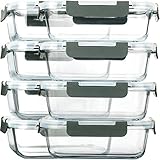
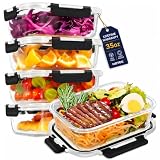
Current examples range from about $9 to $20 for multipacks, depending on the material, number of pieces, lids, and compartment design. A 10-pack of 32-ounce two-compartment containers, such as the Glotoch Express style, may cost around $10. A 10-piece divided set similar to the GoodCook option may cost about $13, while a 15-pack of 32-ounce three-compartment containers similar to Freshware may be around $15. A cookbook-style product focused on high-protein meals and make-ahead salads may cost about $20, but it is not necessarily a container set.
How to Measure Your Space
- Measure the usable length and width. Use a tape measure inside the lunch bag, refrigerator drawer, or cabinet. Do not measure only the outside of the storage area. Record the smallest measurement if the space narrows at the corners.
- Measure vertical clearance. Leave room for the lid, lid tabs, and your hand. A container listed as 2 inches tall may need 2.25-2.5 inches of clearance once the lid is attached or stacked.
- Account for rounded corners. Rectangular containers often have curved corners, so the interior floor is slightly smaller than the listed outside length and width.
- Check the lid footprint. Some lids extend beyond the container base by 1/4 inch or more on each side. Measure the widest point, including locking clips.
- Test stacking height. If you stack five containers that are 2 inches high, the total is not always exactly 10 inches because lids may nest or add extra height. Stack the actual containers before committing to a refrigerator shelf.
- Measure your microwave turntable. A container may fit through the door but fail to rotate. For a microwave with a 10-inch turntable, a container wider than about 9 inches may need to be placed off-center or heated without rotation.
- Leave headspace for liquid foods. Keep roughly 1/2 inch (1.3 cm) empty at the top for soups, sauces, and foods that may expand when heated. For freezing, leave about 1 inch (2.5 cm) of space because liquids expand as they freeze.
By Room or Use Case
Home refrigerator
Choose 24-ounce containers for a tidy stack of individual 500-calorie meals. Their moderate footprint makes them easier to arrange on a shelf, especially when you are storing several days of food. Clear rectangular containers generally use refrigerator space more efficiently than round bowls because they leave fewer gaps.
Office lunch bag
A 24-ounce container is usually the safest option for a standard insulated lunch bag. Select a 32-ounce model if the bag is at least 10 inches wide and 7 inches deep internally. Include the ice pack when measuring, since it can reduce available width by 1-2 inches. Leak-resistant lids are more important than extra capacity for meals that travel upright in a crowded bag.
High-volume salads
Use a 28- to 32-ounce container for leafy salads, roasted vegetables, and meals with several toppings. Greens take up considerable volume even when they contribute few calories. Keep dressing in a separate 2- to 4-ounce cup when possible so lettuce remains crisp and the meal does not become soggy.
Freezer meal prep
For stews, chili, curries, and cooked grains, a 24- to 32-ounce freezer-safe container is appropriate. Prefer straight-sided containers with a little headspace; sharply tapered designs can be harder to fill and may waste space. Verify that the material is labeled freezer-safe, and let hot food cool before sealing and freezing.
Gym or post-workout meals
A divided 32-ounce container works well when a 500-calorie meal includes protein, carbohydrates, and a separate vegetable or fruit portion. Choose a model weighing roughly 4-8 ounces empty if portability matters. Heavier glass containers are sturdy and resist odors, but they can add roughly 1-2 pounds to a packed meal compared with lightweight plastic.
Common Sizing Mistakes
- Choosing by calories alone: A 500-calorie salad may need 32 ounces, while 500 calories of dense pasta may fit in 20-24 ounces.
- Ignoring compartments: Dividers take up room. A divided 32-ounce container may hold less usable food than an open 32-ounce container.
- Filling to the lid: Overfilled containers leak, crush food, and make reheating uneven. Leave headspace, particularly with sauces and liquid meals.
- Confusing listed and usable capacity: The advertised volume may be measured to the rim. Practical fill capacity is lower when you need room for the lid.
- Buying a set without checking dimensions: A large multipack is not useful if the containers do not fit your shelves or lunch bag.
- Using a container that is too large: Excess empty space allows food to shift during transport. A snug 24-ounce container often protects a regular meal better than an oversized tub.
FAQ
Is a 32-ounce container too big for a 500-calorie meal?
Not necessarily. It may be larger than needed for a compact rice-and-chicken meal, but it is practical for salads, vegetables, fruit, or meals with separate components. Fill it according to the food’s volume rather than treating the entire capacity as a required portion.
Will a 24-ounce container hold a full 500-calorie meal?
Usually, yes. A balanced meal with a moderate serving of protein, starch, and vegetables commonly fits in 24 ounces. Foods that are fluffy, bulky, or difficult to compress may need 28-32 ounces.
Should I choose one compartment or multiple compartments?
Choose one compartment for saucy meals, casseroles, and foods that can mix. Choose two or three compartments when you want to keep crisp vegetables, fruit, or a side dish separate. For maximum usable volume, an open container is generally more efficient.
What size container is best for meal prep portion control?
A 24-ounce container is the most versatile starting point for 500-calorie meals. Add 8- to 12-ounce containers for snacks and sides, or choose 32-ounce containers when your meals emphasize high-volume, low-calorie foods. Use a kitchen scale for accurate calories because container size alone cannot determine portion weight.