Key takeaways
- Confusing liquid cups with food portions: Three cups of leafy greens is not the same meal size as three cups of cooked rice. Capacity describes space, not serving recommendations.
- Buying by piece count alone: A 20-piece package may contain only 10 containers plus 10 lids. Check the container-to-lid ratio.
- Ignoring compartments: A 3-cup divided container may provide only 1½ to 2 cups in the largest section. Estimate each compartment when planning meals.
- Measuring only the base: A wide lid or locking tab can prevent a container from fitting in a narrow lunch bag or drawer.
- Filling to the rim: Overfilled containers leak more easily and leave no room for expansion, stirring, or reheating.
- Choosing height over footprint: Deep containers may hold the advertised volume but can be difficult to stack and awkward to eat from at a desk.
What's inside
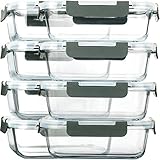
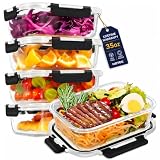
If you are wondering how many cups a standard meal prep container holds, the most useful answer is 2.5 to 3 cups. That capacity is large enough for a balanced lunch or dinner without taking up excessive room in a refrigerator, lunch bag, or freezer. A 3-cup container typically accommodates about 1 to 1½ cups of vegetables, ¾ to 1 cup of protein, and ½ to 1 cup of rice, pasta, potatoes, or another grain.
Container size is usually listed by volume, while storage fit depends on the outside dimensions. A container labeled 2.85 cups may be similar in footprint to one labeled 3 cups, but lid shape, compartment dividers, and wall thickness can affect how much food it holds. Use both capacity and measurements when shopping for a set in 2026.
As an Amazon Associate we earn from qualifying purchases at no extra cost to you. Product prices and availability are accurate as of the date shown and are subject to change.


The Short Answer
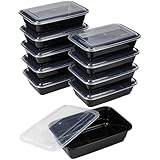
A standard meal prep container holds approximately 2 to 3 cups. Choose a 2-cup container for lighter meals, snacks, side dishes, or portion-controlled servings. Choose a 3-cup container for a typical adult lunch or dinner. Larger 4- to 5-cup containers are better for generous portions, salads with toppings, leftovers, or meals that need to stay separate.
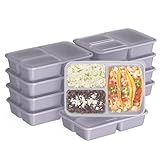
For most people, a set that includes containers between 2.5 and 3 cups offers the best everyday balance. A single-compartment design provides the most usable space. Two- and three-compartment designs are convenient when you want to keep a main dish, side, and vegetables apart, although the dividers reduce flexibility and may make each section too small for bulky foods.
Standard Sizes
The measurements below represent common outside dimensions for rectangular plastic meal prep containers. Actual dimensions vary slightly by manufacturer, lid design, and whether the listed size refers to the base or the complete container with lid.
| Capacity | Approximate food volume | Typical outside dimensions | Typical best use |
|---|---|---|---|
| 1 cup | 8 fl oz | 5.5 × 4 × 1.5 in (14 × 10.2 × 3.8 cm) | Sauces, fruit, snacks, and small sides |
| 2 cups | 16 fl oz | 7 × 5 × 1.75 in (17.8 × 12.7 × 4.4 cm) | Light lunches, breakfasts, and portion-controlled meals |
| 2.5 cups | 20 fl oz | 7.25 × 5.25 × 2 in (18.4 × 13.3 × 5.1 cm) | Average lunch with a protein, grain, and vegetable |
| 2.85 to 3 cups | 22.8 to 24 fl oz | 7.5 × 5.5 × 2.25 in (19.1 × 14 × 5.7 cm) | Standard adult meal prep and leftovers |
| 4 cups | 32 fl oz | 8.5 × 6 × 2.5 in (21.6 × 15.2 × 6.4 cm) | Large meals, salads, pasta, and family leftovers |
| 5 cups | 40 fl oz | 9 × 6.5 × 2.75 in (22.9 × 16.5 × 7 cm) | Large portions or meals with several bulky ingredients |
A 2.85-cup container, such as the capacity used by some two-compartment storage designs, is effectively a standard 3-cup container for everyday planning. A typical package may cost about $5 to $9 for a small set or approximately $12 to $30 for a larger multi-piece set, depending on material, lid style, compartment layout, and brand. A low-cost 10-pack can work out to roughly $1 to $2 per container, while premium sets may cost $4 to $7 per container.
When comparing products, note whether the package count includes lids. For example, a 20-piece set commonly means 10 containers and 10 lids, not 20 containers. Single-compartment sets generally offer the most capacity for the price. Three-compartment sets may cost about the same per piece, but their divided interiors are less suitable for large chicken breasts, sandwiches, or tall servings of pasta.
How to Measure Your Space
- Measure the shelf or drawer opening. Record the usable width, depth, and height in inches. Measure between refrigerator walls rather than relying on the advertised shelf width.
- Leave clearance for the lid. Subtract at least ¼ inch from the available width and depth. For a tight stack, allow ½ inch above the tallest container so the lid can be lifted without scraping.
- Measure the lunch bag interior. Check the inside dimensions, not the outside dimensions. A container listed as 7.5 inches long may need 8 inches of practical clearance if the lid has a raised rim.
- Check the base, not just the lid. Some lids flare wider than the container base. The lid measurement determines whether containers can sit side by side.
- Account for stacking. Multiply the container height by the number you plan to stack, then add room for handles, shelves, or a freezer drawer lip. A 2.25-inch container stacked four high needs at least 9 inches before allowing clearance.
- Test usable capacity. If you have a measuring cup, fill the container with water one cup at a time. Stop below the rim; practical food capacity is usually slightly less than the brim capacity.
By Room or Use Case
Kitchen refrigerator
For everyday refrigerator storage, 2.5- to 3-cup containers are the most versatile. A footprint around 7.5 × 5.5 inches fits many refrigerator shelves while providing enough room for a complete meal. Low, rectangular containers stack efficiently and cool more evenly than very deep containers. If shelf height is limited, choose a container no taller than 2 inches.
Office or school lunch bag
A 2- to 3-cup container is usually appropriate for one adult lunch. Choose a 2-cup size for a smaller appetite or when carrying fruit separately. A 3-cup container works better for a full entrée, but confirm that its width fits the bag’s insulated interior. Containers measuring about 7 to 8 inches long and 5 to 5.5 inches wide are common choices.
Freezer
Freezer storage benefits from straight sides and a little headspace. Leave roughly ½ inch empty for foods that expand as they freeze, especially soups, beans, and cooked grains. A 2- to 3-cup container is convenient for one or two servings. Avoid filling containers to the rim, and verify that the material is labeled freezer safe before storing hot or liquid foods.
Portion-controlled meal prep
For calorie or portion management, 2-cup containers can make serving sizes easier to estimate. A divided 2.5- to 3-cup container is useful when you want a larger section for vegetables and smaller sections for protein and grains. Remember that compartments measure volume, not nutrition; a dense food such as cheese or nuts weighs more than the same volume of leafy vegetables.
Family leftovers
Use 4- to 5-cup containers for casseroles, pasta, roasted vegetables, or two servings of a main dish. Larger containers reduce the need to force food into several small boxes, but they take up more refrigerator and freezer space. For a household, a mixed set with several 3-cup containers and two or three 4-cup containers is usually more practical than buying only oversized pieces.
Common Sizing Mistakes
- Confusing liquid cups with food portions: Three cups of leafy greens is not the same meal size as three cups of cooked rice. Capacity describes space, not serving recommendations.
- Buying by piece count alone: A 20-piece package may contain only 10 containers plus 10 lids. Check the container-to-lid ratio.
- Ignoring compartments: A 3-cup divided container may provide only 1½ to 2 cups in the largest section. Estimate each compartment when planning meals.
- Measuring only the base: A wide lid or locking tab can prevent a container from fitting in a narrow lunch bag or drawer.
- Filling to the rim: Overfilled containers leak more easily and leave no room for expansion, stirring, or reheating.
- Choosing height over footprint: Deep containers may hold the advertised volume but can be difficult to stack and awkward to eat from at a desk.
FAQ
How many cups should a standard meal prep container hold?
Choose 2.5 to 3 cups for a standard adult meal prep container. This size usually holds a protein, a grain or starch, and vegetables without being excessively bulky. Choose 2 cups for lighter meals and 4 cups or more for large portions or shared leftovers.
Is a 2.85-cup container the same as a 3-cup container?
For practical meal planning, yes. The 0.15-cup difference equals about 1.2 fluid ounces, so the two sizes are nearly interchangeable. The container’s actual shape and compartment arrangement will have a greater effect on usability than the small capacity difference.
What container size fits most lunch bags?
A rectangular container around 7 to 8 inches long, 5 to 5.5 inches wide, and 2 to 2.5 inches tall fits many adult lunch bags. Measure the bag’s interior before buying, especially if the container has locking tabs or a raised lid.
Should meal prep containers be one compartment or divided?
Choose one compartment for maximum flexibility and easier cleaning. Choose two or three compartments if you prefer foods to stay separate or want built-in portion guidance. For mixed meals, a single 3-cup container is generally more useful than a divided container with several small sections.