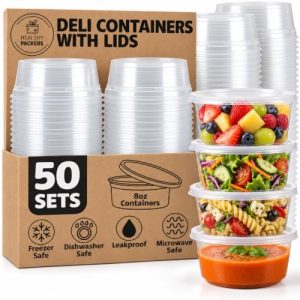
For dressing or dip, start with 1 to 2 fl oz. For toppings or a small side, try 4 fl oz. When buying small food plastic containers with lids for a lunch bag, choose a model explicitly described as leakproof. Check that you can open it with the grip you have and wash the lid using your normal routine.
Choose small food plastic containers with lids by portion
Start with what you actually put in the container. Dressing needs little space, while a serving of grapes can fill a small cup before the lid closes. Measure three portions you pack regularly and note how much room each needs at the top for closing, dipping, pouring, or stirring.
| What you pack | Capacity to try | Feature to check |
|---|---|---|
| Salad dressing or a finishing sauce | 1–2 fl oz | An explicit leakproof claim and an opening that pours cleanly |
| Dip, shredded cheese, or chopped toppings | 2–4 fl oz | A mouth wide enough for a spoon or the food you dip |
| Nuts, cut fruit, or a small side | 4–8 fl oz | Inside width and a lid you can open at the table |
| A larger side or an extra serving of leftovers | Around 1 cup or more | Storage footprint and approved reheating method |
These ranges are starting points. A tablespoon or two of vinaigrette may fit in a tiny cup, but a serving of hummus needs room for dipping. Several cherry tomatoes can have the same total volume as a few spoonfuls of chopped vegetables and still need a wider mouth. Try packing the food in an existing dish to see where the lid sits and what happens when you reach in with a spoon.
Use fluid ounces to compare capacity and the outside dimensions to compare fit. Four U.S. fluid ounces equals half a U.S. cup. A label that gives ounces by weight describes a different measure. For a multipack, make sure the listed capacity applies to each container. A photo showing a stack of small bowls gives you little idea of how much one bowl holds.
How to size small food plastic containers with lids for a lunch box
Measure the empty space around the main dish after adding everything you always pack. Include the ice pack, utensils, and the parts of the larger container that protrude. Measure both the opening and the usable interior so a cup that fits on paper also goes in easily.
A condiment cup that fits inside a bento compartment can save space, provided its lid closes independently and the main lid closes without pushing on it. A short, broad cup is easier to dip into, while a tall, narrow one may slide beside a rectangular entree tray. Use the shape that fits the way you intend to eat and the space that remains once lunch is packed.
Check where the small cup will end up when the bag moves. If it tends to slide under the main tray, plan where you can place it so it is easy to retrieve. An upright side pocket can be practical for a closed dressing cup. If the bag regularly rests on its side, look for an explicit leakproof claim for the item and check the manufacturer’s restrictions on carrying liquids.
At home, use the shape that suits your refrigerator or drawer. Round cups can be easy to scoop from. Rectangular ones may line up along the edge of a shelf where you can see and reach each one. If you group several cups in a bin, measure the width including the lids so you can lift one out without taking out the whole row.
Leave the right amount of room for the food
A measured serving should fit comfortably below the closure. Leave enough room to turn the lid without dragging it through the food, and enough room to scoop without tipping the bowl. For freezer use, follow the fill and headspace directions for the exact container.
For soft foods such as yogurt, fill an existing cup to the level you find comfortable, then measure the contents. If you also add fruit, measure the finished serving. The label volume may be adequate for the yogurt alone while leaving the finished snack too close to the lid.
Consider how many portions you need at once. If you make one dressing on Sunday and portion it into five lunches, five matching cups are useful. If several people choose different sauces each day, you may need a mix of capacities or a way to tell the cups apart. A simple label on the outside can keep similar dips recognizable without committing you to another lid shape.
Choose the lid for the food and the trip
For nuts or dry toppings that stay upright, a simple snap lid may be convenient. For a container that carries thin sauces, check the product’s stated leak performance. A twist top or latch tells you how a lid closes. The label and care guide tell you how the product is intended to travel.
Use a twist lid when the threads are easy to engage
A screw lid can work well for a small round cup if you can seat it level and turn it without strain. Check the grip on the lid and the height of the cup. Very short containers may leave little room to hold the base, especially when the sides or your hands are wet.
Target’s up&up Twist & Store 4-fl-oz round containers come in a six-count package, and Target describes the twist lid as leakproof. That makes the set worth checking for someone who wants several matching dressing or dip cups. The 4-fl-oz capacity leaves more room for dipping than a tiny dressing cup, but measure the width if you want to place it inside another box.
When you first try a threaded lid, start with the body upright. Follow the closing instructions and check that the lid sits evenly. If the lid starts crooked or becomes hard to turn early, reopen it and check the threads. If you see food caught there, clean the area before closing. A wide grip surface can help if you open the cup often.
A twist lid may be inconvenient when you need to open a cup with one hand at your desk or in a car that is parked. If that is a regular part of your routine, handle a similar model before buying a multipack. For jobs where you can set down the cup and hold the base, a threaded design can be a practical fit.
Check whether a latch lid justifies its footprint
A latch lid gives you visible points to check before packing the container. On a small dish the tabs can add width, and they require room to lift open. Compare the dimensions with your lunch bag and think about whether you can operate the tabs without sliding the cup around.
Rubbermaid’s Brilliance Small Rectangle, model 2024347, is a half-cup plastic version with two bases and two lids. Rubbermaid describes its seal as airtight and leakproof. The clear body and lid can be useful when you store several small portions together. At equal capacity, the rectangular footprint and the latch mechanism are the main reasons to compare it with the round up&up cup.
Try the way you will use it. If you take a dish out of the refrigerator and put it in a bag every morning, visible latches may help you confirm closure. If the cup is for dry toppings that stay on a shelf, you may prefer a lid that takes fewer steps to open and close. There is little reason to buy a larger mixed bundle just to get a closure you will use on one small portion.
For liquid carry, you can check a new cup with cool water over a sink if the product permits liquids. Close it as directed and see whether the rim stays dry in the orientation you expect in the bag. A quick check can reveal a closure that was seated poorly. It gives you information about that particular unit under those conditions, while wear and travel can change how it behaves.
Check cleaning and reheating before buying multiples
Read the care instructions for the base and lid of the exact model you plan to buy. Small containers often get used for sticky or oily foods, so look at the rim, the closure, and the parts that touch sauce. Buy a design you can wash and dry easily when several cups are dirty at once.
Look for threads and grooves you can clean
Inspect the underside of the lid and the rim of the container. A broad, smooth opening is easier to reach with a sponge. If a closure has narrow channels, check whether the manufacturer explains how to clean them. If a seal comes out, verify how to reinstall it correctly.
A dressing cup may arrive home with residue on the lid even when the body looks empty. Rinse the contact surfaces and clean them as directed. With a twist lid, look at the threads from both sides. With a latch lid, check the areas close to each tab. Reassemble removable parts only after they have dried as directed, and make sure the lid still seats evenly.
Plan for the number of small pieces you will need to wash. If both the model and dishwasher manuals allow it, secure the parts in a shallow basket or on a rack so they stay in place. A cup that flips during the wash can collect water. If you normally hand wash, see whether the smallest opening is wide enough for the sponge or brush you already use.
Clear containers make it easier to see sauce along the rim and identify contents in the refrigerator. If you mainly pack dry ingredients, a simple opaque cup with an outside label can still work. Choose the level of visibility you need, especially if family members prepare several similar portions at the same time.
Follow the lid rules when reheating or freezing
Look for instructions about microwave use on the exact base and lid. Some containers require you to remove the lid, while others have a venting procedure. For freezing, check both parts and follow any instructions about headspace. Plan for how you will thaw or reheat the portion later.
Rubbermaid says its plastic Brilliance containers are intended to reheat precooked food in the microwave. Its instructions describe the vented lid design. Review the product’s directions before using it, especially if the small cup will go in the microwave alongside a larger lunch dish with different lid rules.
If you only use the cup to pack an ingredient that goes on after reheating, buy for the way it travels and cleans. A salad dressing cup may never need to go in a microwave. A small container used for leftover pasta sauce may need to accommodate the fridge or freezer and a specific reheating routine. The appliance feature is worth paying for when it avoids a transfer you would otherwise make.
For frequent freezing, think about how much sauce you want to thaw at once. Four small portions can make sense when one portion accompanies a single lunch. A larger container may be easier to handle if you use all the sauce for a family dinner. Leave room as specified and label the outside clearly enough that you can find the portion without opening several containers.
Buy the number of cups you will actually use
Count how many portions are full at once, then add only the extras you need while others are in a bag or being washed. Compare the delivered price per complete container you expect to use. A low price for a large set matters most when enough pieces are in your regular rotation.
For example, a hypothetical $9 set contains six covered cups, but you use three each week. That is $3 per regularly used cup before tax or shipping. If a hypothetical four-pack costs $8 and you use every cup, the cost is $2 per regularly used cup. Change the math for a household that packs six servings at once. The same two offers can trade places when storage and use change.
Check whether the listing counts lids as pieces. Rubbermaid model 2024347 is a four-piece set with two covered containers. Target lists the up&up twist cups as a six-count pack. Read the descriptions when comparing the two. Capacity, closure, and the number of bases tell you more than the largest number printed on the package.
For a family, matching bases and lids can simplify cleanup. If you need both dressing and sides, start with one size for each job and learn which one runs short. If a cup comes home every night and gets cleaned, two may cover alternating days. If you batch everything at the start of the week, count the full prep session before you decide how many to buy.
Compare two half-cup designs for different routines
The 4-fl-oz up&up round twist cup and the half-cup Rubbermaid Brilliance rectangle have the same stated capacity. Choose based on the opening, the bag fit, and your closure preference. Check the model or retailer item number so you compare the same configuration when you shop.
The round twist design makes sense to try if you need several cups for the same job and have enough room to grip and turn the lid. It can work for a dipping sauce when the round opening clears your spoon or the food you plan to dip. Check the actual footprint if the cup needs to sit next to a larger round bowl or inside a divided lunch box.
The Brilliance rectangle makes sense to consider if a clear lid helps you identify your portions or you prefer to verify a latch by sight. If you already use other sizes in that range, check whether the small cup fits where you keep them. Confirm replacement lid compatibility with the specific half-cup model before counting on a spare.
If you need a two-tablespoon serving of dressing, neither example has to be your default. A smaller cup saves space when the job is strictly pouring a little sauce. If you use a spoon or dip vegetables straight from the cup, the extra capacity and opening can be useful. Decide based on what you do with the food when you open the lid.
For a first purchase, compare how each lid feels when you open a full cup. If the lid releases suddenly, the extra space above the dip can help you keep it off your hands. A lid that is easy to control matters more when you share the cups with children or pack lunch in a hurry.
Conclusion
Choose a cup that holds your usual portion with room to close the lid cleanly. A 4-fl-oz cup is a practical starting size for dips and toppings, while a smaller one can save space for dressing. For a lunch bag, look for a leakproof claim and pick a lid you can close, open, wash, and dry easily.
More from Amazon
Programs that pair well with the guide above. Offers and eligibility are set by Amazon and may change.
Set up recurring deliveries of everyday items on eligible products. Terms and savings are set by Amazon.
Explore Subscribe & SaveCollect the home and kitchen items you want in one registry that guests can shop from.
Create a wedding registryFree shipping on eligible items, Prime Video and more. Eligible new members can start with a free trial.
Start a Prime free trialAudiobooks and podcasts to listen to on the go. Eligible new members can start with a free trial.
Try Audible freeAs an Amazon Associate we earn from qualifying purchases.