Key takeaways
- A 200 g slim pack absorbs roughly 200 x 334 = 66,800 J while melting.
- A typical soft insulated lunch bag lets in heat at roughly 3 to 5 W on a 72°F day (1 W = 1 J per second).
- At 4 W: 66,800 / 4 = 16,700 seconds, or about 4.6 hours before the pack is fully melted.
The best ice packs for lunch boxes are slim, hard-shell or gel packs that weigh around 150 to 250 g each, freeze in under 8 hours, and fit flat against the food container, with two packs (one above, one below) for any lunch that has to stay cold for more than 4 hours. Size and placement matter more than brand: a thin pack that touches the food beats a chunky pack rattling in the corner of the bag.
Why the amount of ice matters: a quick calculation
An ice pack keeps food cold mainly while it melts. Melting water ice absorbs about 334 joules per gram, and most gel packs behave similarly because they are mostly water with a thickener.

Rubbermaid Blue Ice Twin Lunch Pack (Twin Pack)
Included for 'Best Ice Packs for Lunch Boxes: Slim vs Gel vs Hard-Shell Compared' as a relevant option in this category; details come from the product listing.
View on Amazon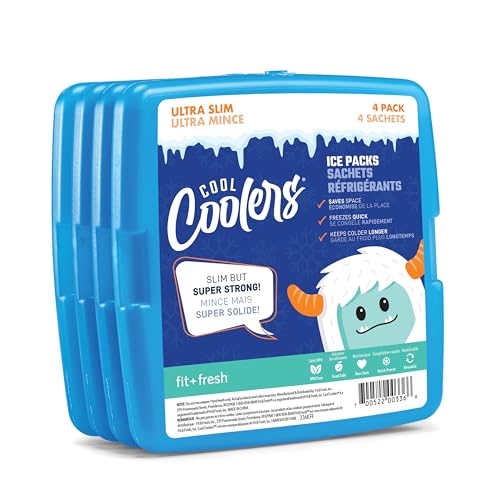
Cool Coolers by Fit + Fresh, 4 Pack Slim Ice Packs, Space Saving Reusable Ice Packs for Lunch Boxes or Coolers, Blue, Single Pack
Included for 'Best Ice Packs for Lunch Boxes: Slim vs Gel vs Hard-Shell Compared' because the listing specifies 4 Pack Slim Ice Packs and Space Saving Reusable Ice Packs for Lunch Boxes or Coolers, details this guide uses to compare options.
View on Amazon
Igloo Maxcold Small Ice Block, 2-Pack, Blue
Included for 'Best Ice Packs for Lunch Boxes: Slim vs Gel vs Hard-Shell Compared' because the listing specifies 2-Pack and Blue, details this guide uses to compare options.
View on Amazon
TOURIT 4 Pack Reusable Slim Ice Packs for Lunch Boxes and Coolers,Baby Blue
Included for 'Best Ice Packs for Lunch Boxes: Slim vs Gel vs Hard-Shell Compared' because the listing specifies Baby Blue, details this guide uses to compare options.
View on Amazon- A 200 g slim pack absorbs roughly 200 x 334 = 66,800 J while melting.
- A typical soft insulated lunch bag lets in heat at roughly 3 to 5 W on a 72°F day (1 W = 1 J per second).
- At 4 W: 66,800 / 4 = 16,700 seconds, or about 4.6 hours before the pack is fully melted.
That number is optimistic, because the pack also has to cool the food you put in. Starting with food already refrigerated at 38°F instead of room temperature adds hours. In practice, one 200 g pack in a soft bag covers a morning-to-lunch window; two packs or a better-insulated bag cover a full 8 to 10 hour shift. Food safety guidance from the USDA recommends at least two cold sources for packed perishable lunches and keeping cold food at or below 40°F.
Types of reusable lunch ice packs compared
| Type | Typical size | Weight | Freeze time | Pros | Cons |
|---|---|---|---|---|---|
| Slim hard-shell pack | ~6 x 4 x 0.5 in | 120–200 g | 4–6 h | Fits flat, durable, does not leak | Rigid, will not wrap around containers |
| Soft gel pack | ~6 x 5 in | 150–300 g | 6–8 h | Flexible when slightly thawed, cheap | Can puncture, sweats more |
| Fabric-covered gel pack | ~7 x 5 in | 200–300 g | 6–8 h | Less condensation on food | Fabric needs washing, slower to freeze |
| Ice-sheet (cube grid) | ~11 x 8 in, cuttable | 300–600 g | 8–12 h | Wraps around containers, scalable | Bulky to store flat, cells can split |
| Large hard-shell block | ~8 x 6 x 1.5 in | 450–900 g | 12–24 h | Longest hold time | Too big for most lunch boxes |
| Freezable bag (built-in gel) | Whole bag lining | N/A | 8–12 h (whole bag) | No separate pack to forget | Takes freezer space, bag cannot be washed in a machine |
Slim ice packs: the default for most lunch boxes
Slim hard-shell packs are the easiest win for bento boxes and meal prep containers. Cool Coolers by Fit + Fresh slim packs are a long-running example, sold in multi-packs sized to slide into lunch bags. Bentgo also makes reusable ice packs shaped to sit on top of its bento boxes. Rubbermaid Blue Ice is the classic rectangular hard-shell option in several sizes.
What to look for:
- A thickness of 0.5 inch or less if you use a snug bento bag.
- A non-toxic, BPA-free shell; if the pack ever cracks, discard it rather than taping it.
- A footprint close to your container’s lid size so it actually covers the food.
Ice packs for meal prep bags and long shifts
Multi-meal prep bags carrying three to six containers need more cold capacity. Here, hard-shell packs designed for coolers, such as YETI ICE in its 1 lb size, or flexible ice sheets cut to fit the bag floor, give longer hold times. The trade-off is weight: two 450 g packs add almost 2 lb to the bag.
| Your day | Bag type | Ice recommendation |
|---|---|---|
| Office, fridge at work | Any small lunch bag | 1 slim pack (~150 g) for the commute |
| School, lunch at noon | Kids’ bento bag | 1 slim pack plus a frozen water bottle or yogurt tube |
| 8–10 h shift, no fridge | Insulated lunch box | 2 slim packs, one above and one below the food |
| 12 h shift, hot vehicle | Hard-sided cooler or premium insulated bag | 2 x 1 lb hard packs, or ice sheet plus a slim pack |
| Multi-meal prep bag | Meal prep bag with 3–6 containers | Ice sheet on the floor plus 1–2 slim packs between layers |
Packing for maximum cold
- Chill everything first. Put containers in the fridge overnight. A warm container can use up a third or more of a small pack’s cooling capacity just reaching fridge temperature.
- Place ice on top. Cold air sinks, so a pack on top cools the whole stack. Add a second pack underneath for long days.
- Fill empty space. Air gaps warm faster. A frozen water bottle doubles as a cold source and a drink by afternoon.
- Keep the bag out of the sun and out of a hot car whenever possible. Interior car temperatures can exceed 120°F, which can overwhelm any small pack.
Durability and ownership realities
- What fails first: soft gel packs develop pinhole leaks at the seams, usually within 6 to 18 months of daily use. Hard shells last years but can crack if dropped while frozen.
- Condensation: every pack sweats as it thaws. Wrap the pack in a thin cloth or use a fabric-covered version if you pack sandwiches or bread.
- Cleaning: wash packs in warm soapy water every few days; residue from spills can grow mold in the textured surfaces. Avoid the dishwasher unless the manufacturer allows it.
- Freezer rotation: own at least two sets so one is always freezing while the other is in use.
Cost per use
A four-pack of slim hard-shell packs usually costs $10 to $20. Used five days a week and rotated, a set easily lasts two years, around 520 uses. At $16, that is about 3 cents per lunch, less than a bag of ice once a week.
FAQ
Are gel packs or hard-shell packs colder?
Both reach freezer temperature. Some gel packs use additives that freeze slightly below 32°F, which can help a bit, but total weight and placement matter more than the gel itself.
Can I use a frozen water bottle instead?
Yes. A frozen 16.9 oz (500 ml) bottle holds about as much cold as two slim packs. Leave a little headspace before freezing so it does not split.