
Key takeaways
- Using outside dimensions as interior dimensions: Insulation and seams can reduce usable space substantially.
- Ignoring the zipper opening: A large base does not help if your food container cannot pass through the opening.
- Forgetting the ice pack: Reserve space for at least one ice pack, particularly for perishable foods.
- Buying too much height: Tall bags may waste space when your containers are wide and shallow.
- Measuring an empty bag only: A flexible bag can change shape when packed, especially around side pockets and bottle compartments.
- Overlooking loaded weight: A large bag can become uncomfortable once filled with food, drinks, and cooling packs.
- Assuming every bottle pocket is insulated: An exterior pocket may not provide the same temperature protection as the main compartment.
What's inside
Choosing the right lunch bag is less about finding the biggest option and more about matching its outside measurements to the food containers, drink bottles, and storage space you use every day. The best fit should hold a complete meal without forcing the zipper, tipping containers, or wasting room in a refrigerator, backpack, or office cabinet.
If you are wondering what dimensions fit best in standard lunch bags, start with a bag that is approximately 9 to 11 inches wide, 6 to 8 inches deep, and 7 to 10 inches high. That range works well for most adult lunches, while smaller 8-by-5-by-6-inch designs suit children or compact meals. The guide below explains common sizes, how to measure your space, and which dimensions work best for different routines in 2026.
As an Amazon Associate we earn from qualifying purchases at no extra cost to you. Product prices and availability are accurate as of the date shown and are subject to change.


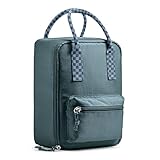
The Short Answer
For a typical adult work lunch, look for interior dimensions of at least 9 inches wide by 6 inches deep by 7 inches high. This usually accommodates a rectangular food container, a piece of fruit, a snack, and a 16- to 20-ounce drink.
A larger lunch bag measuring about 11 inches wide by 8 inches deep by 10 inches high is better for multiple containers, meal-prep boxes, ice packs, or a 24- to 32-ounce bottle. For children, a compact bag around 8 inches wide by 5 inches deep by 6 inches high is easier to carry and generally holds a sandwich container, snack, and small drink.
Remember that listed dimensions are often the bag’s outside measurements. Insulation, lining, seams, pockets, and the shape of the opening can reduce usable interior space by roughly ½ to 1½ inches per direction.
Standard Sizes
Lunch bags do not follow one universal sizing standard, but the following ranges cover the most common formats. Measurements are shown in inches first, followed by centimeters. Capacity is approximate because soft-sided bags expand and contract depending on what is packed.
| Lunch bag type | Typical outside dimensions | Approximate interior dimensions | Best for | Approximate weight |
|---|---|---|---|---|
| Compact kids’ bag | 8 × 5 × 6 in (20.3 × 12.7 × 15.2 cm) |
7 × 4 × 5 in (17.8 × 10.2 × 12.7 cm) |
Small meals, snacks, and 8- to 12-ounce drinks | 0.4–0.9 lb (0.2–0.4 kg) |
| Standard personal bag | 9 × 6 × 7 in (22.9 × 15.2 × 17.8 cm) |
8 × 5 × 6 in (20.3 × 12.7 × 15.2 cm) |
Sandwiches, one entrée container, fruit, and a drink | 0.7–1.3 lb (0.3–0.6 kg) |
| Large adult lunch bag | 11 × 8 × 10 in (27.9 × 20.3 × 25.4 cm) |
10 × 7 × 9 in (25.4 × 17.8 × 22.9 cm) |
Meal prep, multiple containers, and larger ice packs | 1.0–1.8 lb (0.5–0.8 kg) |
| Tall bottle-friendly bag | 10 × 7 × 12 in (25.4 × 17.8 × 30.5 cm) |
9 × 6 × 11 in (22.9 × 15.2 × 27.9 cm) |
Layered meals and 24- to 32-ounce bottles | 1.0–2.0 lb (0.5–0.9 kg) |
| Family or all-day tote | 12 × 8 × 10 in (30.5 × 20.3 × 25.4 cm) |
11 × 7 × 9 in (27.9 × 17.8 × 22.9 cm) |
Two or more meals, snacks, and drinks | 1.3–2.5 lb (0.6–1.1 kg) |
These dimensions describe useful shopping benchmarks, not guaranteed specifications for every model. A thickly insulated freezable bag may have less interior room than a similarly sized fabric tote. Bags with bottle pockets also use some of their width for storage outside the main compartment.
For value comparison, everyday lunch bags commonly cost about $10 to $35. Compact children’s models are often near $10 to $18, while larger insulated work bags generally fall between $15 and $35. For example, the listed reference products range from $9.99 for the Fit & Fresh Connor kids’ bag to $29.99 for the Fit & Fresh Bloomington bag. The PackIt Freezable Classic is listed at $26.99, and the Fit & Fresh Laketown bag at $14.44. Prices can change, so treat those figures as shopping context rather than permanent pricing.
How to Measure Your Space
- Measure the items you actually pack. Record the length, width, and height of your largest food container, bottle, ice pack, and snack container. Measure lids at their widest points.
- Measure the storage location. Check the refrigerator shelf, desk drawer, locker, backpack compartment, or cabinet where the bag will sit. Measure width, depth, and height, including the clearance needed to open a zipper or flap.
- Add room for insulation. If you are measuring an available space rather than a food container, leave at least ½ inch of clearance on each side. For a rigid refrigerator cubby, 1 inch of total extra width and depth makes removal easier.
- Account for the opening. A bag may have a generous base but a narrow zipper opening. Compare the opening width with the longest side of your meal container.
- Check vertical stacking. Add the height of stacked containers, an ice pack, and any lid or handle obstruction. A bag that is 7 inches tall may hold only 5½ to 6 inches of usable food space.
- Allow expansion without overstuffing. Soft bags need a little flexibility for insulation and seams. Aim to use no more than about 80% to 90% of the interior volume so the zipper closes without pressure.
By Room or Use Case
Office and Work Commutes
A standard 9-by-6-by-7-inch interior is enough for a single lunch at work. Choose a larger 10-by-7-by-9-inch interior if you pack breakfast, an afternoon snack, or a reusable water bottle. A structured base helps prevent containers from tipping during a commute, while an exterior bottle pocket can preserve the main compartment’s space.
School and Daycare
Children usually benefit from a compact bag around 8-by-5-by-6 inches. It should be light enough for a child to carry, with an opening that is easy to reach and a base that fits inside a backpack. Allow room for a small ice pack, but avoid choosing a bag so large that food shifts around. A 12- to 16-ounce bottle generally fits more comfortably than a full-size adult bottle.
Meal Prep and High-Volume Lunches
Meal-prep users should look for at least 10-by-7-by-9 inches of interior space. This accommodates two medium containers or one larger entrée box plus snacks. Before buying, check whether the containers can lie flat. Some tall bags hold more total volume but are poorly suited to wide, shallow meal-prep boxes.
Travel, Fieldwork, and Long Days
For jobs without convenient refrigeration, an 11-by-8-by-10-inch bag or a tall 10-by-7-by-12-inch design provides room for larger ice packs and extra food. Consider the loaded weight: food, drinks, and ice can easily add 3 to 6 pounds, even when the empty bag weighs less than 2 pounds. A padded shoulder strap or reinforced handles can make a noticeable difference.
Small Refrigerators and Tight Storage
If your lunch must fit in a crowded office refrigerator, prioritize a compact footprint over capacity. A bag no wider than 9 inches and no deeper than 6 inches is easier to slide onto a shelf. Measure the refrigerator door opening as well; a bag that fits inside may still be awkward to insert if the opening is narrow.
Common Sizing Mistakes
- Using outside dimensions as interior dimensions: Insulation and seams can reduce usable space substantially.
- Ignoring the zipper opening: A large base does not help if your food container cannot pass through the opening.
- Forgetting the ice pack: Reserve space for at least one ice pack, particularly for perishable foods.
- Buying too much height: Tall bags may waste space when your containers are wide and shallow.
- Measuring an empty bag only: A flexible bag can change shape when packed, especially around side pockets and bottle compartments.
- Overlooking loaded weight: A large bag can become uncomfortable once filled with food, drinks, and cooling packs.
- Assuming every bottle pocket is insulated: An exterior pocket may not provide the same temperature protection as the main compartment.
FAQ
What is the best lunch bag size for one adult?
For most adults, choose an interior close to 9-by-6-by-7 inches. Move up to approximately 10-by-7-by-9 inches if you pack multiple containers, snacks, or a bottle larger than 20 ounces.
Will a lunch bag fit a standard meal-prep container?
Many rectangular meal-prep containers measure about 7 to 9 inches long, 5 to 7 inches wide, and 2 to 3 inches high. A bag with an interior at least 1 inch wider and deeper than the container is usually easier to load and unload.
How much extra space should I leave in a lunch bag?
Leave roughly 10% to 20% of the interior volume open. This makes room for an ice pack, protects the zipper from strain, and allows the insulation to retain its shape.
Are larger lunch bags better?
Only if you regularly use the capacity. Larger bags can hold more food and cooling material, but they also take up more refrigerator space and may weigh more when full. For a single daily meal, a standard personal bag is usually the most efficient choice.


