Our Top Picks
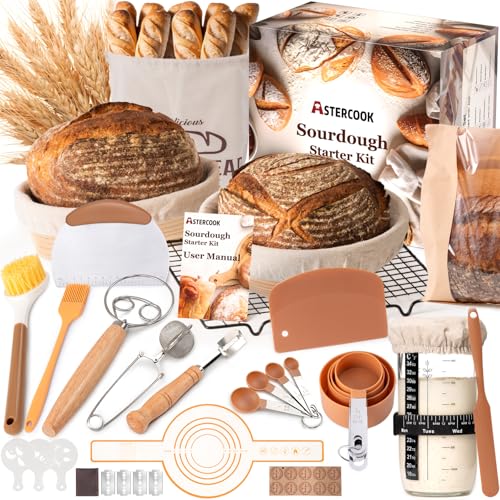 Astercook Sourdough Starter Kit with Round & Oval11 x 6 x 10 inches11 x 6 x 10 Inches4.6 PoundsCheck on Amazon
 Superbaking Sourdough Starter Kit: 9" Banneton Basket9"15.75 x 13.78 x 3.54 inches3.13 poundsCheck on Amazon
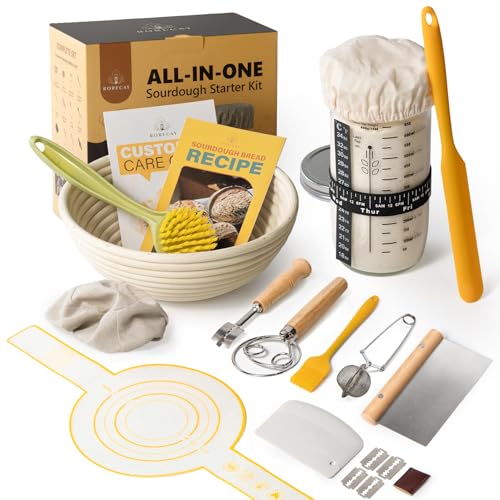 Rorecay Sourdough Starter Kit with Banneton Bread Proofing9 inches9 x 9 x 3.3 inches2.7 poundsCheck on Amazon
Best overall: the Astercook Sourdough Starter Kit with Round & Oval Banneton Bread Proofing Basket, Starter Jar, Dough Whisk and Scraper. It wins because it is one of the few kits in this roundup that ships both a round and an oval proofing basket plus a starter jar and mixing tools in a single box, so you can bake a boule and a batard without buying a second basket later. It suits anyone moving from “I want to try sourdough” to “I want to bake most weekends.” If budget is the hard limit, the Rorecay kit covers the same core job for less. If you want a baking vessel included so one purchase covers mixing, proofing and baking, the EWFEN kit with its enamel cast iron pot is the premium answer. Below, each kit is broken down by what is actually in the box, the banneton dimensions that decide whether your dough fits, the proofing materials beginners most often discover are missing after delivery, and how the pieces assemble into a working setup.
Top 3 Picks
Best overall: Astercook Sourdough Starter Kit. A two-basket setup (round and oval) plus starter jar, whisk and scraper, which means no second purchase when you want to switch loaf shapes. The right call for a baker who plans to bake regularly and wants both shapes available from week one.
Best budget: Rorecay Sourdough Starter Kit. It covers the genuine minimum — a proofing basket and a jar to keep the starter in — without padding the box with tools you will not touch. Best for someone who wants to find out whether sourdough sticks before spending more.
Best premium: EWFEN Sourdough Starter Kit with Enamel Cast Iron Pot. The only kit here built around a baking vessel, so the purchase covers mixing, proofing and baking in one order. Best for a baker who owns no Dutch oven and does not want to buy one separately.
Quick Comparison
| Product | Best For | Key Specs | Price Tier |
|---|---|---|---|
| Astercook Sourdough Starter Kit | Bakers who want round and oval loaves from day one | Round + oval banneton, starter jar, dough whisk, scraper; liners included | Premium |
| Superbaking Sourdough Starter Kit | Small kitchens and first-time bakers | 9-inch round banneton, silicone sling, starter jar | Mid-range |
| Umite Chef Sourdough Starter Kit | Bakers who want a multi-basket proofing set | Banneton proofing basket set, liners, starter accessories | Mid-range |
| EWFEN Sourdough Starter Kit | Buyers who need a baking vessel included | Enamel cast iron pot, round + oval banneton, full tool set | Premium |
| BAVIFY Sourdough Starter Kit | Bakers who want a tidy mid-range basket set | Banneton proofing basket set with liners, starter accessories | Mid-range |
| Rorecay Sourdough Starter Kit | Tight budgets and first loaves | Banneton basket, starter jar, basic mixing tools | Budget |
| KitHero Sourdough Starter Kit | Buyers who want the fullest box | Round + oval banneton, complete bread baking supplies | Premium |
| INOBYO Sourdough Starter Jar Kit | Starter maintenance rather than baking | 24 oz wide-mouth glass jars | Budget |
| ABIOTO Sourdough Starter Kit | Tool-count shoppers | 24-piece set, proofing baskets, baking tools | Premium |
| Panny Sourdough Starter Kit | Beginners who want the basics done well | Banneton, starter supplies, baking tools | Mid-range |
| RYMTOX Complete Sourdough Starter Kit | Beginners who dislike scrubbing | Easy-clean banneton set, starter tools | Budget |
| Ayerphalo 38oz Glass Sourdough Starter Jar Kit | Jar-first beginners | 38 oz glass jar, guidebook, starter tools | Budget |
How We Chose
These picks were assembled from published listing specifications, category standards for proofing baskets and starter vessels, and a straightforward question: if a beginner opened this box on a Saturday morning, what would they still have to buy before the first loaf came out of the oven? That question does most of the sorting. A kit with two bannetons and no jar is less complete than a kit with one banneton and a jar, because the jar is cheap to add but the second basket is a separate decision.
Four criteria carried weight. First, spec clarity: where a listing states a basket diameter, a jar volume or a piece count, that number is used; where it does not, the item is described by spec class rather than by an invented figure. Second, category fit — whether the basket size suits the loaf the buyer is likely to bake, and whether the materials are the ones that actually hold up to wet dough. Third, use case: a starter-maintenance kit and a full baking kit solve different problems and should not be ranked against each other on tool count. Fourth, upgrade path — whether the kit leaves the buyer one small purchase away from a complete workflow, or three. Price tiers reflect where each kit sits in the market, not a fixed number, because listing prices move.
1. Astercook Sourdough Starter Kit – Best for Bakers Who Want Both Loaf Shapes in One Box
Astercook Sourdough Starter Kit with Round & Oval Banneton Bread Proofing Basket, Starter Jar, Dough Whisk, Scrapers, Stencils, Complete Sourdough Bread Baking Supplies, Fathers Day Gift for Men
Chosen because it specifies Starter Jar and Dough Whisk.
View on AmazonAstercook’s kit is aimed at the baker who already knows they want both a round boule and an oval batard, and who would rather pay once for a two-basket setup than buy a second proofing basket three months in. If you have watched sourdough videos and noticed that half the bakers are shaping round and half are shaping oval, this kit removes the choice — you get both. It also suits someone who wants the starter vessel and the mixing tools to arrive in the same order, rather than hunting for a jar and a whisk separately.
Key specs
- Baskets: two banneton proofing baskets, one round and one oval, each with a matching cloth liner
- Round basket capacity: typically holds roughly 1–1.5 kg (about 2–3 lb) of dough, the standard range for a 9–10 inch round banneton
- Oval basket capacity: sized for a batard of roughly 800 g–1 kg, the typical oval banneton footprint
- Starter vessel: a sourdough starter jar with a lid, sized for a working culture you feed regularly
- Mixing tools: a dough whisk and a scraper, the two items most often left out of cheap kits
- Materials: natural cane or rattan basket construction with cotton liners, the category standard
- Price tier: premium
Strengths
The two-basket configuration is the real value here, and it is worth being precise about why. A round banneton and an oval banneton are not interchangeable: the round one supports a boule’s even rise, while the oval one holds a batard’s longer shape so it keeps its length instead of spreading into an oval blob. Buying both at once costs less than buying a single-basket kit and then adding an oval later, and it means your shaping practice is not constrained by your equipment. The dough whisk matters more than it looks, too — a stiff dough whisk cuts through a 70–80% hydration dough without the dough climbing the tines the way it does with a fork.
The inclusion of a scraper closes another common gap. Bench and bowl scrapers are how you move a sticky, high-hydration dough off the counter without tearing it, and they are the single most-underrated item in a beginner kit. Astercook also includes liners with both baskets, which matters because unlined cane can let a wet dough stick badly enough to ruin the surface of a loaf.
Pros
- Round and oval baskets in one purchase — no second basket needed later
- Starter jar, dough whisk and scraper included, covering the actual mixing workflow
- Liners included with both baskets, so no separate linen purchase
- Two shapes let you practise both boule and batard shaping from the start
Cons
- Premium tier — you pay for the second basket whether or not you use both shapes
- No baking vessel included, so you still need a Dutch oven, combo cooker or a stone
- No scoring lame or blade in the described contents, a small extra purchase
Compared with the nearest alternative: the KitHero kit also ships round and oval bannetons and a full supplies list, so the two sit in the same premium tier and the same two-shape concept. Astercook’s advantage is that its stated contents are narrowly focused on the mixing-and-proofing stage — jar, whisk, scraper, two baskets — rather than a long tail of accessories. If you want the largest possible count of items, ABIOTO’s 24-piece set beats both on quantity; if you want a baking vessel in the box, EWFEN is the one to look at. For a baker whose gap is specifically “I have no proofing baskets and no jar,” Astercook is the shortest path.
2. Superbaking Sourdough Starter Kit – Best for Small Kitchens and First-Time Bakers
Superbaking Sourdough Starter Kit: 9" Banneton Basket, Silicone Sling & Jar | Round Rattan, Splinter-Free, Non-Stick Bread Sling, Glass Starter Jar, Whisk, Lame, Scraper, Sourdough Bread Baking Supplies
Chosen because it specifies Silicone Sling & Jar.
View on AmazonSuperbaking’s kit is built around a single 9-inch round banneton, a silicone sling and a jar. That combination points at a specific baker: someone in a small kitchen who wants one good basket rather than a set, and who has already worked out that a round boule is the loaf they actually want to make. The 9-inch round is the most common banneton size in home baking, and it is the size most beginner recipes assume when they say “one large banneton.”
Key specs
- Basket: one 9-inch round banneton proofing basket with liner
- Capacity: a 9-inch round banneton typically holds 1–1.5 kg of dough, enough for a 900 g–1 kg boule
- Silicone sling: a transfer sling for lowering a proofed dough into a hot Dutch oven without burning your knuckles
- Starter vessel: a jar for maintaining the culture
- Footprint: single-basket storage, roughly the diameter of a dinner plate
- Price tier: mid-range
Strengths
The silicone sling is the standout inclusion and the reason this kit earns a mid-range slot despite carrying only one basket. Transferring a fully proofed, high-hydration dough from a banneton into a preheated 230–250°C (450–480°F) Dutch oven is the moment most beginners lose a loaf — the dough folds on itself, sticks to a hand, or lands off-centre. A sling turns that into a lift-and-lower motion. Parchment paper does the same job, but a reusable sling means you stop buying it.
The single 9-inch basket is also a defensible choice rather than a limitation. Two baskets take up real cabinet space and need to be kept dry and aired out between bakes; one basket that gets used every week is better than two that get used alternately. For a small kitchen, that trade is straightforward. The jar completes the minimum viable setup: something to keep the starter alive in while the basket does its work.
Pros
- 9-inch round banneton is the standard size most beginner recipes are written for
- Silicone sling makes hot-Dutch-oven transfers far safer
- Compact single-basket footprint suits small kitchens and rented storage
- Starter jar included, so the culture has a home from day one
Cons
- No oval basket — batards are off the menu unless you buy a second basket
- No dough whisk or scraper described, both of which you will want for wet dough
- Mid-range tier for a comparatively small item count
Compared with the nearest alternative: the Rorecay kit sits one tier below and also covers the minimum basket-plus-jar job, so a budget-first buyer should look there first. Superbaking’s edge is the sling, which is a genuinely useful piece of kit rather than filler. Against the Panny kit, which also targets beginners in the mid-range band, Superbaking is the narrower and more focused purchase: one basket, one sling, one jar, no padding. If you know you want oval loaves as well, step up to Astercook or KitHero instead of buying this and then adding a basket.
3. Umite Chef Sourdough Starter Kit – Best for Bakers Who Want a Multi-Basket Proofing Set

Umite Chef Sourdough Starter Kit, Banneton Bread Proofing Baskets Set | Complete Sourdough Bread Baking Supplies, 9" Round and 10" Oval Rattan Banneton & 24 oz Starter Jar, Gifts for Home Bakers
Chosen because it specifies Banneton Bread Proofing Baskets Set.
View on AmazonUmite Chef’s kit is positioned as a banneton proofing basket set with starter accessories, which places it with the bakers who want more than one basket in the box but do not necessarily need a full tool roll. It suits someone who bakes two loaves at a time, or who wants to proof one loaf while a second is retarding in the fridge, and who would rather buy a set than assemble one piece at a time. It is a reasonable middle path for a household that has moved past the single-loaf stage.
Key specs
- Baskets: a banneton proofing basket set — multiple baskets rather than a single round
- Liners: cloth liners included with the baskets, the category standard for cane construction
- Capacity: standard home banneton capacity of roughly 1–1.5 kg of dough per round basket
- Starter accessories: starter vessel and feeding tools bundled with the proofing set
- Materials: natural cane or rattan with cotton liners
- Price tier: mid-range
Strengths
The point of a multi-basket set is throughput, and that is worth spelling out. Sourdough is a slow process with long waits — a bulk ferment of several hours, a shaped proof of one to three hours at room temperature or twelve to sixteen hours in the fridge. If you own one basket, you can only have one loaf in the shaped-proof stage at a time. Two baskets let you stagger: mix one dough, shape it into basket one, then mix a second dough and shape it into basket two while the first is retarding. That roughly doubles what a single baking session produces without adding any hands-on time.
Umite Chef also bundles the starter side of the workflow, so the kit is not just proofing equipment. Having a dedicated jar and feeding tools keeps the maintenance routine separate from your mixing bowls, which sounds fussy until you have scraped dried starter off a bowl you needed for something else. The liners are the other practical inclusion: they control sticking and make the basket easier to clean between bakes, which extends the life of the cane.
Pros
- Multiple baskets allow staggered proofing and larger bake sessions
- Liners included, reducing sticking and simplifying cleaning
- Starter vessel and feeding accessories bundled in
- Mid-range tier keeps the cost below a full premium setup
Cons
- Basket count can be overkill for a baker producing one loaf a week
- Multiple baskets need proper drying and storage to avoid mould
- No baking vessel or scoring tool described
Compared with the nearest alternative: the BAVIFY kit occupies a very similar mid-range, multi-basket position, so the choice between them comes down to which set of accessories you actually want — starter-focused or purely proofing-focused. Against the Superbaking kit, Umite Chef trades the silicone sling for additional baskets; if you bake one loaf at a time, the sling is more useful, and if you bake two, the extra basket is. Against the premium Astercook kit, you give up the guaranteed round-and-oval pairing but stay a tier lower on cost.
4. EWFEN Sourdough Starter Kit – Best for Buyers Who Need a Baking Vessel Included

EWFEN Sourdough Starter Kit with Enamel Cast Iron Pot, Complete Sourdough Bread Baking Supplies, Round & Oval Bread Proofing Basket with 34 Oz Starter Jar, Bread Making Tools Kit
Chosen because it specifies Complete Sourdough Bread Baking Supplies and Round & Oval Bread Proofing Basket with 34 Oz Starter Jar.
View on AmazonEWFEN’s kit is the one in this roundup built around an enamel cast iron pot. That single inclusion reframes the purchase: instead of buying proofing equipment and then separately deciding on a Dutch oven, you get the vessel that actually turns dough into bread in the same box, alongside round and oval bannetons and a full supplies list. It suits a baker starting from nothing — no cast iron, no baskets, no jar — who wants one order to cover the whole process.
Key specs
- Baking vessel: an enamel-coated cast iron pot, the standard home vessel for trapping steam during the first phase of baking
- Baskets: round and oval banneton proofing baskets with liners
- Basket capacity: round typically 1–1.5 kg of dough; oval sized for a batard
- Supplies: a complete sourdough bread baking supplies list — starter vessel, mixing and shaping tools
- Vessel material note: enamelled cast iron is heavier than bare cast iron but does not need seasoning and resists acidic dough
- Price tier: premium
Strengths
The cast iron pot is what justifies the premium tier. Sourdough baking depends on steam: a covered vessel traps the moisture escaping from the dough, keeping the crust soft and extensible long enough for the loaf to expand fully, which is what produces oven spring. A preheated enamelled cast iron pot at 230–250°C (450–480°F) does this reliably, and the enamel coating means you are not managing a seasoning layer or worrying about a long ferment’s acidity reacting with bare iron. A pot also doubles as a general-purpose braiser, so it is not single-task equipment.
Adding round and oval baskets on top of the pot makes this the most complete workflow in the list. You can bulk ferment, shape into either basket, retard overnight, then bake in the same pot. The liners and starter vessel close the remaining gaps. For a buyer who wants to spend once and start baking, that is a real advantage over kits that leave the vessel out.
Pros
- Baking vessel included, so the kit covers proofing and baking
- Enamel coating needs no seasoning and handles acidic dough well
- Round and oval baskets support both boule and batard shapes
- Pot has uses beyond bread, so it is not a one-job purchase
Cons
- Premium tier — the pot is the largest single cost in the box
- Enamelled cast iron is heavy, which matters if lifting a hot pot is difficult
- Enamel chips if knocked against a hard edge, so storage needs care
Compared with the nearest alternative: the KitHero kit matches EWFEN on completeness of proofing supplies but does not centre on a baking vessel, so a buyer who already owns a Dutch oven gets better value there. Against Astercook, EWFEN trades a narrower proofing focus for the pot. The deciding question is simple: do you already own a heavy lidded pot that can take 250°C? If yes, EWFEN’s premium is largely redundant and Astercook or KitHero is the smarter buy. If no, EWFEN is the only kit here that closes that gap in one order.
5. BAVIFY Sourdough Starter Kit – Best for Bakers Who Want a Clean Mid-Range Basket Set
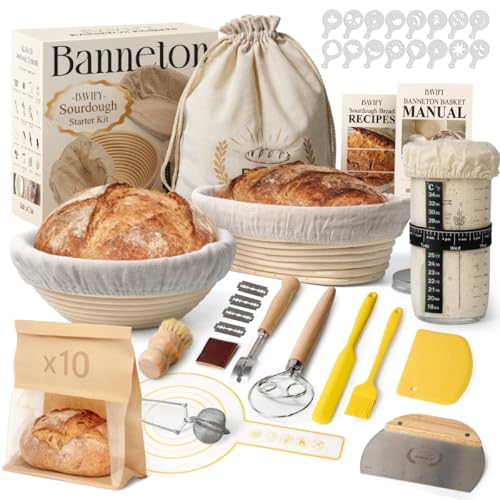
BAVIFY Sourdough Starter Kit, Banneton Bread Proofing Baskets Set | Complete Sourdough Bread Baking Supplies, Beginner Friendly, 9 in Round and 10 in Oval Rattan Banneton & 24 oz Starter Jar
Chosen because it specifies Banneton Bread Proofing Baskets Set.
View on AmazonBAVIFY’s kit sits in the same territory as the Umite Chef set: a banneton proofing basket set with the starter-side accessories bundled alongside. It suits a baker who wants proofing equipment that is properly specified rather than decorative, and who is happy to spend mid-range money on baskets and a jar without paying for a cast iron pot. If your kitchen already has a Dutch oven, a combo cooker or a baking stone, this is the kind of kit that fills the gap in front of it.
Key specs
- Baskets: banneton proofing basket set with cloth liners
- Capacity: standard home-baking range of roughly 1–1.5 kg of dough per round basket
- Materials: natural cane or rattan with cotton liners
- Starter accessories: starter jar and feeding tools included
- Storage: stackable basket footprint, easier to store than a pot-inclusive kit
- Price tier: mid-range
Strengths
The case for a basket-only kit is storage and flexibility. Cane bannetons stack, weigh very little, and do not care whether you bake in a Dutch oven, a clay baker or on a stone. If you are still deciding how you want to bake — or if you already have a vessel you like — spending mid-range money on proofing equipment rather than on a second pot is the more efficient allocation. BAVIFY’s set covers the proofing half of the process properly, with liners included so the cane does not get caked in dough.
The bundled starter accessories mean the culture has its own jar and its own feeding routine, separate from the mixing bowls. That separation is a small thing that pays off in consistency: a starter kept in a dedicated, marked jar is easier to monitor for rise and fall, which is how you learn to judge when it is ready to leaven a dough. A kit that supplies the jar encourages that habit.
Pros
- Mid-range price with proofing and starter equipment covered
- Lightweight, stackable baskets that store easily
- Liners included, keeping the cane clean and the dough release reliable
- Works with whatever baking vessel you already own
Cons
- No baking vessel, so it is not a one-purchase solution
- No scoring lame described among the accessories
- Sits close in price and contents to other mid-range basket sets, so the differences are small
Compared with the nearest alternative: Umite Chef is the closest match, with a near-identical pitch. The tiebreaker is basket count and accessory mix rather than quality — if you want more baskets, compare the stated set sizes carefully; if you want the starter side more fully furnished, check what each bundle actually lists. Against the Rorecay kit one tier down, BAVIFY buys you better-specified baskets and a fuller accessory list. Against EWFEN, you are deliberately giving up the pot to save the premium.
6. Rorecay Sourdough Starter Kit – Best for Tight Budgets and First Loaves
Rorecay Sourdough Starter Kit with Banneton Bread Proofing Baskets and Jar | Complete Sourdough Bread Baking Supplies, Beginner Friendly, 9in Round Rattan Banneton & 24oz Glass Starter Jar, Sturdy Tools
Picked as a relevant option in this category.
View on AmazonRorecay’s kit is the budget entry in this roundup, built around a banneton proofing basket and a jar. It suits the baker who wants to find out whether sourdough is a hobby they will keep before committing premium money to it — and who is willing to add a couple of small tools later if it sticks. It is also a sensible gift for someone curious about the process without being certain they will continue.
Key specs
- Basket: banneton proofing basket with liner
- Capacity: standard home banneton capacity, roughly 1–1.5 kg of dough
- Starter vessel: a jar for maintaining the culture
- Included tools: basic mixing tools as described in the listing
- Materials: cane or rattan basket construction with a cotton liner
- Price tier: budget
Strengths
The budget tier earns its place by covering the two items you cannot improvise. You can mix dough in any large bowl and bake in any heavy lidded pot, but you cannot easily fake a banneton — the coiled cane wicks moisture away from the surface of the dough and holds the shape during the final proof, which is what gives a loaf its skin and its structure. And you cannot maintain a starter without a jar. Rorecay supplies both, which is the honest definition of a minimum viable kit.
Buying budget first is a defensible strategy rather than a compromise. Sourdough has a steep early learning curve: the first few loaves are usually dense, underproofed or overproofed, and the equipment is not what is holding you back. Spending less at the start and upgrading the pieces you actually use — a second basket, a better whisk, a sling — once you know your own workflow is often cheaper overall than buying a premium kit you only half-use. The basket and jar remain useful regardless of what you add later.
Pros
- Lowest-cost way to get a real banneton and a starter jar
- Core items remain useful even after you upgrade other tools
- Small, low-commitment entry for testing whether the hobby sticks
- Easy to store and easy to replace if it gets damaged
Cons
- Thinner tool list — expect to add a whisk, scraper or sling later
- Single basket means one shaped loaf in proof at a time
- No baking vessel, so a Dutch oven or equivalent is still needed
Compared with the nearest alternative: the RYMTOX kit sits in the same budget tier with a similar basket-and-tools pitch, and Ayerphalo’s jar-first kit is the other budget option — but Ayerphalo leads with a large glass jar and a guidebook rather than with proofing equipment. If your priority is a proofing basket at the lowest cost, Rorecay is the closer fit; if you mainly want a well-sized jar and written guidance, Ayerphalo is. Against Superbaking one tier up, you give up the silicone sling and the 9-inch size guarantee to save money.
7. KitHero Sourdough Starter Kit – Best for Buyers Who Want the Fullest Box
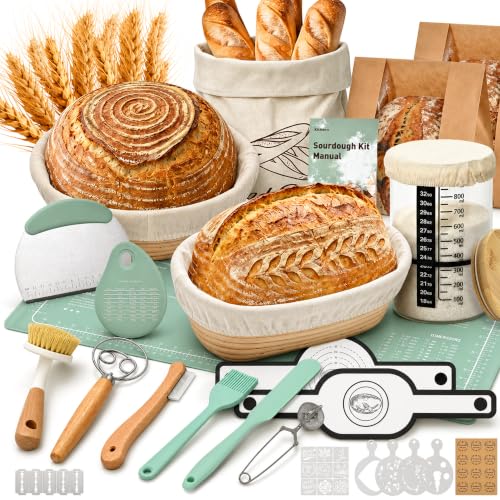
KitHero Sourdough Starter Kit – Complete Bread Baking Supplies with Round & Oval Banneton Bread Proofing Basket, Starter Jar, Bread Slings, Silicone Mat, Scrapers – Baking Tools Gift for Home Bakers
Chosen because it specifies Starter Jar and Bread Slings.
View on AmazonKitHero’s kit is pitched as complete bread baking supplies with round and oval banneton baskets, which puts it in the same two-shape, everything-included category as the Astercook kit. It suits a baker who wants to open one box and find every non-consumable item the process requires — baskets, liners, starter vessel, mixing and shaping tools — without a follow-up order. If you dislike discovering mid-bake that you are missing something, this is the design philosophy you want.
Key specs
- Baskets: round and oval banneton proofing baskets with liners
- Round capacity: typically 1–1.5 kg of dough, the standard for a home round banneton
- Oval capacity: sized for a batard of roughly 800 g–1 kg
- Supplies: a complete bread baking supplies list covering starter maintenance, mixing, shaping and scoring
- Materials: cane or rattan baskets, cotton liners, food-safe tools
- Price tier: premium
Strengths
The argument for a full-box kit is the elimination of mid-process interruptions. Sourdough has enough moving parts without discovering at the shaping stage that you have no bench scraper, or at the scoring stage that you have no blade. KitHero’s approach is to enumerate the whole workflow and supply it: a vessel for the starter, something to mix with, something to scrape with, two baskets to proof in, and liners to keep them clean. Each individual item is inexpensive, but the aggregate saves several small orders and the delays that come with them.
The round-and-oval pairing is the second advantage, and it is the same one Astercook offers. Having both shapes available means you can decide on baking day whether you want a tall boule or a longer batard, rather than having the equipment dictate the answer. The oval basket in particular is the piece most single-basket kits omit, and it is the one that expands what you can bake — sandwich loaves, longer bâtards for slicing, and shapes that suit a rectangular pot or a baking stone better than a round does.
Pros
- Round and oval baskets in one order, covering both major loaf shapes
- Complete supplies list reduces the chance of a mid-bake gap
- Liners included for both baskets
- Premium tier buys breadth rather than a single expensive component
Cons
- Large kits include items some bakers never use, which is wasted spend
- No baking vessel described, unlike the EWFEN kit
- More pieces to store and keep dry between bakes
Compared with the nearest alternative: the Astercook kit is the closest competitor — same two-basket concept, same premium tier — so the decision rests on which specific accessories matter to you. KitHero leans toward breadth of supplies; Astercook leans toward the proofing and mixing core. Against ABIOTO’s 24-piece set, KitHero is likely to be the more curated box, since a large piece count often includes duplicates and minor extras. Against EWFEN, you lose the cast iron pot but gain a broader tool list.
8. INOBYO Sourdough Starter Jar Kit – Best for Starter Maintenance Rather Than Baking

INOBYO Sourdough Starter Jar Kit, 24 oz Wide Mouth Sour Dough Jars Glass | Sourdough Bread Baking Supplies, Sourdough Tools for Beginners and Pro, Dishwasher-Safe, Borosilicate Glass, 1 Pack
Chosen because it specifies 24 oz Wide Mouth Sour Dough Jars Glass.
View on AmazonINOBYO’s kit is not a full baking setup — it is a starter jar kit built around 24 oz wide-mouth glass jars. That makes it the right purchase for a specific reader: someone who already owns proofing and baking equipment and just needs a better vessel for the culture, or someone who wants to start a starter now and buy baking gear later once it is active. It also suits bakers who keep more than one starter, or who want to split a culture for experimentation.
Key specs
- Jar volume: 24 oz (about 710 ml) per jar — the wide-mouth format that makes feeding and scraping easy
- Material: glass, which does not retain odours or stains and can be cleaned thoroughly
- Mouth: wide-mouth opening, large enough to get a spatula or spoon in and out comfortably
- Quantity: a jar kit — multiple vessels rather than a single container
- Excluded: no banneton, no proofing basket, no baking vessel
- Price tier: budget
Strengths
The 24 oz size is the detail worth understanding. A starter roughly doubles in volume after feeding, so a jar needs headroom: if you keep 100 g of starter and feed it 100 g flour and 100 g water, you have 300 g of mixture that will expand toward 600 g at peak. A 24 oz (710 ml) jar holds that comfortably without overflowing, while staying small enough to fit on a counter or in a fridge door. Larger jars tempt you to keep more starter than you need, which means more discard.
Wide-mouth glass is the practical choice for two reasons. Glass is non-porous and does not hold onto the sour smell the way plastic can, and a wide mouth lets you stir right to the bottom of the jar without a long-handled tool. If you keep two jars, you can move the starter between them at each feeding and wash the spare, which avoids the crusted ring that builds up on a jar you never rotate. That rotation habit alone makes a starter easier to read — you can see the rise line clearly on a clean jar wall.
Pros
- 24 oz capacity gives proper headroom for a doubling starter
- Wide mouth makes feeding, stirring and scraping straightforward
- Glass is non-porous and cleans back to clear
- Budget tier — a cheap upgrade if your current jar is too small or too narrow
Cons
- No proofing basket, so it is not a complete baking kit
- Glass can crack if subjected to sudden temperature change
- Multiple jars need labels to avoid mixing up starters
Compared with the nearest alternative: the Ayerphalo kit is the other jar-led option here, but it centres on a larger 38 oz jar with a guidebook, so it is aimed at beginners who want room and written instructions. INOBYO’s 24 oz jars suit a baker who already knows their feeding routine and wants a right-sized vessel or a pair of them. Neither includes a banneton, so if you need proofing equipment, start with Rorecay or Superbaking and add a jar kit only if your current container is the bottleneck.
9. ABIOTO Sourdough Starter Kit – Best for Tool-Count Shoppers

ABIOTO Sourdough Starter Kit with Bread Proofing Baskets & Tools, 24-Pieces | Complete Beginner Sourdough Bread Baking Supplies - Round & Oval Bannetons, Liners, Slings, Jar, Mat, Lame, Whisk, & Scrapers
Chosen because it specifies 24-Pieces.
View on AmazonABIOTO’s kit is a 24-piece set with bread proofing baskets and tools, and it is aimed squarely at the buyer who wants maximum coverage in a single purchase. It suits someone setting up a kitchen for bread baking from scratch, or a household where more than one person bakes and duplicate tools are genuinely useful rather than clutter. If your instinct on a kit is “does it have everything?”, this is the box designed for that instinct.
Key specs
- Piece count: 24 pieces, one of the largest sets in this roundup
- Baskets: bread proofing basket or baskets included, with liners
- Tools: a broad assortment covering mixing, shaping, scoring and starter maintenance
- Capacity: standard home banneton range of roughly 1–1.5 kg of dough
- Materials: cane or rattan baskets, cotton liners, food-safe tool materials
- Price tier: premium
Strengths
A large piece count has a real benefit and a real risk, and it is worth naming both. The benefit is redundancy and coverage: with 24 pieces you are unlikely to hit a step where you lack a tool, and small items like scrapers, whisks and scoring tools are exactly the things that go missing in a busy kitchen. If two people bake in the same house, having a second scraper or a second liner matters more than it sounds. For a beginner who does not yet know which tools they will favour, a broad set lets them discover their own workflow rather than guessing in advance.
The baskets are the part that has to be right, and the standard home capacity applies: a round banneton in the usual size holds roughly 1–1.5 kg of dough, which covers a typical 900 g–1 kg boule. Everything else in the box is secondary to that. As long as the basket is properly sized cane or rattan with a liner, the extra tools are genuinely extra — useful, but not the reason the bread turns out well.
Pros
- Very broad coverage — unlikely to leave a workflow gap
- Duplicate-friendly for households with more than one baker
- Proofing baskets and liners included
- Good option for a beginner who has not yet settled on a workflow
Cons
- Some pieces will go unused, which is spend you cannot recover
- More items to store, clean and keep dry
- Premium tier for what may effectively be a basket plus a long tail
Compared with the nearest alternative: the KitHero kit is the other premium all-in box, but it emphasises round and oval baskets specifically, whereas ABIOTO emphasises count. If shape variety matters more than quantity, KitHero is the better read; if you want the largest assortment, ABIOTO leads. Against Astercook, you trade the guaranteed two-shape basket pairing for a wider tool assortment. A useful check before buying any large set: count how many of the pieces you would actually reach for in a normal bake — for most people that is a basket, a liner, a scraper, a whisk and a jar.
10. Panny Sourdough Starter Kit – Best for Beginners Who Want the Basics Done Well

Panny Sourdough Starter Kit, Banneton Bread Proofing Baskets Gift Set | Complete Sourdough Bread Baking Supplies, Beginner Friendly, 9 in Round & 10 in Oval Bannetons, 24 oz Sour dough Starter Jar
Chosen because it specifies Sour dough Bread Baking Supplies with Banneton.
View on AmazonPanny’s kit is a mid-range starter kit with a banneton and the supporting sourdough bread baking supplies. It sits in the middle of the market deliberately: more than a bare basket-and-jar budget kit, less than a premium box with a cast iron pot or twenty-four pieces. It suits the beginner who has decided sourdough is worth a proper go and wants the standard equipment without over-buying before they know their preferences.
Key specs
- Basket: banneton proofing basket with liner
- Capacity: standard home range, roughly 1–1.5 kg of dough
- Starter supplies: vessel and feeding accessories for maintaining the culture
- Baking tools: mixing and shaping tools included as described
- Materials: cane or rattan basket, cotton liner, food-safe tools
- Price tier: mid-range
Strengths
The mid-range position is the sensible default for most beginners, and it is worth explaining why. Budget kits often stop at a basket and a jar, leaving you to improvise a whisk, a scraper and a sling. Premium kits bundle a cast iron pot or a very large tool count, both of which cost meaningfully more. A mid-range kit like Panny’s typically lands in the middle: a properly sized basket, a starter vessel, and the everyday tools you will actually use, without the pot you may already own.
The other advantage of this band is that the equipment is not the variable. When a loaf comes out dense, the cause is nearly always fermentation timing, shaping tension or oven temperature — not the basket. Buying mid-range means the tools stop being a suspect, which makes troubleshooting simpler. If you are learning, that clarity is worth more than either saving a few pounds at the budget end or adding a pot at the premium end.
Pros
- Balanced mid-range contents without premium-tier extras
- Properly sized banneton with liner included
- Starter vessel included, keeping the culture in its own container
- Leaves budget for a Dutch oven or a stone if you need one
Cons
- Single basket — no oval option without a second purchase
- Contents overlap with several other mid-range kits, so differentiation is limited
- No baking vessel included
Compared with the nearest alternative: BAVIFY and Umite Chef both sit in the mid-range band with basket-led kits, so the practical difference comes down to basket count and which accessories are listed. Panny is the more conservative choice — fewer pieces, standard sizes, no surprises. Against Superbaking, you give up the silicone sling but potentially gain a broader tool list; against Rorecay one tier down, you pay more for better-specified baskets and a fuller set. If you want the option of oval loaves, step up to Astercook, KitHero or EWFEN.
11. RYMTOX Complete Sourdough Starter Kit – Best for Beginners Who Dislike Scrubbing

RYMTOX Complete Sourdough Starter Kit | Easy to Clean for Beginners | Sourdough Bread Baking Supplies with Round Bread Proofing Basket, Bread Sling, Starter Jar, Dough Whisk, Scrapers, Bag,Manual
Chosen because it specifies Easy to Clean for Beginners.
View on AmazonRYMTOX’s kit is a budget-tier complete starter kit with an emphasis on being easy to clean, which is a more useful selling point than it first appears. It suits a beginner who wants the standard basket-and-jar setup but who has already realised that sourdough generates a lot of washing up — sticky bowls, crusted jars, dough-caked baskets. If cleanup is the part of baking you dread, this is the kit pitched at you.
Key specs
- Basket: banneton proofing basket with liner, the piece that most affects cleaning effort
- Capacity: standard home range, roughly 1–1.5 kg of dough
- Starter tools: starter vessel and feeding accessories
- Cleaning design: listed as easy to clean, which in this category usually means a liner that lifts out and tools without deep crevices
- Materials: cane or rattan basket, cotton liner, food-safe tools
- Price tier: budget
Strengths
Cleanability is a legitimate specification in sourdough because the process is messy in a particular way. High-hydration dough is sticky and gets into everything, and a cane banneton is the hardest item to clean properly — you cannot soak it, because the cane will warp and can grow mould. The liner is therefore the key component: a removable cotton liner can be shaken out, brushed and washed, while the basket underneath only needs a dry brush and a period of air drying. Kits that make this rotation easy are genuinely less work over a year of baking.
The other cleaning factor is the jar. Starter residue dries hard and clings, so a vessel that is straightforward to empty and scrub saves time at every feeding. Combined with a budget price, the pitch is coherent: the minimum useful equipment, chosen so that maintenance is not a chore. For a beginner whose enthusiasm tends to fade when a hobby becomes a washing-up job, that is a reasonable thing to optimise for.
Pros
- Designed around easier cleanup, which matters in a messy process
- Basket and liner included, with the liner doing the hard cleaning work
- Budget tier keeps the entry cost low
- Standard basket sizing, so recipes transfer without adjustment
Cons
- Budget contents — expect a short tool list and add-ons later
- Single basket, so one shaped loaf at a time
- No baking vessel included
Compared with the nearest alternative: the Rorecay kit is the direct budget competitor, and the two overlap heavily on contents. RYMTOX’s differentiator is the stated cleaning focus; Rorecay’s is straightforward budget coverage. Against Ayerphalo, you trade the large 38 oz jar and guidebook for proofing equipment. If you are choosing purely on price and want a basket plus a jar, either works — pick the one whose listed tool list you prefer. Remember that any cane basket needs to dry fully between uses regardless of brand, which is the single biggest maintenance rule.
12. Ayerphalo 38oz Glass Sourdough Starter Jar Kit – Best for Jar-First Beginners Who Want Written Guidance

Ayerphalo 38oz Glass Sourdough Starter Jar Kit for Beginners with Guidebook | Guidebook: steps, recipes & video; Lid doubles as protective base; Extra space for starter to rise; Side loop stores spatula
Picked as a relevant option in this category.
View on AmazonAyerphalo’s kit leads with a 38 oz glass jar and includes a guidebook, which makes it the natural choice for someone starting with the starter itself rather than with the loaf. It suits a complete beginner who wants a large, easy-to-watch vessel and written instructions for the first weeks, and who is comfortable buying proofing equipment once the culture is alive. It is also a good fit for a baker who wants a single generous jar instead of several smaller ones.
Key specs
- Jar volume: 38 oz (about 1.1 litres) — noticeably larger than the 24 oz format
- Material: glass, non-porous and easy to clean back to clear
- Guidebook: printed guidance included for beginners
- Starter tools: accessories for feeding and maintaining the culture
- Excluded: no banneton proofing basket, no baking vessel
- Price tier: budget
Strengths
The 38 oz size is the differentiator and it is a genuine trade-off rather than a straight upgrade. A larger jar gives more headroom, which is useful when you are building a starter from scratch and it is rising unpredictably — a 38 oz (1.1 litre) vessel will not overflow during an enthusiastic early rise the way a small one might. It also lets you keep a larger working quantity, which is handy if you bake often enough to need more than 100 g of starter per loaf. Watching the rise and fall through glass is how beginners learn to judge readiness, and more volume means a clearer read.
The guidebook is the second reason this kit exists. The hardest part of sourdough for a beginner is not technique, it is timing — knowing when the starter is active enough to leaven bread and when the dough has proofed enough. Written instructions give a starting reference point, which is more useful than guessing. The trade-off with the large jar is discard: keeping more starter means pouring more away at each feeding unless you deliberately scale down. Most bakers settle on a smaller working quantity inside a larger jar, which is a perfectly sensible compromise.
Pros
- 38 oz capacity gives generous headroom during an unpredictable early rise
- Guidebook provides written guidance, useful for a first starter
- Glass is non-porous, odour-free and easy to clean
- Budget tier, so it pairs cheaply with proofing gear bought later
Cons
- No banneton, so it cannot proof or shape a loaf on its own
- Large capacity encourages more discard unless you scale the working quantity down
- Glass needs care with sudden temperature changes
Compared with the nearest alternative: the INOBYO jar kit is the other starter-first option, using 24 oz wide-mouth jars. Ayerphalo’s 38 oz jar suits a baker who wants room and a single vessel; INOBYO’s smaller jars suit someone who rotates between clean containers or keeps more than one culture. Neither replaces a proofing basket, so if you have no banneton at all, budget for one alongside — Rorecay or Superbaking are the natural partners. If you already own proofing equipment and only your jar is the problem, either jar kit solves it at low cost.
How to Choose
The kits above differ far less in quality than in composition, so choosing well is mostly about matching contents to the workflow you will actually run. Work through the following in order; the first two decisions eliminate most of the list.
Start with the banneton, not the tool count
The proofing basket is the one item in a sourdough kit you cannot substitute with something from the kitchen. Its job is to hold a shaped dough during the final proof while drawing surface moisture away, which firms the outside of the dough into a skin that holds its shape and scores cleanly. A bowl lined with a tea towel does not do this properly, and the result is a slack loaf that spreads rather than rises.
Size is the specification that matters most. A round banneton in the standard home size holds roughly 1–1.5 kg of dough, which comfortably covers a 900 g–1 kg boule — the typical size for a recipe using 500 g of flour. An oval banneton has a longer, narrower footprint, sized for a batard of roughly 800 g–1 kg. If you buy one basket and it is too small, the dough will dome over the rim and the base will spread; too large and the dough slumps sideways instead of rising up.
| Basket type | Typical footprint | Dough weight it suits | Loaf it produces |
|---|---|---|---|
| Round, small | Around 8 inches across | Roughly 500–800 g | Compact boule, good for smaller ovens |
| Round, standard | Around 9–10 inches across | Roughly 900 g–1.5 kg | Classic boule from a 500 g flour recipe |
| Oval | Roughly 10 × 6 inches | Roughly 800 g–1 kg | Batard, easier to slice, suits rectangular vessels |
Decide how many baskets you need
One basket is enough for one loaf per session. Two baskets let you stagger: mix and shape a first dough, then start a second while the first is retarding in the fridge overnight. Because sourdough’s shaped proof can run twelve to sixteen hours cold, a single basket effectively caps you at one loaf per day. If you bake weekly and eat one loaf a week, one basket is correct and a set is wasted spend. If you bake for a family, or want to give loaves away, two baskets roughly doubles output for no extra hands-on time — which is the real argument for the Astercook, KitHero, EWFEN and Umite Chef configurations.
Check the liner situation
Liners matter more than their cost suggests. Unlined cane can grip a wet dough hard enough that releasing it tears the surface, ruining the crumb structure you spent hours building. A cotton liner dusted with rice flour releases cleanly and can be shaken out and washed between bakes, while the basket underneath only needs a dry brush and air drying. Rice flour is the standard choice for dusting because it does not absorb into the dough the way wheat flour does. Confirm that liners are included, and if they are not, budget for them.
Match the starter vessel to your routine
Starter vessels come in two useful sizes in this roundup: 24 oz (about 710 ml) and 38 oz (about 1.1 litre). A starter roughly doubles after feeding, so a jar needs headroom for the peak. If you keep 100 g of starter and feed it 100 g flour plus 100 g water, you have 300 g of mixture rising toward roughly 600 g at peak — comfortable in a 24 oz jar, roomy in a 38 oz one. Larger jars encourage keeping more starter than you need, which means more discard unless you deliberately scale the working quantity down. Wide-mouth openings are worth prioritising: they let you stir to the bottom and scrape the sides properly.
Understand what the tools actually do
- Dough whisk: mixes a stiff, wet dough without it climbing the tines the way it does with a fork, and without developing the gluten as aggressively as a stand mixer.
- Bench scraper: lifts and turns a sticky dough during shaping without tearing it, and cleans the counter in one pass
Affiliate disclosure. As an Amazon Associate we earn from qualifying purchases at no extra cost to you. Prices accurate as of the date shown.Best Sourdough Bread Baking Starter KitsCheck price on Amazon