Key takeaways
-
Filling a clean, dry jar with suitable food.
-
Positioning a compatible sealing lid.
-
Attaching the electric vacuum sealer.
-
Activating the vacuum pump.
-
Removing the appliance after the sealing cycle.
-
Checking that the lid remains securely attached.
Comparing an electric Mason jar vacuum sealer vs canning reveals two fundamentally different food preservation methods. Vacuum sealing reduces air exposure around dry foods, while proper canning uses heat to make suitable foods shelf-stable. Choosing the correct method is essential for food quality and safety.
Electric Mason jar vacuum sealer vs canning at a glance
Electric Mason jar vacuum sealers are convenient for organizing shelf-stable dry ingredients and reducing exposure to oxygen. Traditional canning serves a different purpose by applying controlled heat to suitable foods according to tested preservation recipes, allowing safe pantry storage when processed correctly.
| Comparison criteria | Electric Mason jar vacuum sealer | Traditional canning |
|---|---|---|
| Primary purpose | Reduce air exposure | Preserve food through heat processing |
| Operating method | Electric vacuum pump | Boiling water or pressure canning |
| Heat treatment | No | Yes |
| Best for | Shelf-stable dry ingredients | Approved wet-food recipes |
| Suitable for dry grains | Yes | Generally unnecessary |
| Suitable for shelf-stable canned meat | No | Yes, with tested pressure canning |
| Suitable for jams and jellies | Not as a canning substitute | Yes, with tested recipes |
| Preparation effort | Relatively low | Moderate to high |
| Electricity consumption | Generally limited | Depends on heating equipment |
| Refrigeration requirements | Depend on original food | Generally unnecessary before opening when properly canned |
| Botulism prevention | Does not provide a validated kill step | Requires correct processing |
| Learning curve | Relatively simple | More extensive |
Quick verdict: Choose an electric Mason jar vacuum sealer for dry pantry ingredients. Choose traditional canning when you want to preserve suitable fruits, vegetables, jams, pickles, or meat at room temperature using scientifically tested methods.
These methods complement each other rather than functioning as interchangeable alternatives.
How an electric Mason jar vacuum sealer works
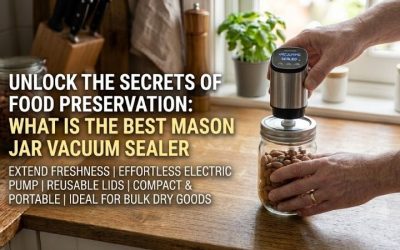
An electric Mason jar vacuum sealer uses a small powered pump to remove air from a compatible glass jar before establishing a vacuum closure. Unlike traditional canning equipment, the device does not apply the controlled thermal processing required to make perishable foods safe for pantry storage.
Most standalone electric models fit directly over compatible Mason jar openings. Depending on the product, adapters may support regular-mouth and wide-mouth jars.
The general operating process involves:
-
Filling a clean, dry jar with suitable food.
-
Positioning a compatible sealing lid.
-
Attaching the electric vacuum sealer.
-
Activating the vacuum pump.
-
Removing the appliance after the sealing cycle.
-
Checking that the lid remains securely attached.
Specific operating procedures vary between manufacturers.
What vacuum sealing does to food inside a jar
Removing air from a Mason jar changes the atmosphere surrounding its contents, which can help reduce certain forms of quality deterioration. This is particularly useful for dry ingredients affected by oxygen exposure, although vacuum packaging cannot eliminate every cause of food spoilage.
Potential quality benefits include:
-
Reduced oxygen exposure.
-
Slower oxidative deterioration of certain ingredients.
-
Convenient organization of dry pantry foods.
-
Reduced exposure to external humidity when the closure remains intact.
-
Reusable glass storage.
However, vacuum sealing does not remove all moisture from food, sterilize ingredients, or destroy harmful bacterial spores.
The original food must already be appropriate for its intended storage conditions.
Foods suitable for electric Mason jar vacuum sealing
Electric jar sealers are most useful when packaging commercially shelf-stable dry ingredients that do not require refrigeration. Their compact operation makes them attractive for households that frequently purchase dry groceries in bulk and want reusable storage containers instead of disposable bags.
Suitable examples include:
-
Dry white rice.
-
Uncooked dried pasta.
-
Dry lentils.
-
Dried beans.
-
Shelf-stable breakfast cereals.
-
Rolled oats.
-
Crackers.
-
Dry tea leaves.
-
Commercially shelf-stable coffee beans.
-
Suitable commercially dried herbs and spices.
Home-dehydrated and freeze-dried foods require appropriate preparation and moisture control before reduced-oxygen storage.
Foods that appear dry on the outside are not necessarily sufficiently dry for safe vacuum packaging.
How traditional canning preserves food
Traditional home canning combines suitable ingredients, correctly prepared jars, and a tested thermal processing method. Unlike simple vacuum packaging, canning uses specific processing conditions to control microorganisms and enzymes that could otherwise cause food deterioration or serious foodborne illness.
Two established home canning methods are boiling-water canning and pressure canning.
The appropriate method depends on food acidity, recipe composition, jar dimensions, processing requirements, and elevation.
Water bath canning for high-acid foods
Boiling-water canning is suitable for specific high-acid or properly acidified foods prepared according to tested recipes. The combination of food acidity and controlled thermal processing allows suitable products to be preserved without relying exclusively on the vacuum created inside the jar.
Common applications include:
-
Many fruit preserves.
-
Tested jam and jelly recipes.
-
Properly acidified pickles.
-
Certain fruit-based sauces.
-
Tomatoes prepared according to tested acidification instructions.
The process requires appropriate canning jars, lids, a suitable canner, and the processing instructions specified by a reliable recipe.
Do not assume all fruit or tomato preparations can be processed using identical times or acidity adjustments.
Changing ingredient proportions can affect preservation safety.
Pressure canning for low-acid foods
Pressure canning allows food to reach temperatures above the normal boiling point of water. This additional thermal capability is essential for safely preserving suitable low-acid foods that could support the growth of dangerous microorganisms when stored in sealed containers at room temperature.
Common applications include tested recipes for:
-
Beef and pork.
-
Chicken and turkey.
-
Green beans.
-
Carrots.
-
Certain vegetable combinations.
-
Approved broth and soup preparations.
Low-acid foods generally have a pH above 4.6 and require pressure canning when intended for shelf-stable home preservation.
Processing requirements vary according to the recipe, jar size, canner type, and elevation.
An ordinary electric Mason jar vacuum sealer cannot perform this function. An electric pressure cooker should not automatically be treated as an approved pressure canner either.
Food safety: The most important difference
Food safety is the decisive factor when comparing electric jar sealing with traditional canning. Although both methods can produce a lid that appears securely attached to the jar, only properly conducted canning provides the validated thermal processing necessary for shelf-stable preservation of suitable wet foods.
Why a vacuum seal does not prove food is safe
A firmly attached Mason jar lid indicates that a pressure difference exists between the inside and outside of the container. It does not demonstrate that the food has received adequate heat treatment or that harmful microorganisms have been destroyed during preparation.
This distinction is particularly important because an electric vacuum sealer can produce a jar that visually resembles a traditionally canned product.
The two jars may look similar while having completely different food safety characteristics.
For example, consider two jars containing homemade chicken broth:
-
One jar has been sealed using an electric vacuum sealer without thermal processing.
-
The other has been processed according to a tested pressure canning recipe.
The first jar still requires appropriate refrigeration or freezing. The second can be suitable for pantry storage if every processing and sealing requirement has been satisfied.
The appearance of the lid alone cannot establish which jar is safe.
Botulism risks and oxygen-free environments
Removing oxygen does not automatically make food safer because some dangerous microorganisms can grow under low-oxygen conditions. Clostridium botulinum is a particularly important concern when improperly preserved low-acid, moisture-rich foods are stored inside sealed containers at room temperature.
Electric vacuum sealing does not provide the heat treatment necessary to control bacterial spores in these foods.
Never use an electric jar vacuum sealer as a substitute for tested canning procedures when preparing shelf-stable versions of:
-
Cooked meat.
-
Homemade soups.
-
Chicken broth.
-
Fresh vegetables.
-
Cooked beans.
-
Homemade sauces.
-
Garlic stored in oil.
Botulinum toxin cannot reliably be identified through appearance, smell, or taste.
Never taste questionable preserved food to determine whether it is safe. If you suspect that food has been improperly preserved, follow appropriate food safety disposal guidance.
Does filling jars with hot food make vacuum sealing safe?
Pouring hot food into a Mason jar before applying an electric vacuum sealer does not create the same preservation conditions as traditional canning. The temperature of freshly cooked food and the formation of a vacuum closure cannot replace a scientifically established processing schedule.
This practice is sometimes promoted as a convenient alternative to boiling-water or pressure canning.
However, it does not establish that sufficient heat has reached every part of the food for the required period.
Hot-packed jars must still undergo the processing method specified by a tested canning recipe when intended for room-temperature storage.
If you do not want to perform traditional canning, refrigerate or freeze the prepared food using suitable containers and recommended handling practices.
Electric Mason jar vacuum sealer vs canning by food type
Choosing the correct preservation method becomes easier when foods are classified according to their moisture content, acidity, and original storage requirements. Dry pantry ingredients and freshly prepared wet foods should not be treated as equivalent simply because they can fit inside the same Mason jar.
| Food type | Electric vacuum sealing for pantry storage | Appropriate alternative |
|---|---|---|
| Dry white rice | Suitable | Ordinary airtight storage |
| Dried pasta | Suitable | Ordinary airtight storage |
| Dry beans | Suitable | Ordinary airtight storage |
| Rolled oats | Suitable | Ordinary airtight storage |
| Dried spices | Suitable | Airtight storage |
| Commercially dried fruit | Depends on moisture and storage instructions | Appropriate dried-food storage |
| Fresh strawberries | Not suitable | Refrigeration, freezing, or tested preservation recipe |
| Homemade jam | Not suitable as a canning substitute | Tested jam canning recipe |
| Tomato sauce | Not suitable | Tested canning recipe or freezing |
| Fresh green beans | Not suitable | Pressure canning or freezing |
| Cooked chicken | Not suitable | Tested pressure canning or cold storage |
| Homemade soup | Not suitable | Approved pressure canning recipe or freezing |
| Cooked rice | Not suitable | Refrigeration or freezing |
The electric vacuum sealer is most useful for foods that are already shelf-stable before packaging.
Canning is appropriate when a scientifically tested preservation process exists for the intended food.
If no approved canning recipe is available, freezing or refrigeration may be the better choice.
Shelf life and food quality comparison
Storage duration depends on the original food, its preparation, the preservation method, and environmental conditions. Neither a strong vacuum nor an intact canning lid independently guarantees unlimited shelf life, making appropriate storage guidance and regular stock rotation important considerations.
How long do vacuum-sealed Mason jar foods last?
Vacuum-sealed dry ingredients may retain their quality longer than equivalent foods repeatedly exposed to surrounding air and humidity. However, the actual improvement varies according to food composition, initial moisture levels, closure performance, storage temperature, and frequency of opening.
There is no universal shelf-life guarantee for electrically vacuum-sealed Mason jars.
For example:
-
Dry rice may respond differently to storage than brown rice containing more natural oils.
-
Coffee beans gradually lose desirable aromatic compounds even when protected from excessive air exposure.
-
Nuts can develop rancid flavors because of their fat content.
-
Dried herbs may lose color and aroma over time.
-
Moisture-sensitive cereals can deteriorate if condensation enters the container.
Follow the original food manufacturer’s storage recommendations and rotate older ingredients first.
Avoid relying on advertisements that promise a fixed number of additional storage years for every food type.
How long does properly canned food last?
Properly home-canned food should be stored under appropriate conditions after processing and seal verification. The National Center for Home Food Preservation recommends planning canning quantities around approximately one year of use for best quality, unless food-specific guidance indicates otherwise.
Suitable storage conditions generally include a clean, cool, dark, and dry location.
Protect jars from:
-
Excessive heat.
-
Direct sunlight.
-
Freezing temperatures.
-
Persistent humidity.
-
Physical impacts.
-
Damage to lids and sealing surfaces.
The one-year recommendation concerns optimal food quality rather than a guarantee that every jar remains safe for that period.
Food safety still depends on correct processing, appropriate storage, and maintenance of the original seal.
Refrigerated storage after electric vacuum sealing
Electric vacuum sealing does not reset the safe storage period of cooked leftovers or other refrigerated ingredients. Although reduced air exposure may help maintain certain quality characteristics, it does not eliminate the microorganisms responsible for foodborne illness or prevent all microbial growth.
USDA guidance recommends consuming most properly refrigerated cooked leftovers within three to four days or freezing them for longer storage.
Keep refrigerated perishable foods at 40°F or below.
For longer storage, maintain frozen foods at 0°F or below and use containers specifically rated for freezer conditions.
Do not assume that vacuum sealing homemade soup or cooked meat makes it safe to refrigerate for several additional weeks.
Equipment requirements and operating costs
Electric Mason jar sealers and traditional canning equipment involve different purchasing and ownership considerations. Comparing their costs requires evaluating the appliance itself, compatible jars and lids, energy requirements, replacement accessories, and the quantity of food you expect to preserve.
Equipment needed for electric Mason jar vacuum sealing
An electric jar sealing system requires relatively little equipment compared with traditional canning. Its compact design is convenient for households with limited kitchen storage, especially when the primary application involves packaging dry ingredients purchased from grocery stores or bulk food suppliers.
Typical equipment includes:
-
Electric Mason jar vacuum sealer.
-
Compatible regular-mouth or wide-mouth adapters.
-
Suitable Mason jars.
-
Compatible sealing lids.
-
Charging cable for rechargeable models.
-
Storage labels.
-
Replacement seals or accessories when required.
Before purchasing an electric model, check whether it supports both common Mason jar opening sizes.
Regular-mouth jars typically have approximately 70 mm openings, while wide-mouth jars use approximately 86 mm openings.
Compatibility should still be confirmed against the specific jar and lid system.
Equipment needed for traditional canning
Traditional canning requires equipment appropriate to the type of food being preserved and the processing instructions established by a tested recipe. This generally involves a larger initial equipment commitment than purchasing a standalone electric Mason jar vacuum sealer for pantry organization.
Typical supplies include:
-
Appropriate boiling-water or pressure canner.
-
Home canning jars.
-
Suitable canning lids and bands.
-
Jar lifter.
-
Canning funnel.
-
Headspace measuring tool.
-
Timer.
-
Tested canning recipes.
Pressure canning equipment may require additional maintenance involving its pressure regulation components, seals, or gauges, depending on the design.
Buy equipment intended for the required canning method rather than selecting an ordinary multicooker based solely on its advertised pressure settings.
Comparing long-term ownership costs
The most economical preservation method depends on what you intend to store rather than which appliance has the lowest initial price. A compact electric sealer may involve fewer equipment expenses, while a canner provides capabilities that simple vacuum packaging cannot reproduce.
| Ownership expense | Electric jar sealer | Traditional canning |
|---|---|---|
| Initial equipment | Generally simpler | More extensive |
| Mason jars | Required | Required |
| Replacement lids | As specified | Required according to lid instructions |
| Energy consumption | Vacuum pump | Heating and processing |
| Maintenance | Seals, adapters, battery | Canner-specific maintenance |
| Preparation time | Generally shorter | Recipe-dependent |
| Wet-food pantry preservation | Not supported | Supported for tested recipes |
An electric jar sealer may offer better purchasing value for households that only want to organize dried groceries.
However, choosing a vacuum sealer instead of a pressure canner does not provide a lower-cost method of safely preserving wet, low-acid foods at room temperature.
Convenience, speed, and everyday usability
Electric jar sealers are designed around quick packaging tasks, whereas traditional canning requires more detailed preparation and processing. Understanding these workflow differences helps buyers determine whether they need convenient pantry organization, seasonal food preservation, or separate equipment for both applications.
Electric jar sealing for everyday kitchen organization
A compact electric sealer is particularly convenient when dry ingredients are opened and closed frequently. Rather than preparing a large batch for preservation, users can package individual pantry ingredients as needed, making the device useful for ordinary grocery organization and household meal planning.
Practical applications include:
-
Repackaging bulk rice purchases.
-
Organizing different varieties of dried beans.
-
Protecting suitable dry ingredients from external humidity.
-
Separating baking ingredients.
-
Maintaining an organized pantry.
The main drawback is that opening a jar releases its vacuum.
Users must reseal the jar whenever they want to restore reduced-oxygen storage.
An ordinary airtight container may be more convenient for ingredients accessed several times each day.
Traditional canning for seasonal food preservation
Traditional canning becomes more valuable when households have large quantities of seasonal produce or want to prepare suitable foods for future pantry storage. Although the process requires more time, it provides a preservation capability that cannot be achieved through simple air extraction alone.
For example, gardeners may use tested canning methods to preserve seasonal vegetables, fruit preserves, or properly acidified tomato products.
The additional preparation and processing effort can be worthwhile when the household intends to consume these foods throughout the following months.
Unlike frequently accessed dry storage jars, properly canned foods are normally processed as individual sealed portions intended to remain unopened until needed.
Which preservation method should you choose?
The correct purchasing decision starts with identifying the foods you want to store and whether they already qualify for room-temperature storage. Vacuum sealing and canning should be evaluated according to their distinct capabilities rather than treated as competing methods that produce equivalent safety outcomes.
Electric Mason jar vacuum sealer vs canning for beginners
Beginners interested primarily in organizing commercially shelf-stable ingredients can start with an electric Mason jar vacuum sealer. Those who want to preserve fresh produce or homemade wet foods for pantry storage should learn tested canning procedures and obtain the equipment appropriate to those recipes.
Choose an electric Mason jar vacuum sealer if you:
-
Regularly purchase dry groceries in bulk.
-
Want to organize rice, pasta, grains, and legumes.
-
Prefer compact kitchen appliances.
-
Already own compatible Mason jars.
-
Want reusable dry-food storage.
-
Do not intend to create shelf-stable wet foods.
Choose traditional canning if you:
-
Grow vegetables or fruit at home.
-
Prepare homemade jams and preserves.
-
Want approved shelf-stable meat or vegetable products.
-
Need seasonal food preservation.
-
Are prepared to follow scientifically tested recipes.
-
Have suitable canning equipment and storage space.
Owning both systems can be useful when your household has both dry-food organization and traditional preservation requirements.
Frequently asked questions
Electric jar sealing raises several important questions because the finished containers can resemble traditionally canned food. Understanding these differences before purchasing equipment helps prevent unsafe storage decisions, unnecessary appliance expenses, and incorrect assumptions about how vacuum packaging preserves ingredients.
Can an electric Mason jar vacuum sealer replace canning?
No. An electric Mason jar vacuum sealer removes air from a compatible jar but does not provide the validated thermal processing required to make suitable perishable foods shelf-stable. It is primarily a packaging tool for appropriate dry ingredients and does not replace traditional canning.
Use tested canning procedures when preserving suitable wet foods for pantry storage.
Can you vacuum seal homemade jam instead of canning it?
Electric vacuum sealing cannot replace the tested heat-processing requirements for shelf-stable homemade jam. A vacuum-sealed jar containing homemade jam should be stored according to the recipe’s refrigeration or freezing instructions unless it has been properly processed through an approved canning method.
Can vacuum-sealed Mason jars contain bacteria?
Yes. Removing air from a jar does not destroy all bacteria or bacterial spores. Certain microorganisms can survive or grow in reduced-oxygen conditions when other environmental factors are suitable, which is why vacuum packaging cannot independently establish the safety of perishable foods.
Conclusion
Electric Mason jar vacuum sealers are practical for organizing shelf-stable dry foods, while traditional canning provides validated preservation methods for suitable wet foods. Choose equipment according to your ingredients and storage goals, and never substitute vacuum sealing for required thermal processing.
More from Amazon
Programs that pair well with the guide above. Offers and eligibility are set by Amazon and may change.
Set up recurring deliveries of everyday items on eligible products. Terms and savings are set by Amazon.
Explore Subscribe & SaveCollect the home and kitchen items you want in one registry that guests can shop from.
Create a wedding registryFree shipping on eligible items, Prime Video and more. Eligible new members can start with a free trial.
Start a Prime free trialAudiobooks and podcasts to listen to on the go. Eligible new members can start with a free trial.
Try Audible freeAs an Amazon Associate we earn from qualifying purchases.