Key takeaways
- Powder-coated steel (14–16 gauge): stiffest, best for gravel and concrete, rusts once the coating chips at seams and bolt holes.
- Galvanized steel: better corrosion resistance than paint, slightly heavier, tends to cost $20–$40 more.
- HDPE poly: never rusts, absorbs impact, lighter by 10–15 lb, less stiff under point loads.
For most yard and garden work, the best wheelbarrow is a 6-cubic-foot single-wheel model with a powder-coated steel tray, a 16-inch pneumatic tire, and hardwood handles — True Temper and Jackson both build this class in the $120–$180 range, and it balances capacity, tipping ease, and price better than anything else. Buy a poly-tray version instead if you mostly move wet compost, mulch, or manure and want something that never rusts, and step up to a dual-wheel or four-wheel cart if you are hauling heavy loads over uneven ground or want to avoid tipping altogether. The rest of this guide breaks down tray materials, wheel configurations, load ratings, and the numbers that decide which one actually fits your yard.
Quick comparison: wheelbarrow types at a glance
| Type / example class | Best for | Tray & capacity | Wheel configuration | Typical rated load | Price range |
|---|---|---|---|---|---|
| Single-wheel steel contractor barrow (True Temper, Jackson) | All-round yard work, tight paths | Powder-coated steel, 6 cu ft | 1 × 16 in pneumatic | ~300 lb | $120–$180 |
| Poly-tray barrow (Marathon, Ames) | Mulch, compost, wet soil | UV-stabilized HDPE, 6 cu ft | 1 × 16 in pneumatic | 250–300 lb | $110–$200 |
| Dual-wheel steel barrow | Heavy loads, slopes, gravel | Steel, 6 cu ft | 2 × 13–16 in pneumatic | 350–500 lb | $150–$260 |
| Budget steel barrow | Occasional light work, small storage | Steel, 4 cu ft | 1 × 14 in pneumatic | ~200 lb | $70–$110 |
| Four-wheel garden cart (Gorilla Carts GOR6PS class) | Hauling without tipping, level ground | Poly, 6 cu ft | 4 × 10–13 in | Up to ~1,200 lb per manufacturer | $150–$350 |
| Convertible cart (Worx Aerocart class) | Small yards, multi-purpose use | Convertible, roughly 3 cu ft | 2 wheels, converts to dolly | Low hundreds of pounds | $150–$220 |
Prices are general market ranges for new units; contractor-grade models with heavier-gauge trays and 4-ply tires sit at the top of each band.
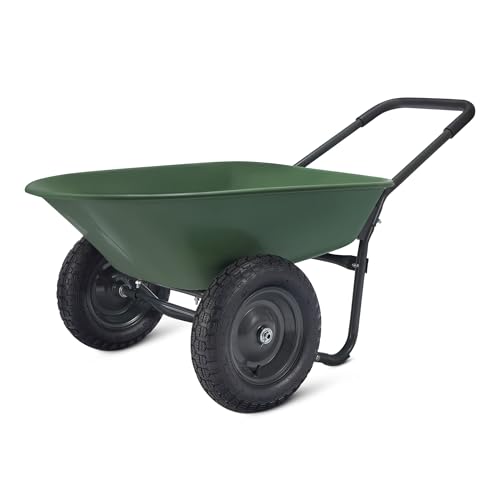
Amazon Basics Garden Wheelbarrow, Heavy Duty, 330 Pounds Capacity, 3.7 Cubic Feet, 26.8W x 53.9D x 27.2H inches, Green, 1-Pack
Included for 'Best Wheelbarrows for Yard and Garden Work' because the listing specifies Heavy Duty and 330 Pounds Capacity, details this guide uses to compare options.
View on Amazon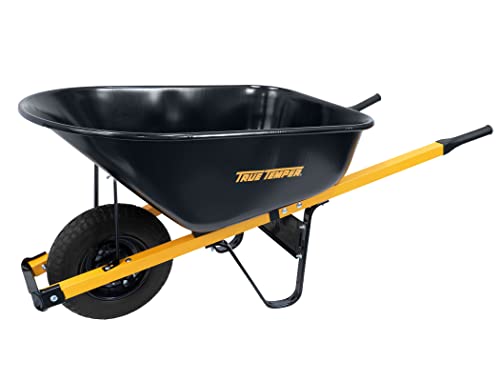
True Temper Steel Wheelbarrow with Never Flat Tire & Steel Handles, 6 Cu. Ft
Included for 'Best Wheelbarrows for Yard and Garden Work' because the listing specifies 6 Cu. Ft, details this guide uses to compare options.
View on Amazon
True Temper Wheelbarrow with Pneumatic Tire and Steel Handles, 6 Cu. Ft
Included for 'Best Wheelbarrows for Yard and Garden Work' because the listing specifies 6 Cu. Ft, details this guide uses to compare options.
View on Amazon
IDZO Upgrade 2 Wheel Wheelbarrow, Yard Cart with Padded Handlebar, 14 Inch
Included for 'Best Wheelbarrows for Yard and Garden Work' because the listing specifies Yard Cart with Padded Handlebar and 14 Inch, details this guide uses to compare options.
View on AmazonBest overall: 6 cu ft single-wheel steel barrow
A 6-cubic-foot steel tray on a single 16-inch pneumatic wheel is the default for a reason. One wheel means the barrow pivots on a dime, so you can turn inside a 3-foot garden row or roll a full load up a ramp without wrestling it. The 300-pound rating covers a heaped load of mulch, compost, or gravel, and steel trays resist the scraping that comes with shoveling in and out all season.
Who it suits: homeowners with a mix of planting, mulching, and small concrete or gravel jobs. Main trade-off: a single wheel is inherently tippy — you balance the load yourself, and a badly loaded barrow on a side slope will go over. Empty weight runs 45–60 lb, so it is not the easiest thing to hang on a wall.
Best for wet and heavy organic loads: poly tray
Polyethylene trays are the better answer for mulch, compost, manure, and wet soil, because they cannot rust and they flex slightly instead of denting when you drop a shovel load into them. A 6-cubic-foot poly barrow typically weighs 35–45 lb — noticeably lighter than steel — and rated capacity is usually 250–300 lb. Marathon and Ames both build this class.
Who it suits: gardeners who mostly move organics and leave the barrow outside. Main trade-off: poly can crack in extreme cold if you slam a frozen load into it, and the tray is not stiff enough for repeated concrete or rubble work. Per manufacturer spec sheets, most poly trays carry a shorter warranty than steel trays on the same frame.
Best for heavy loads and rough ground: dual-wheel
Two wheels take the balancing act out of hauling. Rated loads of 350–500 lb are common, and because the load sits between the wheels you can push rather than carry the weight, which matters on gravel, slopes, and long runs from the driveway to the back bed. The wider track also means it will not tip sideways when you set it down on uneven turf.
Who it suits: anyone moving stone, wet topsoil, or firewood over long or uneven distances. Main trade-off: it will not turn in a tight bed, it is wider than most garden gates at roughly 26–30 inches across the wheels, and it needs more garage space.
Best budget pick: 4 cu ft steel barrow
A 4-cubic-foot steel tray with a 14-inch wheel costs $70–$110 and handles light weeding, potting, and small mulch top-ups. The 200-pound rating is honest — you will run out of volume before you run out of capacity with mulch.
Who it suits: small yards, renters, and anyone who needs a barrow a few times a season. Main trade-off: thinner tray steel, 2-ply tires, and lighter handles mean the frame flexes under repeated heavy use. If you plan more than a dozen real loads a year, the mid-range steel barrow is the cheaper purchase over time.
Best for no-tip hauling: four-wheel garden cart
If tipping is your main frustration, a four-wheel poly cart rated up to about 1,200 pounds by the manufacturer (the Gorilla Carts GOR6PS class) solves it. You pull it, it stays level, and you can load it with bagged goods, potted shrubs, or tools without thinking about balance.
Who it suits: level properties, hauling rather than digging, and anyone with back or balance concerns. Main trade-off: it cannot turn tightly, it does not dump, and on slopes it wants to run away from you — there is no wheel to dig in and brake.
How to choose: the numbers that matter
Tray material
- Powder-coated steel (14–16 gauge): stiffest, best for gravel and concrete, rusts once the coating chips at seams and bolt holes.
- Galvanized steel: better corrosion resistance than paint, slightly heavier, tends to cost $20–$40 more.
- HDPE poly: never rusts, absorbs impact, lighter by 10–15 lb, less stiff under point loads.
Wheel configuration
One wheel for maneuverability, two for stability and heavy loads, four for hauling. Pneumatic tires (typically inflated to about 30 psi maximum per manufacturer markings) ride better over rough ground but go flat; foam-filled and solid rubber tires never do, at the cost of a harsher ride and a little more push effort.
Capacity math: volume fills before weight does
A 6-cubic-foot tray holds 6 cu ft of anything — but weight is what breaks frames. Rough bulk densities: mulch is about 15–22 lb per cu ft, compost about 37–44 lb per cu ft, and moist topsoil about 75–85 lb per cu ft. So a full 6 cu ft tray of mulch weighs 90–130 lb (well under the 300 lb rating), while the same tray heaped with wet topsoil weighs roughly 450–500 lb — well over it. Load soil and gravel to about two-thirds full, mulch to the rim.
For project planning: 1 cubic yard equals 27 cubic feet. Three yards of mulch (81 cu ft) is about 14 trips with a 6 cu ft barrow, or 21 trips with a 4 cu ft model.
Balance, handles, and corrosion
Keep the load centered over the axle — roughly 60 percent of the weight behind the wheel line — and the barrow feels half as heavy. Hardwood handles (ash or hickory, 1.25–1.5 in diameter) damp vibration better than tubular steel and are replaceable for $25–$50 a pair. For corrosion, check that the tray-to-frame bolts are plated, and store the barrow tipped forward so water drains instead of pooling in the tray seam.
Decision matrix
| Your situation | Buy this | Why |
|---|---|---|
| Small yard, a few loads a season, tight storage | 4 cu ft steel, $70–$110 | Light, cheap, fits a narrow shed |
| Mixed planting, mulching, occasional gravel | 6 cu ft steel single-wheel, $120–$180 | Best balance of capacity and maneuverability |
| Mostly compost and mulch, barrow lives outdoors | 6 cu ft poly single-wheel, $110–$200 | No rust, 10–15 lb lighter |
| Stone, wet topsoil, long runs on gravel | Dual-wheel steel, $150–$260 | 350–500 lb rating, no side tipping |
| Level property, hauling not digging, back concerns | 4-wheel cart, $150–$350 | Stays level, up to ~1,200 lb rated |
Durability and ownership: what wears out first
- The tire tube, usually within 1–3 seasons on a pneumatic wheel. Replacement tubes run $8–$15; foam-filled tires cost $25–$40 and end the problem.
- The axle and bearings, which squeal and drag if you never grease them. A few drops of oil at the start and end of each season adds years.
- The tray seam and bolt holes, the first places steel rusts. Touch up chips with enamel before winter.
- Wooden handles, which dry out and split if stored in sun. A coat of linseed oil once a year helps; replacements are cheap and bolt on.
- Poly trays, which fail at the rim and mounting bolts after years of UV exposure rather than wearing through.
Cost per use is the honest way to compare: a $150 barrow used 20 times a year for 10 years is 200 trips, or about $0.75 per trip, plus roughly $10–$20 in consumables over that span. The common mistakes are overloading past the rated capacity, hauling with the load forward of the axle, leaving mortar or concrete to set in the tray, and storing the barrow upright so rainwater sits in the seam.
Frequently Asked Questions
Is a steel or poly wheelbarrow tray better?
Steel is stiffer and better for gravel, rubble, and concrete; poly is lighter, never rusts, and is better for mulch, compost, and wet soil. If your barrow lives outdoors and mostly moves organics, poly will outlast a chipped steel tray. If you shovel abrasive material in and out regularly, steel holds its shape better.
How much weight can a wheelbarrow actually hold?
Most 6-cubic-foot single-wheel models are rated around 300 pounds, dual-wheel versions 350–500 pounds, and four-wheel garden carts up to roughly 1,200 pounds per manufacturer specs. The practical limit is usually lower than the volume suggests: a heaped 6 cu ft load of wet topsoil weighs about 450–500 pounds, so fill soil and gravel to about two-thirds.
Are two-wheel wheelbarrows easier to push?
Yes, for heavy loads on uneven ground — you push rather than balance the weight, and the wider track resists sideways tipping. The trade-off is maneuverability: a dual-wheel barrow is 26–30 inches wide and will not turn inside a narrow garden bed or pass through a tight gate.
How do I stop my wheelbarrow tire from going flat?
Keep pneumatic tires inflated to the pressure marked on the sidewall (commonly around 30 psi maximum) and check them monthly, since low pressure pinches the tube against the rim. If flats are chronic, fit a foam-filled or solid rubber tire for $25–$40 — it never punctures, though the ride is firmer.
Where should I store a wheelbarrow?
Under cover if possible, tipped forward so the tray drains and water does not pool in the seam where rust starts. Store it off the tire if you can, and oil the axle at the start and end of each season. If it must sit outdoors, a poly tray or galvanized steel handles the weather far better than painted steel.
What size wheelbarrow do I need for mulch?
A 6-cubic-foot tray is the practical sweet spot for most yards: a cubic yard of mulch is 27 cubic feet, so three yards is about 14 trips. A 4-cubic-foot barrow turns the same job into 21 trips, which is fine for small beds but tedious for a whole-property refresh.