Key takeaways
- Clean with nonabrasive products: Use dish soap, a soft sponge, and a stainless-steel cleaner when needed. Scrub in the direction of the grain.
- Avoid chlorine bleach and steel wool: They can damage the protective surface or leave rust contamination.
- Do not confuse scratches with structural damage: Fine marks often blend into the brushed finish over time; deep dents and distorted rims are different problems.
- Keep the basin dry after cleaning: Mineral deposits are more visible on dark or highly polished stainless steel.
- Check the mounting system: Undermount sinks depend on properly prepared countertop edges, compatible adhesive, and adequate support. Heavy sinks should not rely on silicone alone.
- Account for depth: A 10-inch bowl may require lowering or reconfiguring the drain trap, especially in older cabinets.
The best undermount kitchen sinks balance usable basin dimensions, 16-gauge stainless steel, manageable corner radii, effective noise insulation, a practical drain position, and enough cabinet clearance for installation.
Quick picks by kitchen situation
| Kitchen situation | Best sink type | Target specifications | Why it fits |
|---|---|---|---|
| Small kitchen or 24-inch cabinet | Single bowl, 25–27 inches wide | 9–10 inch depth, rear drain, R10–R15 corners | Preserves counter space while fitting standard compact bases |
| Most meal-prep kitchens | 30-inch single bowl | Approximately 30 × 18 × 10 inches, 16 gauge | Accommodates sheet pans and large cutting boards without demanding a 36-inch cabinet |
| Frequent batch cooking | 32–33-inch workstation or single bowl | 32–33 × 19–22 × 10 inches, rear-offset drain | Provides more washing room and useful accessories, but requires a wider base cabinet |
| Two-task households | 60/40 or equal double bowl | Approximately 33 × 19–22 inches, 9–10 inch bowls | Separates soaking and rinsing, though each bowl is less useful for oversized cookware |
Best overall: a 30-inch, 16-gauge single bowl
For most kitchens, the strongest all-around choice is a 30-inch undermount stainless-steel sink with a bowl around 30 inches wide, 18 inches front to back, and 10 inches deep. This format offers enough room for a roasting pan or several meal-prep containers while remaining compatible with many 33-inch sink cabinets.

KRAUS Stainless Steel 32 in Undermount Kitchen Sink KWU110-32
Included for 'Best Undermount Kitchen Sinks' as a relevant option in this category; details come from the product listing.
View on Amazon
KRAUS Stainless Steel 33 in 18 Gauge Undermount Kitchen Sink KHU640-33
Included for 'Best Undermount Kitchen Sinks' as a relevant option in this category; details come from the product listing.
View on Amazon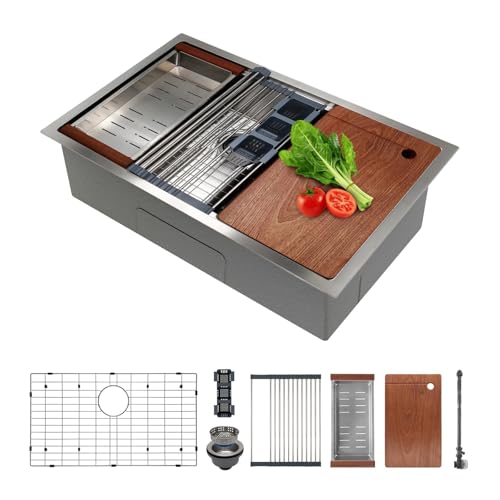
SANYCASA 30 Inch Undermount Kitchen Sink Superior Drain Kitchen Sinks 11 Gauge (3mm) Stainless Steel, Single Bowl Integrated Ledge Multifunctional Workstation Set -
Included for 'Best Undermount Kitchen Sinks' because the listing specifies Single Bowl Integrated Ledge Multifunctional Workstation Set, details this guide uses to compare options.
View on Amazon
Lordear 33 Inch Undermount Kitchen Sink Workstation 33"x19"x10"
Included for 'Best Undermount Kitchen Sinks' as a relevant option in this category; details come from the product listing.
View on AmazonEstablished examples include the Kraus Standart PRO KHU100-30 and the Ruvati RVH7110, both representative of the 30-inch, 16-gauge single-bowl category. Exact accessory packages and cutout dimensions vary by version, so the manufacturer’s installation drawing matters more than the product name.
Why 16 gauge matters
“Gauge” is the thickness designation for the steel; a lower number is thicker. A 16-gauge sink is about 1.5 mm thick, while an 18-gauge sink is about 1.2 mm. The difference does not make a sink indestructible, but thicker steel generally feels less resonant and is less prone to distortion around the rim and drain opening.
Many 18-gauge sinks are perfectly serviceable, particularly in smaller sizes. Pay more for 16 gauge when you use heavy cookware daily, want a quieter basin, or are fitting an expensive stone countertop where replacing the sink later would be disruptive.
Head-to-head comparison of common formats
| Format | Typical outside size | Typical basin depth | Steel thickness | Corner radius | Best use |
|---|---|---|---|---|---|
| Compact single bowl | 25–27 × 18–19 inches | 9–10 inches | 16–18 gauge | R10–R15 | Small kitchens and narrow cabinets |
| Standard single bowl | 30 × 18–19 inches | 9–10 inches | 16 gauge preferred | R10 or tighter | General prep and large cookware |
| Large workstation | 32–33 × 19–22 inches | 10 inches | 16 gauge | R10–R15 | Frequent batch preparation |
| Double bowl | 33 × 19–22 inches | 9–10 inches | 16–18 gauge | R10–R15 | Soak/rinse separation |
Best for tight cabinets: compact single-bowl sinks
A 25- or 27-inch basin is the safer choice when the sink base is 30 inches wide, when plumbing occupies one side of the cabinet, or when you need to retain more countertop for appliances. The trade-off is clear: a compact bowl may not accept a full-size baking sheet flat.
Choose a rear drain if possible. Moving the drain toward the back creates more usable floor area and leaves additional room beneath the bowl for plumbing and a pull-out waste bin. A centered drain is not automatically wrong, but it often competes with the cabinet’s plumbing and reduces storage flexibility.
Best for batch cooking: workstation and large single bowls
A 32- or 33-inch workstation sink is useful for washing produce, draining pasta, and staging a cutting board over the basin. Kraus Kore and Ruvati workstation models are prominent examples of this category. Their included grids, colanders, cutting boards, and ledges can save counter space, but they also add parts to clean and store.
Large sinks need a cabinet that is wide enough not only for the outer dimensions, but also for the mounting rails and clips. A 33-inch sink commonly calls for a 36-inch sink base, although the exact minimum cabinet size depends on the model. Never infer cabinet fit from the nominal sink width alone.
Worked cabinet-fit calculation
Suppose a sink’s installation guide specifies a 33-inch minimum cabinet and your cabinet measures 36 inches wide inside the face-frame area. That leaves approximately 3 inches of total clearance, or 1.5 inches per side before accounting for clips, rails, insulation, and plumbing. If the cabinet is only 33 inches wide externally, its internal opening may be closer to 30–31 inches, making the same sink unsuitable despite the apparently matching label.
Measure the clear interior width at the top, middle, and bottom. Also measure front-to-back depth, the distance from the cabinet top to the plumbing, and the available space behind drawers. Stone and solid-surface countertops usually require a professional fabricator to cut and polish the opening.
Corner radius: cleaning versus appearance
The corner radius describes how sharply the basin floor turns into its walls. A sink with a tight radius, such as R10, looks crisp and maximizes the flat bottom, but its corners need a narrow brush or cloth. A rounder R15–R25 corner is easier to wipe clean and is more forgiving of crumbs and standing water.
For meal prep, R10 is a good compromise if you value rectangular usable space. Choose a larger radius if low-maintenance cleaning matters more than fitting pans tightly into the corners. Check the radius at the lower basin corners, not just the upper rim; manufacturers may describe these areas differently.
Noise insulation: what actually helps
Stainless steel naturally amplifies the impact of running water and cookware. Look for full-coverage or near-full-coverage sound pads on the underside, plus an insulating coating rather than a few small adhesive patches. A thicker 16-gauge bowl reduces vibration, but insulation remains important.
Sink grids also reduce noise and protect the finish from heavy pans. They are useful, but they are not maintenance-free: food particles collect underneath, and rubber feet can trap moisture. Lift the grid regularly, rinse beneath it, and replace damaged feet before metal contacts the basin.
Drain placement and daily usability
A rear drain usually wins for cabinet storage because it moves the trap closer to the back wall. It can also leave more uninterrupted basin floor for dishes. A centered rear drain is easiest to understand; an offset drain may create even more usable space but can complicate the plumbing connection.
Before choosing, open the cabinet doors and identify the garbage disposal, water filter, pull-out bins, and dishwasher hose. A sink that technically fits can still make the cabinet frustrating if the drain outlet collides with a drawer or waste container.
Ownership realities and common mistakes
- Clean with nonabrasive products: Use dish soap, a soft sponge, and a stainless-steel cleaner when needed. Scrub in the direction of the grain.
- Avoid chlorine bleach and steel wool: They can damage the protective surface or leave rust contamination.
- Do not confuse scratches with structural damage: Fine marks often blend into the brushed finish over time; deep dents and distorted rims are different problems.
- Keep the basin dry after cleaning: Mineral deposits are more visible on dark or highly polished stainless steel.
- Check the mounting system: Undermount sinks depend on properly prepared countertop edges, compatible adhesive, and adequate support. Heavy sinks should not rely on silicone alone.
- Account for depth: A 10-inch bowl may require lowering or reconfiguring the drain trap, especially in older cabinets.
How to choose the best undermount kitchen sink
Start with the cabinet, not the countertop opening. Confirm the minimum cabinet size and actual interior clearance, then choose the largest bowl that leaves room for plumbing and storage. For most homes, select a 30-inch single bowl in 16-gauge stainless steel, with a rear drain, sound-dampening pads, and an R10–R15 corner radius. Move to a 32- or 33-inch workstation only when you have a 36-inch cabinet and will use its accessories. Choose a double bowl when separating soaking and rinsing is more valuable than accommodating large cookware.