Key takeaways
- Capacity: Choose at least 500 pounds for regular adult use. Select 600–1,000 pounds when several people will use the bar, when rings or straps will be attached, or when dynamic exercise is permitted.
- Steel: Look for welded structural steel, gusseted brackets, and a durable powder-coated finish. “Heavy duty” without a material thickness or tested capacity is not enough information.
- Fasteners: Wood joists require structural wood fasteners or through-bolts suitable for the design. Concrete requires properly rated anchors. Never mix a concrete mounting kit with wood or vice versa.
- Plates: Wider plates distribute force better and provide more useful bolt locations. Four fasteners per mounting plate is a sensible baseline, but the manufacturer’s design takes priority.
- Dynamic use: Kipping, muscle-ups, and swinging impose greater forces than strict pull-ups. Only use these movements when the bar and ceiling structure are explicitly rated for them.
- Clearance: Leave room for elbows, shoulders, and any attached rings. Check that the bar will not strike the garage door or lighting.
The best ceiling mounted pull up bars for garage gyms are heavy-duty, triangulated steel systems with at least 30 inches of head clearance, a stated capacity of 500 pounds or more, and mounting hardware matched to either wood joists or concrete—not a bar screwed into drywall or thin ceiling material.
Best ceiling-mounted pull-up bars by situation
| Garage-gym situation | Best bar style | Key specifications to target | Typical market range |
|---|---|---|---|
| First home gym on a budget | Fixed straight bar with two steel brackets | 1.25-inch bar, 400–500 lb stated capacity, 12–18 inch drop | $100–$180 |
| Frequent training or multiple users | Triangulated multi-grip ceiling system | 500–1,000 lb capacity, 14-gauge or thicker steel, 18–30 inch drop | $180–$350 |
| Low ceiling or parked-car garage | Compact, low-profile straight bar | 6–10 inch bracket depth, 1.25-inch bar, no unnecessary angled handles | $90–$200 |
| Concrete ceiling | Steel bar with a concrete-rated mounting plate | Four or more anchors per plate, structural concrete approval, 500 lb or greater capacity | $150–$400 before installation |
| Pull-ups plus rings, straps, or a climbing rope | Extended rack-style ceiling mount | 600 lb or greater capacity, reinforced plates, at least 24 inches of clearance around the bar | $250–$500 |
What makes a ceiling-mounted pull-up bar a good buy?
A ceiling bar transfers your bodyweight and movement into the ceiling structure. The bar’s advertised weight limit is only useful when the mount, fasteners, joists, concrete, and installation method can support the same load. A 200-pound user doing a strict pull-up produces a different load from a 200-pound user kipping, swinging, or dropping from the bar.

Kipika 48" Ceiling Mounted Pull Up Bar, Heavy Duty Multi-Grip Chin Up Bar,Mounted Pull Up Bar,Height Adjustable, Ideal for Home Gym and Strength Training
Included for 'Best Ceiling-Mounted Pull-Up Bars for Garage Gyms' because the listing specifies Heavy Duty Multi-Grip Chin Up Bar and Mounted Pull Up Bar, details this guide uses to compare options.
View on Amazon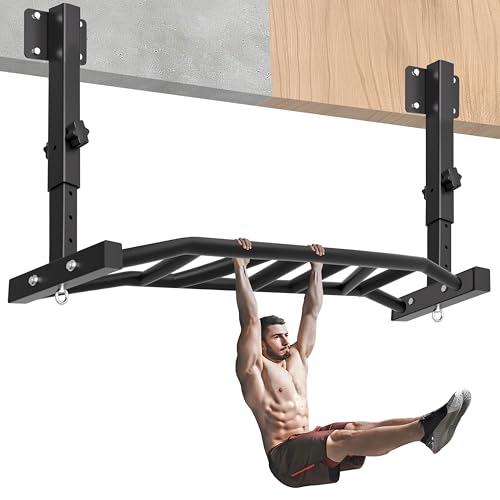
HWOOUSA 48" Joist Mounted Pull Up Bar, 600LBS Heavy Duty Multi Grip Ceiling Mount Chin Up Bar, Ceiling Beam for Home Gym/Garage/Basement with 5-Height Adjustable& Round Anchors, Easy to Install
Included for 'Best Ceiling-Mounted Pull-Up Bars for Garage Gyms' because the listing specifies 600LBS Heavy Duty Multi Grip Ceiling Mount Chin Up Bar and Easy to Install, details this guide uses to compare options.
View on Amazon
HWOOUSA Joist Mounted Pull Up Bar, 650LB Load, Fit 16" Ceiling Beam Spacing
Included for 'Best Ceiling-Mounted Pull-Up Bars for Garage Gyms' because the listing specifies 650LB Load and Fit 16" Ceiling Beam Spacing, details this guide uses to compare options.
View on Amazon
SELEWARE 24" Ceiling Mounted Pull Up Bar, Height Adjustable Chin Up Bar
Included for 'Best Ceiling-Mounted Pull-Up Bars for Garage Gyms' because the listing specifies Height Adjustable Chin Up Bar, details this guide uses to compare options.
View on AmazonFor a garage gym, prioritize a welded steel frame, broad mounting plates, gussets or triangular braces, and a clearly documented fastener pattern. A bar with a 1,000-pound rating is preferable for dynamic movements, but that rating does not make an unsuitable ceiling safe. If the manufacturer excludes kipping, swinging, or inverted exercises, follow that restriction.
Bar diameter and grip
A standard pull-up bar is usually about 1.25 inches in diameter. This is a practical all-purpose size for most adults and works well with chalk. Thicker 1.5-inch bars increase grip demand and can be useful for advanced grip training, but they may make high-repetition work harder.
Multi-grip bars can provide neutral, angled, and wide-grip positions. Neutral handles are often more comfortable for people who dislike a fully pronated grip, while a straight bar is simpler, easier to clean, and less likely to interfere with overhead storage. Foam grips feel comfortable initially but can tear, absorb sweat, and conceal corrosion; knurled or powder-coated steel generally has better long-term ownership characteristics.
Ceiling-clearance requirements: measure before buying
Measure from the finished garage floor to the ceiling, then subtract the bar’s drop and the space needed above your head. For strict pull-ups, aim for at least 12 inches between the top of your head and the ceiling or mount. For kipping or toes-to-bar movements, 24 inches or more is a safer planning target, although the required space varies by athlete and exercise.
Use this calculation:
Usable headroom = ceiling height − mounting drop − user height − movement allowance.
For example, a 96-inch garage ceiling with an 18-inch drop and a 72-inch-tall user leaves 6 inches above the head at full standing height. That may work for controlled pull-ups if the bar is used with bent knees, but it is too tight for comfortable dynamic work. A 12-inch drop would leave 12 inches instead, while a low-profile bar may be the better choice.
Also check the garage door track, opener, lights, storage racks, and the raised door itself. A bar can fit under a closed door yet obstruct the door when it opens. Mark the bar’s footprint with painter’s tape and move the door through its full travel before drilling.
Wood joists versus concrete ceilings
Mounting to wood joists
Wood mounting is usually the simplest option when the bar can be centered directly under structural joists. Fasten through the ceiling finish and into the middle of the joist, not merely into drywall, paneling, or a thin furring strip. Use the bolt diameter and embedment specified by the bar manufacturer; do not substitute short wood screws because they are convenient.
Many garage ceilings have joists spaced 16 or 24 inches on center, while a bar’s mounting plates may use a different spacing. If the plates do not align with two or more structural members, install an appropriately sized structural header or blocking system. That work may require opening the ceiling and should be designed so the added lumber transfers force into the joists rather than hanging from the ceiling finish.
Before installation, inspect for split, water-damaged, twisted, or modified joists. Avoid drilling near large holes, plumbing, electrical wiring, and existing notches. When the framing is uncertain, have a qualified contractor verify it.
Mounting to concrete
Concrete requires anchors designed for structural concrete, such as a suitable mechanical expansion anchor or adhesive anchoring system selected for the slab’s condition. The anchor diameter, embedment depth, edge distance, spacing, and installation torque all matter. A generic sleeve anchor may not be an acceptable substitute for the hardware specified with the bar.
Do not assume a garage ceiling is solid concrete. Some buildings use precast panels, hollow-core slabs, lightweight concrete, or plaster over framing. Drilling into prestressed or post-tensioned concrete can be dangerous. Confirm the ceiling construction and scan for embedded cables, conduit, and reinforcement before drilling. For uncertain slabs, use a qualified installer rather than guessing.
Capacity and hardware checklist
- Capacity: Choose at least 500 pounds for regular adult use. Select 600–1,000 pounds when several people will use the bar, when rings or straps will be attached, or when dynamic exercise is permitted.
- Steel: Look for welded structural steel, gusseted brackets, and a durable powder-coated finish. “Heavy duty” without a material thickness or tested capacity is not enough information.
- Fasteners: Wood joists require structural wood fasteners or through-bolts suitable for the design. Concrete requires properly rated anchors. Never mix a concrete mounting kit with wood or vice versa.
- Plates: Wider plates distribute force better and provide more useful bolt locations. Four fasteners per mounting plate is a sensible baseline, but the manufacturer’s design takes priority.
- Dynamic use: Kipping, muscle-ups, and swinging impose greater forces than strict pull-ups. Only use these movements when the bar and ceiling structure are explicitly rated for them.
- Clearance: Leave room for elbows, shoulders, and any attached rings. Check that the bar will not strike the garage door or lighting.
Fixed straight bar or multi-grip system?
Choose a fixed straight bar if you want the lowest profile, the easiest cleaning, and a predictable grip. It is also the better choice when the garage doubles as parking or storage space. A 1.25-inch straight bar at a comfortable shoulder-width position covers the majority of basic pull-up, chin-up, and hanging exercises.
Choose a multi-grip system if two or more people train regularly or you want neutral-grip options without adding a separate attachment. The trade-off is greater depth, more welds and handles to inspect, and a larger area that may conflict with a garage door or overhead storage. Angled handles can also make the system feel more crowded for wide users.
If you plan to hang gymnastic rings, suspension straps, or a rope, select a system with a deliberately reinforced center or dedicated attachment points. Do not hang accessories from a decorative handle that was designed only for hand placement.
Installation and inspection steps
- Map the ceiling: Locate joists or verify concrete, then mark the garage door’s full travel and the intended exercise zone.
- Confirm dimensions: Compare the bar width, drop, plate spacing, and your available headroom. Account for flooring thickness if rubber mats will be installed later.
- Check the hardware: Match every fastener to the substrate and follow the supplied hole diameter and torque specifications.
- Install squarely: Use a level and tighten the mounting points evenly. A tilted bar can create uneven loading and an uncomfortable grip.
- Load gradually: Apply a controlled partial load first, then test with strict dead hangs. Stop if the ceiling flexes, the mount shifts, or fasteners move.
- Recheck: Inspect all bolts after the first few sessions and again monthly during frequent use.
Durability and ownership realities
Powder coating commonly wears first where hands, rings, or straps contact the steel. Surface wear is cosmetic unless rust develops; wipe sweat and chalk from the bar and touch up exposed steel with an appropriate coating. Foam and rubber grips can crack or become slippery before the metal frame shows any problem.
Inspect welds for visible cracking, mounting plates for bending, and wood for crushing or splitting around the bolts. On concrete, look for anchor movement or new cracks around the mounting points. Retightening is not a cure for a damaged substrate. Remove the bar from service if it shifts, creaks under a controlled hang, or develops structural damage.
Bottom line
For most garage gyms, the best choice is a fixed or multi-grip steel bar with a 500-pound-or-greater rating, a 12–18-inch drop, a 1.25-inch primary bar, and mounting plates that align with verified structural joists. Select a low-profile model for limited headroom, a triangulated system for frequent or dynamic use, and a concrete-specific anchor package when mounting overhead to a slab. The safest purchase is the one whose dimensions, hardware, substrate requirements, and movement limits match your actual garage—not simply the bar with the largest advertised capacity.