Key takeaways
- Table of Contents 4 sections 9 min read 1 How to Choose a Sausage Stuffer 1.1 Batch Capacity and Canister Dimensions 1.2 Gear Ratio and Drive Speed Mechanics 1.3 Cylinder Construction and Food-Safe Materials 1.4 Piston Air Release Valves and…
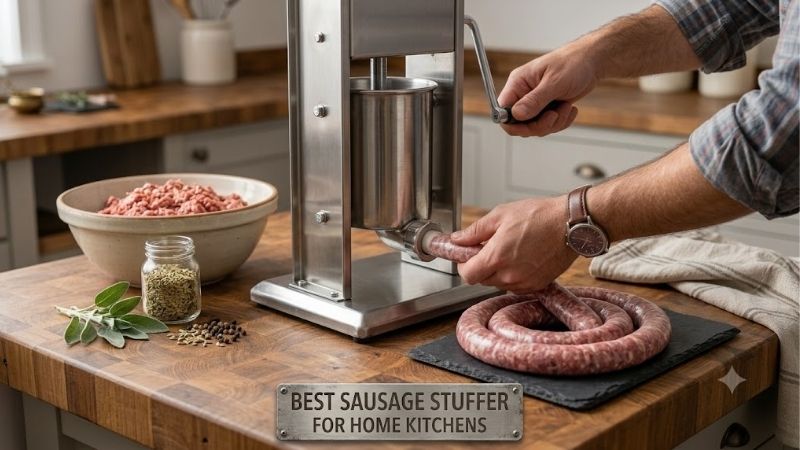
Best sausage stuffer for home kitchens options help home cooks turn seasoned ground meat into uniform snack sticks, bratwursts, and breakfast links without air pockets. Choosing dedicated stuffers eliminates jammed grinders and blown casings. This comprehensive guide reviews tested gear to elevate your home charcuterie routine.
How to Choose a Sausage Stuffer
Selecting the best sausage stuffer for home kitchens requires matching cylinder capacity, drive mechanism, and frame rigidity to your processing volume. Upgrading from multi-purpose meat grinders to dedicated vertical cylinders streamlines sausage making. Focus on durable components that simplify post-cooking cleanup routines.
Batch Capacity and Canister Dimensions
Small home processing jobs require canisters that match typical ground meat purchasing amounts without requiring constant reloading mid-batch. Compact five to seven pound cylinders easily accommodate standard family recipes without occupying excess counter area. Selecting oversized ten pound stuffers often forces cooks to work with half-empty cylinders, creating unnecessary air gaps during extrusion.
Evaluating counter clearance before buying prevents storage headaches in standard kitchen cabinets. Vertical models save horizontal workspace, while motorized hub attachments eliminate base footprints entirely. KitchenAid Sausage Stuffer Attachment KSMSSA fits compact drawers, while standalone LEM Products 5 Lb, Hakka 7 Lb, and VEVOR 7 Lb units handle full five to seven pound batches efficiently.
Gear Ratio and Drive Speed Mechanics
Manual gear systems determine how much physical force is required to push dense sausage emulsion through narrow stuffing funnels. Dual-speed configurations feature a fast gear for rapid piston retraction during reloading and a slow gear for controlled casing filling. Single-speed setups offer simple mechanical reliability but demand steady arm strength during heavy usage.
Smooth gear engagement prevents jerky piston movement that tears fragile collagen or natural hog casings during filling operations. Solid metal bevel gears maintain precise alignment under high pressure, whereas plastic drive gears can flex under load. Hakka 7 Lb and VEVOR 7 Lb feature dual-speed steel gears, whereas LEM Products 5 Lb uses direct drive torque.
Cylinder Construction and Food-Safe Materials
Canister material directly impacts food safety, corrosion resistance, and total appliance longevity over years of seasonal processing. Stainless steel cylinders withstand acidic marinades, harsh sanitizing chemicals, and frequent dishwasher cycles without pitting or rusting. Sturdy metal frames also keep internal drive shafts aligned when pushing chilled beef or pork.
High-impact food-grade plastics offer lightweight handling and easy visual monitoring during low-volume filling sessions. However, heavy-duty metal canisters prevent cylinder flex when compacting stiff snack stick mixtures through thin nozzles. Stainless models like LEM Products 5 Lb, Hakka 7 Lb, and VEVOR 7 Lb deliver commercial durability, while plastic builds like KitchenAid Sausage Stuffer Attachment KSMSSA reduce unit weight.
Piston Air Release Valves and Seals
Air pockets inside stuffed casings cause uneven cooking, rapid oxidation, and unsightly bursts along finished sausage links. Quality pistons incorporate spring-loaded air release valves that bleed trapped air before meat passes into the stuffing tube. Durable silicone gaskets create airtight cylinder seals that force meat downward without blowback.
Proper valve function prevents grease pockets and maintains uniform density across every foot of stuffed casing. Removable piston gaskets allow thorough cleaning behind rubber seals where raw meat debris typically collects. Vertical units like LEM Products 5 Lb, Hakka 7 Lb, and VEVOR 7 Lb integrate automatic air valves, whereas KitchenAid Sausage Stuffer Attachment KSMSSA requires manual tray packing.
Top Picks
Finding the best sausage stuffer for home kitchens depends on balancing counter footprint, gear ratios, and batch output requirements. The following curated models deliver consistent casing pressure, effortless crank movement, and food-grade safety. Compare key specifications to select the ideal machine for your pantry layout.
| Product | Best For | Key Spec | Watch Out For |
| LEM Products 5 Lb Stainless Steel Vertical Sausage Stuffer | Best Overall | 5 lb capacity, carbon steel gears, air release piston | Single crank speed requires steady effort |
| Hakka 7 Lb Stainless Steel Vertical Sausage Stuffer | Best Value | 7 lb (3L) capacity, 2-speed metal gears, 4 tube sizes | Base needs firm clamping on smooth counters |
| KitchenAid Sausage Stuffer Attachment KSMSSA | Best Space-Saver | Stand mixer powered, 2 tube sizes, plastic body | Requires separate food grinder attachment hub |
| VEVOR 7 Lb Vertical Sausage Stuffer | Best Heavy-Duty Budget | 7 lb capacity, dual speed drive, stainless frame | Heavier unit weight demands dedicated shelf space |
LEM Products 5 Lb Stainless Steel Vertical Sausage Stuffer
LEM Products 5 Lb Vertical Stuffer provides exceptional durability and smooth mechanical operation for home charcuterie enthusiasts. This unit features a removable stainless steel cylinder that simplifies loading ground meat and thorough post-use washing. Carbon steel gears deliver dependable torque, pushing dense snack stick mixtures without slipping or bending drive shafts.
A built-in air release valve on the piston prevents air pockets, ensuring continuous, tight link filling across every batch. The sturdy base clamps securely to table edges, holding the machine firm while turning the ergonomic hand crank. This reliable five-pound stuffer is perfect for home cooks making regular batches of bratwursts, kielbasa, and breakfast links.
Hakka 7 Lb Stainless Steel Vertical Sausage Stuffer
Hakka 7 Lb Vertical Stuffer offers commercial-grade performance at an accessible price point for budget-conscious home processors. Featuring a full stainless steel body and cylinder, this three-liter machine resists rust and sanitizes easily after long processing days. Dual-speed bevel gears allow quick piston cranking when reloading meat and precise speed control during casing filling.
Four included stainless steel stuffing tubes accommodate various casing sizes ranging from thin sheep casings to thick summer sausage casings. The resin-damped hand crank minimizes arm fatigue during continuous seven-pound processing sessions. While base stability requires a level work surface, this versatile model delivers outstanding value for homemade link production.
KitchenAid Sausage Stuffer Attachment KSMSSA
KitchenAid Sausage Stuffer Attachment KSMSSA turns existing stand mixers into convenient sausage stuffing stations without adding heavy appliances. Utilizing the power hub of the stand mixer, this compact plastic attachment handles ground meat extrusion automatically. The package includes two nozzle sizes, enabling effortless filling of small breakfast links and large dinner sausages alike.
By using the mixer motor to drive the meat screw, home cooks free up both hands to guide and shape incoming casings smoothly. The food-grade plastic components wash quickly in warm soapy water and store neatly inside small kitchen drawers. It is an ideal space-saving choice for casual weekend cooks who already own a compatible mixer base.
VEVOR 7 Lb Vertical Sausage Stuffer
VEVOR 7 Lb Vertical Stuffer delivers robust stainless steel construction built to handle frequent, heavy-duty home meat processing projects. Its two-speed manual transmission lets users switch between high-speed piston movement for fast reloads and low-speed gear control for delicate stuffing tasks. The ergonomic handle turns smoothly, reducing physical exertion when extruding cold meat emulsions.
Four stainless steel stuffing funnels provide excellent versatility for snack sticks, Italian sausages, and large salami casings. All food-contact components detach swiftly, making sanitization simple and meeting hygienic food prep standards. Although its solid metal frame adds weight, this durable stuffer provides professional-grade reliability for home kitchens.
Frequently Asked Questions
Answering common user questions about the best sausage stuffer for home kitchens clarifies essential operational steps and maintenance guidelines. Proper cleaning protocols, casing preparation techniques, and mixture lubrication ensure trouble-free link production. Review these practical expert tips before starting your next batch.
Why should I use a dedicated sausage stuffer instead of a grinder attachment?
Dedicated vertical stuffers use direct piston pressure to push ground meat smoothly into casings without re-grinding or smearing internal fat. Meat grinders generate friction and heat during extrusion, turning cold meat fat into liquid grease that ruins sausage texture. Separate stuffers preserve lean-to-fat grain, yielding tender, juicy sausages every time.
Using dedicated stuffers also eliminates air pockets because piston valves vent trapped air before meat enters the casing nozzle. Grinder attachments continuously trap air inside auger flutes, causing frequent casing bursts and loose link density. Investing in dedicated piston equipment guarantees professional link structure while saving prep time during large processing runs.
How do I stop sausage casings from bursting during the stuffing process?
Preventing casing bursts requires controlling emulsion temperature, thread tension, and casing moisture before starting the extrusion crank. Soaking natural hog or sheep casings in warm water softens salts and restores elasticity, allowing material to expand smoothly. Keeping meat mixture chilled near thirty-two degrees Fahrenheit ensures fat remains firm, reducing internal barrel friction.
Maintaining a steady crank rhythm while allowing stuffed casing to slide off the funnel at its natural pace prevents overfilling. Trapped air pockets should be pricked immediately with a sterile sausage pricker to release pressure before twisting links. Adjusting piston crank speed according to casing diameter prevents sudden pressure spikes that rupture delicate skins.
What size stuffing tube should I use for different sausage types?
Selecting correct stuffing tube diameters ensures meat flows freely without tearing casings or leaving excessive empty voids inside links. Narrow three-eighths inch nozzles suit slender sheep casings used for breakfast links and snack sticks. Medium five-eighths inch tubes handle standard hog casings for bratwursts, Italian sausages, and polish kielbasa links.
Larger three-quarter inch and one-inch funnels fit wide collagen or fibrous casings destined for summer sausages and salami rolls. Matching tube outer diameter to casing inner diameter allows smooth sliding without snagging during high-speed extrusion. Keeping multiple tube sizes on hand equips home processors to tackle diverse charcuterie recipes easily.
How do I clean and maintain a vertical manual sausage stuffer?
Cleaning a vertical stuffer begins with completely disassembling the stainless steel cylinder, piston assembly, silicone gasket, and stuffing nozzles. Wash all food-contact parts in hot, soapy water using non-abrasive sponges to remove greasy meat residues. Pay close attention to the piston air release valve and gasket groove where raw juices collect.
Dry all metal components thoroughly before storage to prevent water spots and preserve gear lubrication over inactive winter months. Applying food-grade mineral oil to carbon steel gears, drive screws, and cylinder walls prevents corrosion and ensures smooth mechanical action. Regular maintenance preserves equipment hygiene and extends operational life for years of home sausage making.
Final Thoughts
Investing in the best sausage stuffer for home kitchens transforms raw ground meats into masterfully stuffed snack sticks, summer sausages, and dinner links. Selecting durable stainless steel canisters or convenient mixer hubs ensures hassle-free processing. Upgrade your culinary setup today to enjoy consistent custom sausages.