
Key takeaways
- A vacuum-pressure number is listed without pump type, cycle time, or duty-cycle information.
- The product is called commercial but has no stated maximum bag width or recommended daily usage.
- The listing does not identify replacement gaskets, heating strips, or compatible bags.
- “Stainless steel” describes only a thin exterior panel, with no information about the chassis or lid hinge.
- The machine claims to handle liquids but is an external suction model with no pulse mode, drip tray, or clear liquid-use instructions.
- The warranty excludes commercial use, despite commercial branding in the product name.
- The listed dimensions omit the open-lid height or the clearance needed for ventilation.
What's inside
- Decide These 3 Things First
- Size: Match the Seal Bar and Chamber to Your Bags
- Material and Construction: Look Beyond “Stainless Steel”
- Construction and Pump Type: External or Chamber?
- Comfort and Performance: Controls, Seals, and Duty Cycle
- Price Tiers: What Your Budget Should Buy
- Warranty and Service: Confirm What Is Actually Covered
- Delivery and Assembly: Plan for the Whole Purchase
- Spec Checklist
- Red Flags
- FAQ
Buying a commercial vacuum sealer by suction strength alone is an expensive mistake. A listing may advertise 95 kPa of vacuum, yet the machine may have a narrow seal bar, a small pump, awkward controls, or a duty cycle that is unsuitable for repeated packaging. The reverse can also happen: a compact machine with a lower headline number may be easier to use and better suited to a home cook, caterer, or small food business.
- Decide These 3 Things First
- Size: Match the Seal Bar and Chamber to Your Bags
- Material and Construction: Look Beyond “Stainless Steel”
- Construction and Pump Type: External or Chamber?
- Comfort and Performance: Controls, Seals, and Duty Cycle
- Price Tiers: What Your Budget Should Buy
- Warranty and Service: Confirm What Is Actually Covered
- Delivery and Assembly: Plan for the Whole Purchase
- Spec Checklist
- Red Flags
- FAQ
The right choice depends on what you seal, how often you seal it, how much counter space you have, and whether you need to package liquids. This guide explains what specs to look for in commercial vacuum sealers, with practical benchmarks for choosing among external suction models and chamber machines.
As an Amazon Associate we earn from qualifying purchases at no extra cost to you. Product prices and availability are accurate as of the date shown and are subject to change.


Decide These 3 Things First
- What will you seal? Dry foods, meat, cheese, and leftovers work with most external sealers. Soups, marinades, sauces, and other liquids are better handled by a chamber vacuum sealer.
- How many bags per session? Occasional household use does not require the same pump, cooling system, or seal-bar width as a restaurant producing dozens or hundreds of packages.
- What is your bag size? A 12-inch seal bar accommodates common 8- and 11-inch bags, while a 16-inch bar is useful for larger portions and commercial prep. Chamber dimensions also limit the size and height of each package.
Size: Match the Seal Bar and Chamber to Your Bags
Seal-bar width is one of the most important specifications. A 10- or 12-inch bar is adequate for most household storage and small-batch prep. It generally works with bags up to about 11 or 12 inches wide, depending on the manufacturer’s stated maximum. A 16-inch bar gives you more flexibility for bulk cuts, large portions, and food-service packaging.
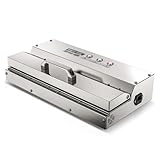
External suction machines are often about 14 to 21 inches wide, 6 to 16 inches deep, and 3 to 8 inches tall. Check the depth carefully if the sealer will sit beneath cabinets. A 16-inch model can be more than 20 inches wide once the lid or bag is positioned, so measure the complete working area rather than the product box alone.
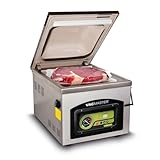
Chamber sealers are substantially larger. A compact chamber model may measure roughly 14 to 20 inches wide, 18 to 24 inches deep, and 10 to 16 inches tall. Chamber size matters more than seal-bar length because the entire filled bag must fit inside the chamber. An 8.5-quart chamber is suitable for many household portions, but a larger commercial chamber is more practical for tall containers or repeated large batches.
Material and Construction: Look Beyond “Stainless Steel”
Stainless steel is useful for a commercial appliance because it resists staining, wipes clean, and tolerates frequent handling. Look for a stainless-steel body or lid, but distinguish between a stainless exterior panel and a fully stainless construction. A plastic base with a stainless-colored cover is not equivalent to a rigid metal chassis.
For frequent use, inspect the hinge, lid, latch, and seal-bar assembly. A heavy lid should close evenly without flexing. The gasket should be replaceable and should sit firmly in its channel. Ask whether the heating wire, Teflon tape, and lid gasket are available as replacement parts.
Food-contact areas should be smooth, with minimal seams or recesses where drips can collect. Chamber models should have a clear, robust lid that lets you monitor the bag without repeatedly interrupting the cycle. A removable drip tray is especially useful on external suction machines.
Construction and Pump Type: External or Chamber?
External suction sealers draw air through a textured or embossed bag. They are usually less expensive, lighter, and easier to store. They are a good fit for dry foods and occasional to moderate use, but liquids can travel toward the pump before the seal is complete. Some models include a pulse mode or liquid-catching channel, but these features do not make every external machine suitable for sealing soup or marinade.
Chamber sealers remove air from the entire chamber, so the pressure inside and outside the bag equalizes before sealing. This makes them much better for liquids, soft foods, and sous vide preparation. They require smooth chamber bags rather than textured external-sealer bags, which changes the ongoing supply cost.
For pump specifications, look for the pump type and duty rating, not just vacuum pressure. Oil-lubricated pumps are common in heavier chamber machines and can offer strong, consistent operation, but they need maintenance and a level installation surface. A 1/2-horsepower oil pump, such as the type found in larger commercial units, is a meaningful heavy-duty specification. Smaller dry pumps are simpler and often sufficient for low-volume use.
A stated vacuum level around 90 to 95 kPa is common in consumer-oriented listings. Treat that figure as a comparison point, not proof of faster or better packaging. Cycle time, pump capacity, bag fit, seal consistency, and cooling time determine real productivity.
Comfort and Performance: Controls, Seals, and Duty Cycle
Useful controls include adjustable vacuum time, adjustable sealing time, pulse mode, manual stop, and a dedicated seal-only function. Automatic programs are convenient, but they should not replace manual control when packaging delicate foods or liquids.
For ordinary food storage, a 2.5- to 3.5-millimeter seal is a practical target. Wider seals can provide more tolerance against small wrinkles or moisture, although the correct width depends on the bag material and machine design. A double-seal option is valuable for long storage, liquids, or foods with sharp edges.
Look for a stated cycle time of roughly 20 to 40 seconds on an external model, including vacuum and sealing, though actual time varies with bag size and contents. More important for a busy kitchen is the recommended duty cycle. A machine rated for 20 to 30 consecutive seals is more suitable for batch work than one that requires a long cool-down after every few bags.
Comfort features matter when the machine is used repeatedly. An easy-lock handle, clear lid, non-slip feet, an accessible cutter, and controls that can be operated without excessive force reduce fatigue. A 400-watt external unit may provide more heating and pump capacity than a small countertop model, but wattage alone does not establish overall performance.
Price Tiers: What Your Budget Should Buy
Budget: about $60 to $150. Expect an external suction sealer, usually with a 10- to 12-inch bar, plastic or mixed construction, basic automatic controls, and a modest duty cycle. A listed 95 kPa 10-in-1 model priced around $79.99 illustrates this category. It can be a sensible choice for leftovers, freezer portions, and occasional meal preparation, but verify replacement parts and cooling requirements.
Midrange: about $250 to $550. This tier may include stronger external machines with 14- to 16-inch bars, stainless-steel construction, double sealing, more substantial pumps, and better controls. A 16-inch, 400-watt model priced around $429.99 fits this general category. Compact chamber machines can also appear in this range; a small 8.5-quart chamber model around $424.10 may be attractive if liquid handling is your priority.
Premium: about $900 to $1,500 or more. These machines are designed for demanding use, with larger chambers, heavier pumps, stronger lids, serviceable components, and higher throughput. A 1/2-horsepower oil-pump chamber sealer priced around $1,249 represents the type of investment appropriate for serious food preparation or small commercial production. Account for oil, replacement parts, bags, and the space required for installation.
Warranty and Service: Confirm What Is Actually Covered
Look for at least a one-year warranty on the complete machine, with separate coverage details for the pump, heating element, electronics, and gasket. A longer warranty is useful only if the company provides a real service process and replacement parts.
Before buying, confirm whether shipping is covered for a warranty repair, how quickly parts are normally supplied, and whether the warranty excludes commercial use. Some products marketed as “commercial” are intended for light-duty household use and may have limitations on continuous operation.
Replacement heating strips, Teflon tape, gaskets, fuses, oil, and pump components should be identifiable and reasonably priced. If a worn seal requires replacing the entire lid assembly, long-term ownership costs can rise quickly.
Delivery and Assembly: Plan for the Whole Purchase
Small external sealers commonly weigh about 5 to 15 pounds and can be unpacked and used immediately. Larger stainless models may weigh 20 to 40 pounds. Chamber machines often weigh 50 to 100 pounds or more, especially those with oil pumps and metal chambers.
Check whether the machine arrives fully assembled, whether the pump requires oil, and whether the unit must sit level before use. A chamber model may need two people to position safely. Allow several inches of clearance around ventilation areas and enough front space to open the lid fully.
Also budget for bags. External machines use textured rolls or bags; chamber machines generally use smooth pouches. Choose a seller that stocks the correct size, thickness, and material. A low machine price is less attractive if compatible bags are difficult to source.
Spec Checklist
| Spec | Budget | Mid | Premium |
|---|---|---|---|
| Typical price | $60–$150 | $250–$550 | $900–$1,500+ |
| Machine type | External suction | Heavy-duty external or compact chamber | Large chamber |
| Seal-bar width | 10–12 inches | 12–16 inches | 12–16 inches or larger chamber opening |
| Seal width | About 2.5–3 mm | About 3–4 mm; double seal preferred | About 3–5 mm; adjustable cycle |
| Power | Approximately 100–250 watts | Approximately 250–500 watts | 400 watts or more, or a rated commercial pump |
| Controls | Automatic vacuum and seal | Pulse, manual stop, adjustable seal | Programmable vacuum and sealing cycles |
| Construction | Plastic or mixed materials | Metal chassis or stainless exterior | Heavy-gauge stainless construction |
| Best use | Occasional dry-food storage | Frequent household or light food-service use | Liquids, sous vide, and high-volume packaging |
Red Flags
- A vacuum-pressure number is listed without pump type, cycle time, or duty-cycle information.
- The product is called commercial but has no stated maximum bag width or recommended daily usage.
- The listing does not identify replacement gaskets, heating strips, or compatible bags.
- “Stainless steel” describes only a thin exterior panel, with no information about the chassis or lid hinge.
- The machine claims to handle liquids but is an external suction model with no pulse mode, drip tray, or clear liquid-use instructions.
- The warranty excludes commercial use, despite commercial branding in the product name.
- The listed dimensions omit the open-lid height or the clearance needed for ventilation.
FAQ
Is 95 kPa enough for a commercial vacuum sealer?
It can be enough for many dry-food applications, but 95 kPa should not be the only buying criterion. Compare pump design, cycle time, seal width, duty cycle, bag compatibility, and warranty. A chamber machine may be the better choice for liquids even if its marketing emphasizes different specifications.
Do I need a chamber vacuum sealer?
Choose a chamber model if you regularly seal soups, sauces, marinades, wet meat, or soft foods. For dry ingredients, frozen portions, cheese, and occasional storage, an external suction model is usually simpler and less expensive.
What seal-bar size is best for home use?
A 10- or 12-inch bar handles most household bags and takes up less space. Choose a 16-inch bar if you package large cuts, wide portions, or multiple smaller bags across a broad roll. Measure your counter before selecting a wider machine.
Are expensive vacuum sealers worth it?
They can be worth the cost when you need liquid handling, repeated cycles, durable construction, or serviceable parts. If you seal only a few dry-food bags each week, a $60 to $150 external model may provide better value. Match the pump, chamber, and duty cycle to your workload instead of paying for specifications you will not use.


