Key takeaways
- Blade: 10-inch diameter, standard 5/8-inch arbor — the most widely stocked blade size in North America
- Motor: 15 amp at 120 volts, which works out to roughly 1,800 watts of input power at full load
- Rip capacity: mid-20-inch class to the right of the blade
- Bevel: adjustable to 45 degrees for trim and chamfer work
- Stand: folding stand included, so the saw collapses for storage
- Table: aluminum top, which resists rust in humid garages better than cast iron but scratches more easily
Best overall: the SKIL 15 Amp 10-Inch Jobsite Table Saw with Folding Stand (TS6307-00) is the strongest Black Friday table saw deal for most home workshops, because it pairs a full 10-inch blade and a 15-amp motor with a folding stand in a single mid-range purchase — the combination that covers ripping plywood, crosscutting dimensional lumber, and beveling trim without a second trip to the store. If your budget is tight and your stock is small, the ExploreHorizon 8-Inch jobsite saw is the value pick that still cuts real lumber. If you break down full 4×8 sheets and want the widest rip capacity in this roundup, the DEWALT 10-Inch with Rolling Stand is the premium choice, and the Evolution R10TS is the one to look at if dado stacks matter to you. Mini and desktop saws are a genuinely separate category: they are precision craft tools for model work, inlay, and small parts, not substitutes for a jobsite saw. Below, blade size, cutting capacity, motor power, portability, safety features, and storage needs are broken down in order, then matched to ten saws and the workshops they actually fit.
Top 3 Picks
Best overall — SKIL TS6307-00 10-Inch Jobsite Saw. A 10-inch blade, a 15-amp motor, and an included folding stand land in the mid-range tier, which is exactly where most home woodworkers should be shopping. It is the only saw here that gives you a full-size blade, a full-size table, and a stand without pushing into premium pricing.
Best budget — ExploreHorizon 8-Inch Jobsite Saw. A 6.7-amp copper motor, 3,576 RPM, and a 24-tooth blade make this the cheapest saw in the roundup that behaves like a table saw rather than a craft tool. It will not rip a 4×8 sheet, but it handles 2x4s, trim, and small panels at a budget-tier price.
Best premium — DEWALT 10-Inch with Foldable Rolling Stand. A 15-amp, 4,800 RPM motor with a 32-1/2-inch rip capacity is the widest cut in this list, and the wheeled folding stand means one person can move it. It is the pick for anyone breaking down sheet goods in a garage or hauling a saw to a jobsite alone.
Quick Comparison
| Product | Best for | Key specs | Price tier |
|---|---|---|---|
| SKIL TS6307-00 10-Inch Jobsite Saw | Most home workshops | 10-in blade, 15 A motor, folding stand included, mid-20s rip capacity | Mid-range |
| Sinpiode Mini Table Saw | Crafts, models, small parts | Desktop footprint, adjustable speed and bevel, 3–4 in blade class | Budget |
| DEWALT 10-Inch with Rolling Stand | Sheet goods and long rips | 10-in blade, 15 A, 4,800 RPM, 32-1/2 in rip capacity, wheeled folding stand | Premium |
| POWSTR 10-Inch Table Saw with Stand | First full-size saw on a mid budget | 10-in blade, 15 A, 5,000 RPM, stand included | Mid-range |
| SKIL TS6308-00 8-1/4-Inch Compact Saw | Tight shops, trim and framing | 8-1/4 in blade, 15 A, stand sold separately | Mid-range |
| Evolution R10TS 10-Inch Jobsite Saw | Dado work and clean cuts | 10-in blade, 15 A, 26 in rip capacity, zero-clearance throat plate, dado plate included | Premium |
| Evolution R10TBLX 10-Inch with Wheeled Stand | Mobility plus dado capability | 10-in blade, 15 A, 26 in rip capacity, wheeled stand, dado plate included | Premium |
| Billowvolve Precision Mini Electric Saw | Hobby bench work with depth control | Bench-top class, adjustable cut depth, 3–4 in blade class | Budget |
| Ubnffsv 200W Mini Table Saw | Beginners and thin stock | 200 W motor, 0–90° bevel, 1.3 in cut depth, 7 speeds, 3,000 RPM | Budget |
| ExploreHorizon 8-Inch Jobsite Saw | Cheapest saw that cuts lumber | 8-in blade, 6.7 A copper motor, 3,576 RPM, 24T blade | Budget |
How We Chose
This roundup was built from published manufacturer specifications, product listing documentation, and category knowledge rather than hands-on use. The first filter was specification class: blade diameter, arbor size, motor amperage or wattage, stated RPM, and rip capacity. A saw only made the list if those numbers put it in a recognizable class — a true jobsite saw, a compact saw, or a bench-top craft saw — rather than straddling two categories without the specs to support either.
The second filter was category fit and use case. A 200-watt mini saw and a 15-amp 10-inch saw are not competitors, so each product was assessed against the jobs it can realistically do: breaking down sheet goods, ripping dimensional lumber, crosscutting trim, cutting dadoes, or fine craft work. The third filter was the upgrade path and ownership reality — whether the saw takes standard blades with a common 5/8-inch arbor, whether the fence is a full-length rip fence or a scaled-down guide, whether parts and consumables are widely available, and whether a stand is included or sold separately, since a stand can change the real cost of ownership by a meaningful margin. Finally, safety equipment was treated as a selection criterion rather than a bonus: a riving knife, blade guard, anti-kickback pawls, and a push stick belong on any saw a beginner will use. Where a listing does not state a figure, this article describes the spec class instead of guessing at a number.
1. SKIL TS6307-00 10-Inch Jobsite Saw – Best for Most Home Workshops
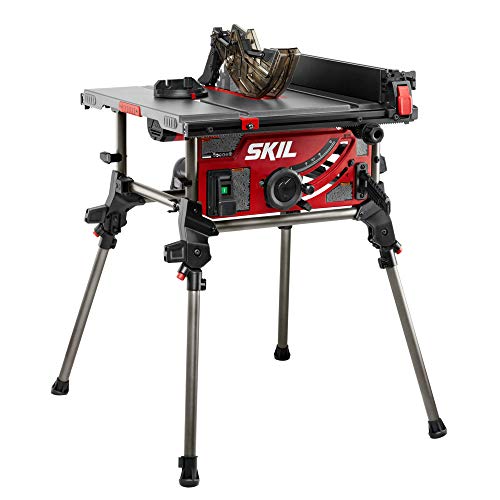
SKIL 15 Amp 10-Inch Jobsite Table Saw with Folding Stand-TS6307-00
Included for 'Best Black Friday Table Saw Deals' as a relevant option in this category; details come from the product listing.
View on AmazonThe SKIL TS6307-00 is aimed at the person who wants one saw that does everything a home workshop asks: ripping plywood, crosscutting 2x4s, beveling trim, and cutting the occasional sheet good. It is a full-size 10-inch jobsite saw with a 15-amp motor and a folding stand in the box, which is the sweet spot for a garage or basement shop that has to be packed away at the end of a project.
Key specs
- Blade: 10-inch diameter, standard 5/8-inch arbor — the most widely stocked blade size in North America
- Motor: 15 amp at 120 volts, which works out to roughly 1,800 watts of input power at full load
- Rip capacity: mid-20-inch class to the right of the blade
- Bevel: adjustable to 45 degrees for trim and chamfer work
- Stand: folding stand included, so the saw collapses for storage
- Table: aluminum top, which resists rust in humid garages better than cast iron but scratches more easily
The case for this saw is the blade size. A 10-inch blade gives you roughly 3 to 3-1/8 inches of depth of cut at 90 degrees in this class of saw, which means it can cut a 4×4 post in a single pass and handle thick stock that an 8-1/4-inch saw simply cannot reach. Because 10-inch blades are the industry standard, you can walk into any hardware store and find a 24-tooth ripping blade, a 40-tooth general-purpose blade, an 80-tooth fine-finish blade, or a thin-kerf blade for an underpowered motor. That blade ecosystem is worth more over five years of ownership than any single feature on the saw.
The 15-amp motor is the other half of the value equation. It is the same amperage class as the premium saws in this roundup, which means it will not bog down in 3/4-inch plywood or a full-length rip in 2x material the way a 6.7-amp compact saw will. It will still slow down if you feed too fast or run a dull blade, but it has enough headroom for real work.
Pros
- Full 10-inch blade with a standard 5/8-inch arbor means unlimited blade options at every price point
- 15-amp motor matches the premium saws in this list on amperage
- Folding stand included, so there is no separate purchase to make the saw usable
- Mid-range tier pricing for a full-size saw, which is where the value curve flattens out
- Rip capacity in the mid-20s of inches covers most furniture and shelving cuts
Cons
- Aluminum table top marks and scratches more easily than cast iron, and it is lighter, which can mean more vibration
- Rip capacity is narrower than the 32-1/2-inch DEWALT, so you cannot rip a full 4×8 sheet down the middle without a track saw or a circular saw assist
- No dado plate or zero-clearance insert included, unlike the Evolution saws
- Jobsite-saw fences in this class generally need checking and re-squaring more often than cabinet-saw fences
How it compares: Against the DEWALT 10-inch with rolling stand, the SKIL gives up roughly six inches of rip capacity and the wheeled stand, but it costs a full tier less and uses the same blade and motor class. Against the POWSTR 10-inch, the two are direct competitors — same blade size, same 15-amp class — and the deciding factor is usually which one includes the better stand and fence. If your work stays inside 24 inches of rip width, the SKIL is the more sensible buy; if you routinely break down sheet goods, step up to the DEWALT.
2. Sinpiode Mini Table Saw – Best for Crafts and Small-Part Work
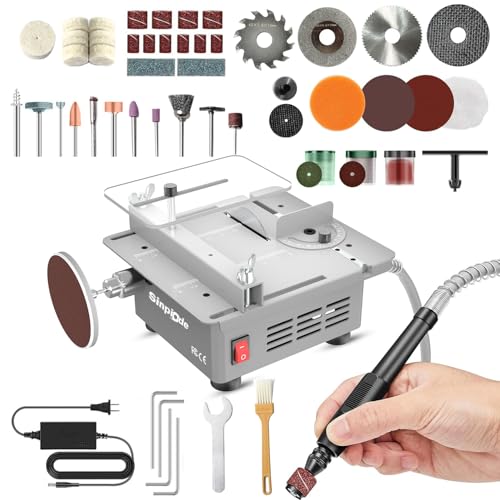
Sinpiode Mini Table Saw, Multi-Functional Desktop Portable Table Saw for Crafts with Adjustable Speed & Angle, All-in-One Cutting, Sanding, Engraving & Drilling Tool for Wood, Plastic,Acrylic, PCB
Included for 'Best Black Friday Table Saw Deals' because the listing specifies All-in-One Cutting and Sanding, details this guide uses to compare options.
View on AmazonThe Sinpiode Mini Table Saw is not a downsized jobsite saw — it is a desktop craft machine. It is built for model makers, pen turners, dollhouse builders, jewelry-box makers, and anyone cutting thin stock who needs a clean edge and a small footprint more than they need capacity. If you have a bench, a spare outlet, and a pile of 1/4-inch and thinner material, this is the category to shop in.
Key specs
- Blade: small-diameter desktop class, typically in the 3-to-4-inch range
- Motor: low-wattage class, sized for thin stock rather than dimensional lumber
- Speed: adjustable, which lets you slow the blade for plastics, soft metals, or brittle material
- Angle: adjustable bevel for angled cuts on small parts
- Footprint: desktop — it will sit on a workbench and store on a shelf
What makes a mini saw genuinely useful is not the cutting depth — it is the control. A small blade with an adjustable speed range lets you make slow, deliberate passes on material that a full-size saw would tear out or fling. The adjustable angle adds the ability to cut miters on trim pieces, corner blocks, and small frames without a miter saw. For a hobbyist working at a kitchen table or a corner of a garage, that combination is more useful than raw power.
The trade-off is capacity, and it is a hard limit rather than a soft one. A mini saw in this class will cut stock measured in fractions of an inch in thickness, not 2x4s, and it will not rip a sheet of plywood. Attempting either is how people burn out small motors and generate kickback with a blade that was never designed for that load. Treat the mini saw as a second tool that complements a circular saw or a full-size table saw, not as a replacement for one.
Safety deserves a note here. Mini saws in this class generally have a smaller blade guard arrangement than a jobsite saw, and many ship without a riving knife, so the discipline has to come from you: use push sticks, keep the blade height set just above the workpiece, never cut freehand without a fence or guide, and unplug the saw before changing blades or adjusting the bevel.
Pros
- Very small footprint — fits on a bench and stores on a shelf in an apartment or small garage
- Adjustable speed and angle suit plastics, thin hardwoods, and craft materials
- Budget-tier price makes it a low-risk entry into table-saw technique
- Quiet enough relative to a 15-amp jobsite saw for shared living space
Cons
- Cannot cut dimensional lumber, sheet goods, or anything approaching 2-inch thickness
- Small blade means small cut capacity — this is a craft tool, not a construction tool
- Fence and miter gauge on mini saws are usually scaled-down guides rather than full rip fences
- Small motors are easier to overload, so feed rate discipline matters more, not less
How it compares: The nearest alternatives in this list are the Ubnffsv 200W Mini and the Billowvolve Precision Mini, and all three occupy the same craft-tool niche. The Ubnffsv publishes more concrete numbers — 200 watts, 1.3-inch cut depth, seven speeds, 3,000 RPM — so if you like to compare specs directly, it is the easier one to evaluate. The Sinpiode’s differentiator is its stated multi-function design and adjustable angle, which suits people cutting angled small parts. Against the ExploreHorizon 8-inch, the gap is categorical: the ExploreHorizon is a real saw for real lumber, and the Sinpiode is a precision tool for small stock.
3. DEWALT 10-Inch Table Saw with Rolling Stand – Best for Sheet Goods and Long Rips
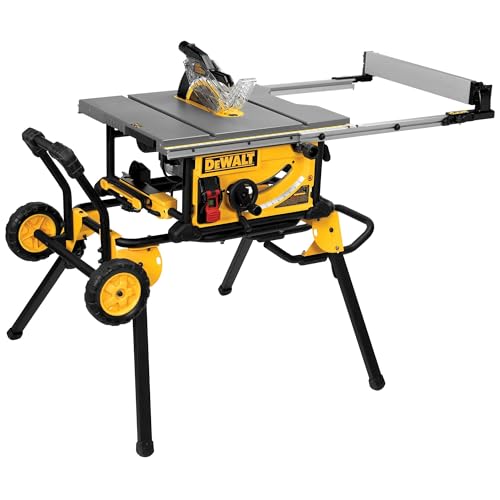
DEWALT Table Saw 10 Inch with Foldable Rolling Table Saw Stand, 15 Amp, 4800 RPM, 32-1/2-Inch Rip Capacity (DWE7491RS)
Included for 'Best Black Friday Table Saw Deals' because the listing specifies 15 Amp and 4800 RPM, details this guide uses to compare options.
View on AmazonThe DEWALT 10-inch table saw with the foldable rolling stand is the premium pick in this roundup, and the reason is a single number: 32-1/2 inches of rip capacity. That is the widest cut here by a comfortable margin, and it is the spec that decides whether you can break down a 4×8 sheet of plywood on the saw or have to reach for a circular saw first.
Key specs
- Blade: 10-inch, standard 5/8-inch arbor
- Motor: 15 amp at 120 volts
- Speed: 4,800 RPM
- Rip capacity: 32-1/2 inches to the right of the blade
- Stand: foldable rolling stand with wheels, designed for one-person transport
- Depth of cut: typical 10-inch jobsite class — roughly 3 to 3-1/8 inches at 90 degrees and about 2-1/4 inches at 45 degrees
Rip capacity is the spec most buyers underestimate. A 24-inch rip capacity is fine for shelving, cabinet face frames, and most furniture parts. But a 4×8 sheet of plywood is 48 inches wide, and cutting it into two 24-inch halves is the single most common sheet-goods operation in a home shop. A 32-1/2-inch capacity gives you real room to work: you can rip a sheet at 30 inches and still have fence travel left over, and you can cut cabinet sides, countertop blanks, and wide shelves without repositioning the fence against its stop.
The rolling stand is the second reason this saw sits in the premium tier. A 10-inch jobsite saw with a folding stand typically lands somewhere in the 70-to-90-pound range for the combined unit, and that is heavy enough that lifting it into a truck bed or across a garage alone is awkward and risky. Wheels change the calculation entirely — one person can tip it, roll it, and fold it without help, which matters if you work alone or move the saw between a garage and a driveway.
DEWALT is a long-established power tool brand, which shows up in the ownership experience rather than the spec sheet: fence parts, throat plates, blade wrenches, and replacement components are widely available, and the fence on this class of saw is designed to be adjusted and re-squared rather than treated as a fixed part.
Pros
- 32-1/2-inch rip capacity is the widest in this roundup by a clear margin
- Rolling folding stand makes a heavy saw genuinely one-person portable
- 15-amp motor and 4,800 RPM are solidly in the jobsite-saw class
- Widely available parts, blades, and accessories because it uses standard 10-inch tooling
Cons
- Premium-tier pricing — the highest-cost category in this list
- Combined saw-and-stand weight is substantial, so it is not a carry-up-the-stairs tool
- No dado plate or zero-clearance insert included, so dado work means sourcing accessories separately
- Overkill for a shop that never cuts material wider than 20 inches
How it compares: The Evolution R10TBLX is the other premium saw with a wheeled stand, and the choice between them comes down to priorities. The DEWALT wins on rip capacity, 32-1/2 inches against 26 inches. The Evolution wins on included accessories — a zero-clearance throat plate and a dado plate come in the box, which the DEWALT does not include. If you cut wide sheet goods, take the DEWALT. If you cut dadoes and want a tighter blade opening for cleaner cuts, take the Evolution.
4. POWSTR 10-Inch Table Saw with Stand – Best for a First Full-Size Saw on a Mid Budget

POWSTR Table Saw with Stand 10-Inch,15A 5000 RPM Portable Jobsite Table Saw
Included for 'Best Black Friday Table Saw Deals' because the listing specifies 15A 5000 RPM Portable Jobsite Table Saw, details this guide uses to compare options.
View on AmazonThe POWSTR 10-inch table saw with stand targets the buyer who has decided they want a full-size saw but does not want to pay premium-tier prices to get one. It matches the class standards — 10-inch blade, 15 amps, 5,000 RPM — and ships with a stand, which is the part budget shoppers most often forget to budget for.
Key specs
- Blade: 10-inch, standard 5/8-inch arbor
- Motor: 15 amp at 120 volts — roughly 1,800 watts input at full load
- Speed: 5,000 RPM, which is at the top of the jobsite-saw range
- Stand: included, portable jobsite style
- Class: portable jobsite table saw
The 5,000 RPM figure is worth understanding rather than just comparing. Blade speed and blade choice interact: a higher RPM with a low-tooth-count blade removes material fast in softwood, while a high tooth count at the same RPM leaves a smoother finish in hardwood and plywood but feeds more slowly. Most 10-inch jobsite saws run somewhere in the 4,000-to-5,000 RPM band, so the POWSTR sits at the fast end — good for framing and rough ripping, slightly less forgiving of a slow, deliberate feed in dense hardwood.
What you are buying at this tier is the full-size format: a table large enough to support a 2-foot-wide panel, a fence long enough to register against, and enough motor to get through 3/4-inch plywood without stalling. What you are typically not buying is brand pedigree. POWSTR is not a legacy tool brand, so the practical questions to answer before purchase are about support and parts: whether replacement fences, throat plates, and blade wrenches are available, and whether the warranty terms are clear. For a first saw used on weekend projects, that is often an acceptable trade. For a saw that will run daily in a working shop, it is a real risk.
Setup matters more on this tier than on premium saws. Check the blade-to-miter-slot alignment with a dial indicator or a combination square before the first cut, verify the fence is parallel to the blade at both the near and far ends of travel, and confirm the blade is square to the table at 0 degrees. Those three checks take twenty minutes and prevent most of the complaints people attribute to “cheap saws.”
Pros
- Full 10-inch blade and 15-amp motor at mid-range pricing
- Stand included, so the out-the-door cost is genuinely the saw cost
- 5,000 RPM is at the fast end of the jobsite class, good for softwood and framing
- Standard 5/8-inch arbor accepts the full range of 10-inch blades
Cons
- Less brand support and a smaller parts ecosystem than the legacy tool brands
- Rip capacity is not published as the widest in this class, so verify before buying if sheet goods are the priority
- Fence and miter gauge quality on value-tier saws varies and may need adjustment out of the box
- No dado plate or zero-clearance insert included
How it compares: This is a direct head-to-head with the SKIL TS6307-00. Both are 10-inch, 15-amp, mid-range saws with stands. The SKIL has the advantage of a longer track record in the jobsite-saw category and a more established accessory and parts pipeline; the POWSTR counters with a slightly higher stated RPM. If the two are close in price when you are shopping, the deciding factors should be rip capacity, fence quality, and which stand folds and rolls more easily — not the RPM number.
5. SKIL TS6308-00 8-1/4-Inch Compact Jobsite Saw – Best for Tight Shops and Trim Work

SKIL 15 Amp 8-1/4-Inch Compact Portable Jobsite Table Saw (Stand SFS0001 Sold Separately)-TS6308-00
Included for 'Best Black Friday Table Saw Deals' as a relevant option in this category; details come from the product listing.
View on AmazonThe SKIL TS6308-00 is the compact sibling of the 10-inch SKIL saw, and it exists for two kinds of buyer: the person with limited storage who still wants a 15-amp motor, and the trim carpenter who wants a lighter saw to carry between rooms. The trade-off is explicit in the name — it uses an 8-1/4-inch blade instead of a 10-inch, and the stand is sold separately.
Key specs
- Blade: 8-1/4-inch diameter, standard 5/8-inch arbor
- Motor: 15 amp at 120 volts — the same amperage class as the full-size saws here
- Depth of cut: typical 8-1/4-inch class — roughly 2-1/2 inches at 90 degrees and about 1-3/4 inches at 45 degrees
- Stand: sold separately (the SFS0001 folding stand is the matching accessory)
- Format: compact and lighter than a 10-inch jobsite saw
The interesting thing about this saw is that it keeps the 15-amp motor while shrinking the blade. Amperage is what determines whether a saw stalls, so a 15-amp motor turning an 8-1/4-inch blade has more torque headroom per inch of blade than the same motor turning a 10-inch blade. In practice that means it cuts 2x material and 3/4-inch plywood without complaint, and it feels less likely to bog down than a lower-amperage compact saw.
The limits are about depth and width, not power. At roughly 2-1/2 inches of depth of cut at 90 degrees, this saw will cut a 2×4 on edge and standard 1x and 2x lumber flat, but it will not cut a 4×4 post in one pass, and it will not accept a stacked dado set in the way a 10-inch saw can. Rip capacity is narrower than a full-size saw, so breaking down a 4×8 sheet is off the table. For trim, shelving, small cabinet parts, and framing cuts, none of that matters.
The stand being sold separately is the detail that catches people out. It is not a flaw in the saw, but it changes the real cost: if you plan to use the saw at a comfortable working height, budget for the stand or plan to build a bench around the saw. Many owners of compact saws build a simple plywood stand with a folding outfeed table, which costs less than a factory stand and gives a larger support surface — a genuinely good option for a fixed home shop.
Pros
- 15-amp motor in a compact, lighter body — strong power-to-size ratio
- Smaller footprint stores more easily in a garage, shed, or van
- 8-1/4-inch blades cost less than 10-inch blades, which lowers consumable costs over time
- Handles the majority of trim, shelving, and framing cuts a home shop makes
Cons
- Stand sold separately, so the true setup cost is higher than the saw price alone
- Roughly 2-1/2 inches of depth of cut means no 4×4 posts and no thick stock in one pass
- Narrower rip capacity than a 10-inch saw, ruling out sheet-goods breakdown
- 8-1/4-inch blade selection is thinner than the 10-inch market, especially for specialty and dado blades
How it compares: Against the SKIL TS6307-00, this is a straightforward capacity-for-portability trade. The 10-inch model gives you about 3 to 3-1/8 inches of depth of cut, a wider table, and a stand in the box; the 8-1/4-inch model gives you a lighter saw and a smaller storage footprint, but you buy the stand yourself. Against the ExploreHorizon 8-inch, the SKIL wins on motor amperage — 15 amps versus 6.7 amps — which is the single biggest difference between them and the main reason to pay mid-range rather than budget.
6. Evolution R10TS 10-Inch Jobsite Table Saw – Best for Dado Work and Clean Cuts

Evolution R10TS 10" Jobsite Table Saw | Zero-Clearance Throat Plate | Dado Plate Included | 15A Motor | 26” Rip | 3-3/8” Cut | 0-45° Bevel | Precision Fence | Heavy Duty Portable Woodworking Saw
Included for 'Best Black Friday Table Saw Deals' because the listing specifies Zero-Clearance Throat Plate and Dado Plate Included, details this guide uses to compare options.
View on AmazonThe Evolution R10TS is the specialist in this group. It brings a 15-amp motor, a 10-inch blade, and 26 inches of rip capacity, but the features that separate it from the pack are the zero-clearance throat plate and the included dado plate. Those two accessories matter to a specific kind of woodworker: someone cutting joinery who cares about tear-out at the blade and wants to cut grooves and rabbets without buying a router setup.
Key specs
- Blade: 10-inch, standard arbor class
- Motor: 15 amp at 120 volts
- Rip capacity: 26 inches
- Throat plate: zero-clearance plate included
- Dado: dado plate included, indicating support for stacked dado cutters
- Brand note: Evolution is known for multi-material cutting blades designed to handle wood with embedded nails as well as non-ferrous metals
A zero-clearance throat plate is one of the highest-value cheap upgrades in woodworking, and having one included is a real advantage. A standard throat plate has a wide opening around the blade, which leaves unsupported wood fibers on either side of the cut. Those fibers tear out on the underside of plywood and on crosscuts in hardwood. A zero-clearance plate has an opening cut to the exact kerf width of the installed blade, so the material is supported right up to the cut line. The practical result is noticeably cleaner edges on plywood and veneered stock, and less blowout on the back side of crosscuts. The catch is that the plate is blade-specific: change to a thicker blade, and you need a new plate or a fresh insert.
The dado plate is the other differentiator, and it is the feature that makes this saw interesting to furniture makers. A stacked dado set cuts a flat-bottomed groove in a single pass, which is how most cabinet and shelving joinery is done — a shelf in a groove, a rabbet on a cabinet back, a dado for a drawer bottom. On many jobsite saws, dado capacity is limited by the arbor length or by the throat plate opening, and some saws do not support it at all. Including a dedicated dado plate signals that this saw was designed with that operation in mind. It is worth confirming the maximum dado stack width against the manual before buying a stack, since arbor length is the usual constraint.
Pros
- Zero-clearance throat plate included — a genuine upgrade most saws in this list lack
- Dado plate included, making groove and rabbet joinery practical on a jobsite saw
- 15-amp motor in the standard jobsite class
- 26 inches of rip capacity covers most furniture and cabinet-part cuts
- Multi-material blade heritage suits work with reclaimed lumber that may contain fasteners
Cons
- Premium-tier pricing, and the included accessories are part of what you are paying for
- 26-inch rip capacity is narrower than the DEWALT’s 32-1/2 inches, so full sheet breakdown is harder
- No wheeled stand on this version — that is the R10TBLX
- Zero-clearance plates are blade-specific and become consumables if you swap blades often
How it compares: The nearest alternative is the Evolution R10TBLX, which is the same saw platform with a wheeled stand instead of a stationary one. If the saw lives on a bench in a fixed shop, the R10TS is the better buy because you are not paying for wheels you will not roll. If it moves between a garage and a driveway, take the R10TBLX. Against the DEWALT, the trade is clear: the DEWALT gives you six and a half more inches of rip capacity, and the Evolution gives you a zero-clearance plate and dado plate in the box.
7. Evolution R10TBLX 10-Inch Jobsite Table Saw with Wheeled Stand – Best for Mobility Plus Joinery

Evolution R10TBLX 10" Jobsite Table Saw with Wheeled Stand | Zero-Clearance Throat Plate | Dado Plate Included | 15A Motor | 26” Rip | 3-3/8” Cut | 0-45° Bevel | Precision Fence | Heavy Duty Portable
Included for 'Best Black Friday Table Saw Deals' because the listing specifies Zero-Clearance Throat Plate and Dado Plate Included, details this guide uses to compare options.
View on AmazonThe Evolution R10TBLX takes everything the R10TS offers — the 15-amp motor, the 10-inch blade, the 26-inch rip capacity, the zero-clearance throat plate, and the dado plate — and mounts it on a wheeled stand. It is the pick for someone who wants joinery capability and also has to move the saw, whether that is across a garage, out to a driveway, or into a truck.
Key specs
- Blade: 10-inch, standard arbor class
- Motor: 15 amp at 120 volts
- Rip capacity: 26 inches
- Throat plate: zero-clearance plate included
- Dado: dado plate included
- Stand: wheeled stand, designed for rolling transport and folding storage
Wheeled stands solve a problem that is easy to underestimate until you own the saw. A 10-inch jobsite saw mounted on a folding stand typically weighs in the 70-to-90-pound range as a unit. That is liftable, but it is not something you want to carry alone twice a week, and it is heavy enough that people who buy a saw without wheels often stop moving it — which means they stop using it. A wheeled stand keeps the saw accessible, and accessibility is what determines how often a tool actually gets used.
The joinery capability is the same as the R10TS, and it is worth restating because it is unusual at this price and format. The zero-clearance throat plate supports material right up to the blade kerf, which reduces tear-out on plywood and veneered panels. The dado plate opens the door to stacked dado cutters for grooves, rabbets, and shelf joints. Together they mean this saw can handle cabinet-grade work, not just rough ripping, and that is a meaningful step up from a bare-bones jobsite saw.
Where it gives ground is rip capacity. At 26 inches, it is four inches wider than a typical compact saw but six and a half inches narrower than the DEWALT. In practice, 26 inches is enough for cabinet sides, shelving, face frames, and most furniture components. It is not enough to rip a 4×8 sheet of plywood down the middle in one pass — for that you need either a wider saw or a circular saw and a straightedge for the first breakdown cut.
Pros
- Wheeled stand makes a heavy saw movable by one person
- Zero-clearance throat plate and dado plate both included — the best joinery accessory package in this roundup
- 15-amp motor and 10-inch blade put it squarely in the jobsite-saw class
- Folding stand collapses for storage against a wall
Cons
- Premium-tier price, and the accessories and stand are a large part of what you are paying for
- 26-inch rip capacity still will not break down a full sheet of plywood in one pass
- Wheeled stands add bulk when stored compared with a simple folding stand
- If you never move the saw, you paid for wheels you do not need
How it compares: Against the R10TS, this is the same saw with a different stand — choose based on whether the saw moves. Against the DEWALT 10-inch with rolling stand, the two are the premium head-to-head in this roundup, and both have wheels. The DEWALT wins on rip capacity by a wide margin; the Evolution wins on included joinery accessories. The honest decision rule: sheet goods and long rips favor the DEWALT, dadoes and clean plywood edges favor the Evolution.
8. Billowvolve Precision Mini Electric Table Saw – Best for Hobby Bench Work with Depth Control

Precision Mini Electric Table Saw, DIY Hobby Handmade Woodworking Bench Cutting Machine Adjustable Cut Depth Small Desktop Saw for Miniature Wood Craft (Regular style)
Included for 'Best Black Friday Table Saw Deals' as a relevant option in this category; details come from the product listing.
View on AmazonThe Billowvolve Precision Mini Electric Table Saw is a bench-top machine aimed at the hobby woodworker who wants adjustable cut depth in a very small package. It belongs to the same family as the other mini saws here, and it is best understood as a precision cutting station for thin stock rather than a small version of a jobsite saw.
Key specs
- Blade: small-diameter desktop class, typically 3 to 4 inches
- Motor: low-wattage class, intended for thin material and light passes
- Cut depth: adjustable, which is the headline feature
- Format: bench-top, DIY and hobby oriented
- Typical stock: thin hardwood, basswood, balsa, plastic sheet, and craft material
Adjustable cut depth sounds like a minor feature until you use it. On a small bench saw, being able to set the blade projection precisely lets you cut shallow rabbets, score a line before a full cut to prevent tear-out, and cut a groove to an exact depth for an inlay or a spline. That is the kind of work hobbyists actually do — box joints, splines, inlay strips, model parts — and it is work where a full-size table saw is clumsy and a mini saw is exactly right.
The realistic envelope for this class is stock measured in fractions of an inch. It will cut 1