Our Top Picks
 Eskimo 69445 Quickfish 3i Insulated Pop-Up Portable Hub-Style3 Person70 x 70 x 80 inches34 PoundsCheck on Amazon
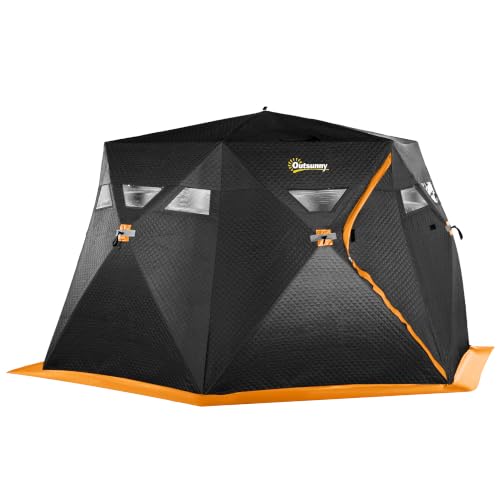 Outsunny 4 Person Insulated Pop-Up Ice Fishing Shelter141.75" x 141.75" x 76.75"141.75 x 141.75 x 76.75 inches37 poundsCheck on Amazon
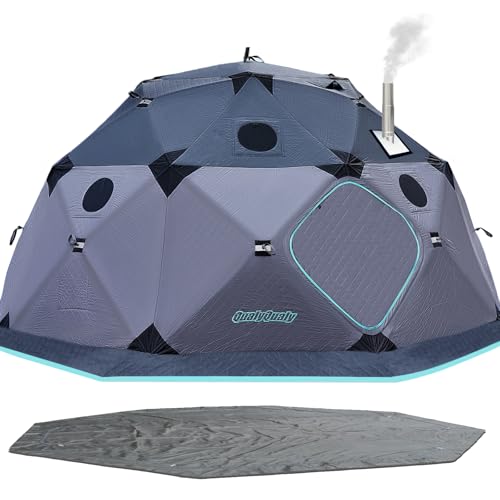 QualyQualy Ice Fishing Tent with Floor13.1ft L× 14.1ft W × 7.2ft H169 x 157 x 86.4 inches77 PoundsCheck on Amazon
The best ice fishing shelters depend on how you travel: choose a hub shelter for the most usable room, a flip-over for fast mobility, or an insulated cabin-style shelter for long stationary days and severe wind.
Quick comparison: hub vs. flip-over vs. cabin
| Shelter type | Typical capacity | Typical packed size | Typical weight | Setup time | Insulation and wind performance | Best for |
|---|---|---|---|---|---|---|
| Hub | 2–6 people | 42–68 in. long bag | 18–45 lb. | 1–3 minutes | Good when fully staked; insulated versions retain heat well | Groups, base camps, and anglers who want interior space |
| Flip-over | 1–3 people | 48–72 in. sled | 45–110 lb. | Under 1 minute after unloading | Very good in wind because the sled anchors the shelter; insulation varies | Run-and-gun fishing and frequent hole changes |
| Cabin-style | 3–6 people | 50–80 in. bag or folded frame | 35–80 lb. | 2–5 minutes | Usually the strongest combination of insulation, headroom, and weather protection | Long sessions, families, and overnight-style comfort |
These are useful buying benchmarks rather than universal specifications. Dimensions and weights change with fabric, window design, skirt length, sled hardware, and whether the shelter has insulated or uninsulated walls.
Eskimo 69445 Quickfish 3i Insulated Pop-Up Portable Hub-Style Ice Fishing Shelter, 34 Square Feet of Fishable Area, 3 Person Shelter, Red
Chosen because it specifies 34 Square Feet of Fishable Area and 3 Person Shelter.
View on Amazon
Eskimo® Outbreak 450XDP, Pop-Up Portable Ice Fishing Shelter, No-Trip Door, 4-5 Person, Red/Black, 50450
Chosen because it specifies Pop-Up Portable Ice Fishing Shelter and No-Trip Door.
View on AmazonOutsunny 4 Person Insulated Pop-Up Ice Fishing Shelter, Black and Orange
Chosen because it specifies Black and Orange.
View on AmazonQualyQualy Ice Fishing Tent with Floor, 8-10 Person Insulated Ice Fishing Shelter, 147sq.ft Pop-Up Shanty with Stove Jack, Winter Windproof Ice Shack Hut with Carrying Bag(Grey)
Chosen because it specifies 8-10 Person Insulated Ice Fishing Shelter and 147sq.ft Pop-Up Shanty with Stove Jack.
View on AmazonWhich of the best ice fishing shelters fits your situation?
| Your situation | Best starting choice | Why | Main compromise |
|---|---|---|---|
| One angler moving every hour | Single-person flip-over | Gear stays in the sled and the shelter travels as one unit | Limited legroom and little room for a second person |
| Two anglers covering several areas | Two-person flip-over | Fast relocation with better wind stability than a light hub | Heavy to pull by hand over rough snow |
| Three or more anglers sharing a base | Medium or large hub | More fishable floor area per pound carried | Must be collapsed and packed before moving |
| Long days below freezing | Insulated hub or cabin | Reduced heat loss and less condensation than thin fabric | Higher purchase price and greater packed weight |
| Small vehicle or limited storage | Compact hub | Soft bag stores more easily than a rigid sled | More setup work and less built-in gear storage |
Hub shelters: the most flexible group option
Hub shelters use folding poles connected by central hubs. Pulling the hubs outward expands the walls, making this the easiest design for creating a large open fishing area without carrying a rigid frame. Common footprints range from approximately 34 by 34 inches for a compact two-person shelter to about 72 by 72 inches or larger for a four- to six-person model.
Their greatest advantage is usable interior volume. A square hub can accommodate multiple holes, chairs, heaters, tackle boxes, and a cooking or snack area without forcing everyone into a narrow sled. That makes it a practical choice when the shelter will serve as a stationary base for several hours.
The drawbacks appear when the weather changes. A hub has no heavy sled anchoring it, so its wind performance depends on properly installed ice anchors, tie-down straps, and a skirt that is packed with snow. A large uninsulated hub can also cool quickly after the door opens. For winter trips, an insulated model with a full skirt and reinforced corner panels is usually worth the added weight.
Hub buying checklist
- Choose at least 30–40 square feet of floor area for two adults with equipment.
- Look for a skirt wide enough to bury with snow around the full perimeter.
- Check that windows can be opened independently of the door for cross-ventilation.
- Confirm the frame poles lock securely and are replaceable.
- Prefer reinforced hubs, pole sleeves, and high-stress corners for repeated use.
Flip-over shelters: fastest for mobile anglers
A flip-over combines a rigid sled, folding bows, and a fabric shell. The sled carries the shelter, auger, heater, rods, and bait, while the fabric flips over the seated angler. This design is difficult to beat when the plan involves drilling several locations and fishing each one briefly.
Flip-overs also perform well in wind because the loaded sled remains on the ice. The low profile reduces exposed surface area, and many models allow the angler to fish with the shelter partially open while moving between holes. In exchange, the sled makes the package bulky and heavy. A shelter weighing 70 pounds before adding equipment may be manageable behind a machine but tiring to drag manually through deep snow.
Capacity labels can be optimistic. A two-person flip-over may fit two anglers shoulder to shoulder, but adding a heater, two tackle boxes, and multiple rods can make the space uncomfortable. For two adults who bring substantial gear, a roomy two-person model or compact three-person model is usually more practical than choosing solely by the printed capacity.
Flip-over ownership considerations
- Measure your vehicle’s cargo opening, not just its interior cargo length.
- Inspect the sled runners and hitch points before every trip.
- Use a tow bar or harness if the loaded sled is too heavy for a short hand pull.
- Dry the fabric before storage so wet insulation does not develop mildew or odors.
- Check that the folded frame cannot rub against the shell during transport.
Cabin-style shelters: comfort for long, cold sessions
Cabin-style shelters emphasize vertical walls, standing height, and a roomier layout. Some use a framed structure, while others resemble an enlarged hub with near-vertical sides. Their shape makes it easier to stand, change layers, organize a meal, or help a child get dressed without crawling across the floor.
They are particularly useful for long stationary outings, but the extra height creates more surface area for wind to push against. Strong tie-downs, ice anchors, and a properly buried skirt are essential. A tall shelter that is merely weighted with loose equipment can shift or flex in gusty conditions.
Cabin designs can also be more demanding to transport. Before buying, compare the packed length with your vehicle, sled, or snowmobile cargo rack. A shelter that fits the floor area but blocks the hatch or prevents other equipment from being secured is not a practical fit.
Insulation, ventilation, and safe heater use
Insulated fabric generally improves heat retention and reduces drafts, but it does not make a shelter airtight. Ventilation remains important whenever a fuel-burning heater is used. Select a shelter with adjustable roof or side vents, keep vents open according to the heater manufacturer’s instructions, and use a battery-powered carbon-monoxide alarm designed for cold conditions.
Do not judge ventilation by window count alone. A shelter needs an inlet for replacement air and an outlet for warm, moist air. Opening a low vent on one side and a high vent on the opposite side creates better airflow than opening two windows at the same height. Condensation that freezes on the inside of the fabric is a sign that moisture is accumulating faster than it is escaping.
Insulation also affects packing. A two-person insulated hub may weigh around 25–35 pounds, compared with roughly 15–25 pounds for a comparable uninsulated model. That difference is meaningful when walking, but often worthwhile for repeated trips in severe cold.
A practical sizing calculation
Allow approximately 15–20 square feet of floor area per seated angler when each person brings a rod case, tackle, heater clearance, and winter clothing. For two anglers, that means a functional target of 30–40 square feet rather than selecting the smallest shelter labeled “two person.” A 60 by 60 inch floor provides 25 square feet, which may work for a short trip with minimal gear but can feel crowded during an all-day outing. A 72 by 72 inch floor provides 36 square feet and leaves substantially more room for equipment.
Leave clear space around the heater and follow its required clearance distances. The floor area occupied by safety zones is not available for chairs, tackle, or food preparation.
Durability and maintenance: what wears first
The first problems are often not dramatic fabric tears. Zippers collect ice and grit, hub joints loosen, pole sections bend, and sled runners wear from repeated contact with rough ice. Skirts may fray where they drag, while window film can become brittle if folded while frozen.
- Brush snow and ice from zippers before forcing them.
- Dry the shelter completely, expanded if possible, before long-term storage.
- Store fabric loosely rather than compressing it while damp.
- Lubricate compatible zipper hardware only with a product approved for that zipper type.
- Carry repair tape, spare pole sections, extra anchors, and a small sewing or patch kit.
- Replace damaged tie-downs before a windy trip rather than relying on improvised knots.
Final recommendation
Choose a flip-over if mobility and rapid setup matter most, a hub if multiple people need the best balance of space and portability, and a cabin-style shelter if comfort, standing room, insulation, and long sessions outrank compact transport. For most buyers, the best ice fishing shelters are not the largest or lightest options; they are the ones whose capacity, packed dimensions, anchoring system, ventilation, and carrying method match the way the shelter will actually be used.