Key takeaways
- Place the receiver on the side or underside of the neck according to the manufacturer’s instructions, avoiding the throat.
- Use the shortest contact points that make consistent contact through the coat. Long points are not automatically more effective.
- Introduce the collar while the dog is calm, pairing it with food, play, or familiar training cues.
- Teach the behavior first on a leash or long line; the remote should reinforce a known cue, not replace instruction.
- Start with tone or vibration. If using a static mode under professional guidance, begin at the lowest level that produces an observable but calm response.
- Remove the collar after training and rotate its position slightly during longer sessions to reduce skin irritation.
The best dog training collars are usually the ones that give you precise, low-level control without relying on stimulation: choose a vibration-only collar for most everyday training, a tone-and-vibration model for sensitive dogs, or a carefully adjustable remote collar only when a qualified trainer has shown you how to use it.
Quick picks by training situation
| Situation | Best collar type | Useful target specifications | Why it fits |
|---|---|---|---|
| First-time owner or puppy | Tone and vibration remote collar | At least 3 vibration levels, 300–800 m range, 12-hour battery | Provides communication without static stimulation |
| Small or sensitive dog | Lightweight vibration-only collar | Under 4 oz receiver, adjustable strap, low-profile contact area | Less bulk and less risk of overwhelming the dog |
| Off-leash work in a large, secure field | Multi-mode remote collar | At least 0.5-mile advertised range, separate buttons, safety lockout | Offers clear communication at distance when introduced properly |
| Swimming, rain, or muddy trails | Waterproof remote collar | IPX7 or better receiver, sealed charging port, waterproof transmitter | Reduces failure risk and simplifies cleaning |
| Two dogs trained together | Expandable dual-channel system | Independent buttons and separate intensity memory | Prevents sending a cue to the wrong dog |
How the main collar types compare
Tone-and-vibration collars
These collars use an audible tone, vibration, or both as a remote cue. They are the most approachable option for recall, attention, loose-leash work, and reinforcing known commands. Vibration is not automatically gentle for every dog: some dogs ignore it, while others find it startling. Begin at the lowest setting and watch body language rather than assuming a higher setting is better.
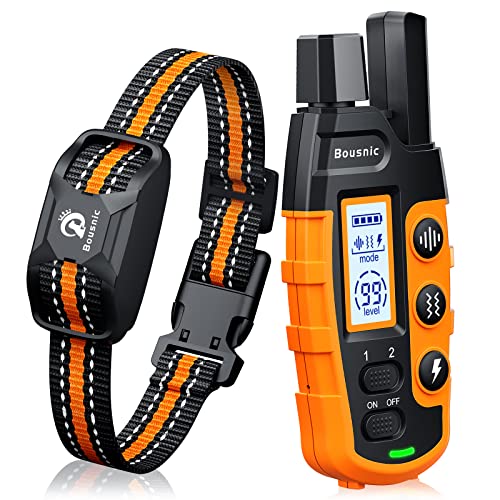
Bousnic Dog Shock Collar - 3300Ft Dog Training Collar with Remote for 5-120lbs Small Medium Large Dogs Rechargeable Waterproof e Collar with Beep (1-8), Vibration(1-16), Safe Shock(1-99) (Orange)
Included for 'Best Dog Training Collars' because the listing specifies Vibration(1-16) and Safe Shock(1-99) (Orange), details this guide uses to compare options.
View on Amazon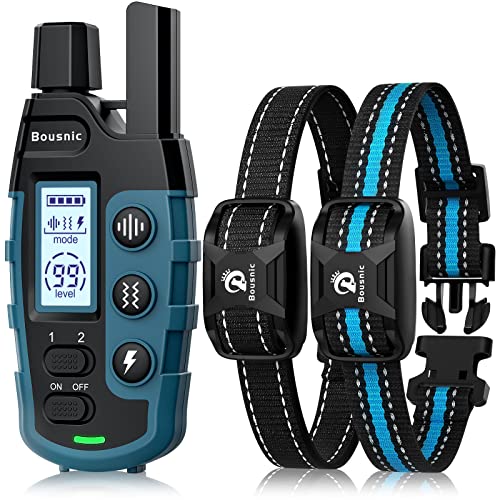
Bousnic Dog Shock Collar 2 Dogs (5-120Lbs) - 3300 ft Waterproof Training Collar for Dogs Large Medium Small with Rechargeable Remote, Beep (1-8) Vibration (1-16) and Humane Shock (1-99) Modes
Included for 'Best Dog Training Collars' because the listing specifies Beep (1-8) Vibration (1-16) and Humane Shock (1-99) Modes, details this guide uses to compare options.
View on Amazon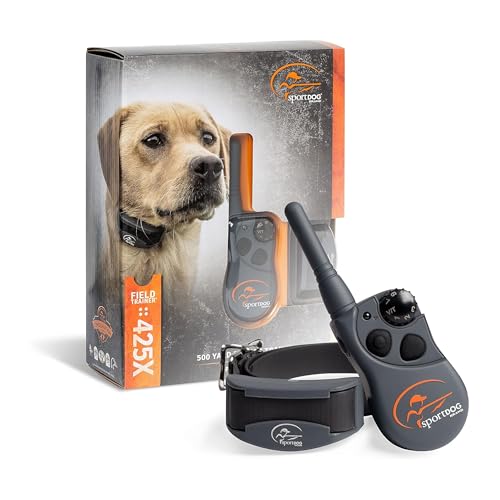
SportDOG FieldTrainer 425X Remote Trainer, 500-Yard Range, Waterproof
Included for 'Best Dog Training Collars' because the listing specifies 500-Yard Range and Waterproof, details this guide uses to compare options.
View on AmazonA vibration-only collar is a particularly sensible choice when you want remote communication but do not need stimulation. Look for separate tone and vibration buttons, several vibration levels, a lockable intensity setting, and a receiver light enough for your dog’s neck.
Static-stimulation collars
Static-stimulation collars deliver an adjustable electrical pulse through contact points. Some modern remote collars allow a very low continuous level, momentary stimulation, boost controls, tone, and vibration. That range can provide precise communication, but it also creates more opportunity for poor timing or excessive intensity.
These collars should not be used to punish fear, aggression, reactivity, or behavior you have not first taught. A dog can associate the sensation with a nearby person, dog, bicycle, or location. If the training problem involves fear, guarding, aggression, or repeated panic, work with a qualified reward-based trainer or veterinary behavior professional rather than trying to solve it with a stronger collar.
Vibration and beep collars without a remote
Automatic collars can respond to barking with sound or vibration. They are less useful for general obedience because the owner cannot choose the exact timing. They may also activate when several dogs are barking or when a dog is vocalizing for an appropriate reason. If you need bark management, identify the cause first and choose a collar with adjustable sensitivity and a clearly accessible off switch.
Head-to-head buying criteria
| Feature | Good baseline | What matters in practice |
|---|---|---|
| Control | Tone, 3 or more vibration levels, separate buttons | Separate controls reduce accidental mode changes during a recall or emergency |
| Range | 300–800 m for ordinary outdoor use; 800 m–1,600 m for large fields | Manufacturers measure range in open conditions; trees, buildings, hills, and radio interference reduce it |
| Water resistance | IPX7 receiver for wet outdoor use | Water-resistant is not the same as submersible; the transmitter may have a lower rating |
| Battery life | 12–24 hours per charge | USB-C charging, a battery indicator, and a replaceable or serviceable battery improve ownership |
| Receiver weight | Under 4 oz for small dogs; under 6 oz for medium and large dogs | A heavy receiver can rotate, pull on the strap, or bother a small dog |
| Safety features | Keypad lock, intensity lock, automatic shutoff, and separate dog channels | These features help prevent accidental stimulation or incorrect-dog corrections |
| Strap and contacts | Adjustable biothane, nylon, or silicone strap; multiple contact sizes | The contact area must stay stable without being tightened like a choke collar |
Range, battery, and waterproofing: what the numbers do not tell you
Advertised range is normally an unobstructed line-of-sight figure. A collar rated for 1,600 m may provide substantially less in a wooded park or neighborhood. For a typical backyard or training field, a reliable 300–800 m system is often sufficient. Buy extra range for terrain and reliability, not because a larger number automatically improves training.
Battery estimates also depend on use. Suppose a receiver is advertised for 24 hours but your dog trains for 45 minutes each day. In theory, one charge covers about 32 sessions: 24 hours divided by 0.75 hours. In real use, standby drain, cold weather, vibration, and charging losses make 20–25 sessions a more practical planning figure. Recharge it before important outings rather than waiting for the low-battery warning.
For wet conditions, IPX7 means a device is designed to tolerate temporary immersion under specified laboratory conditions. It does not excuse leaving charging covers open or storing a wet collar in a sealed bag. Rinse mud from the strap, dry the receiver and contacts, and inspect the charging seal after swimming.
Fit and safe setup
Fit is more important than maximum intensity or range. Measure the dog’s neck where the collar will sit, then compare that measurement with the manufacturer’s strap range. After fastening, you should generally be able to slide two fingers between the strap and the neck. The receiver should remain in position during movement, but the collar should not restrict breathing, swallowing, or normal head movement.
- Place the receiver on the side or underside of the neck according to the manufacturer’s instructions, avoiding the throat.
- Use the shortest contact points that make consistent contact through the coat. Long points are not automatically more effective.
- Introduce the collar while the dog is calm, pairing it with food, play, or familiar training cues.
- Teach the behavior first on a leash or long line; the remote should reinforce a known cue, not replace instruction.
- Start with tone or vibration. If using a static mode under professional guidance, begin at the lowest level that produces an observable but calm response.
- Remove the collar after training and rotate its position slightly during longer sessions to reduce skin irritation.
Durability and ownership costs
The strap is often the first part to wear out, especially when it collects sand, sweat, salt water, or mud. Buckles stretch, charging covers loosen, and contact points can corrode. A replaceable strap and available replacement contacts may matter more than a slightly longer advertised range.
Inspect the skin under the receiver after every early session. Redness that persists, sores, rubbing, or changes in gait are reasons to remove the collar and stop using it until the problem is resolved. Never leave a training collar on continuously or use metal contacts on damaged skin.
Price is commonly divided into three broad groups: basic vibration collars around $30–$80, better-built tone-and-vibration systems around $80–$180, and advanced waterproof multi-mode systems around $180–$400 or more. Replacement straps, charging cables, contact sets, and batteries can add to the long-term cost. A less expensive collar with poor buttons or a weak seal may cost more if it fails during regular outdoor use.
Final choice
For most households, select a lightweight tone-and-vibration collar with a lockable control, at least 12 hours of battery life, an IPX7-rated receiver, and a strap that fits without excessive tightening. Choose a multi-mode system only when you have a specific training reason, reliable off-leash foundations, and guidance from an experienced professional. The best dog training collars improve timing and communication; they should never be used as a substitute for teaching, management, exercise, and humane behavior training.